
The next Greek Author on my list from Thomas More’s personal library in Utopia is the philosopher and physician Galen of Pergamon. This deep dive into Medicine of Antiquity is a slight departure for me as my quests tend to be of Literature, Culture, and Languages. I consulted my Son-in-Law, Phillip, who is a Pediatric Hospitalist, about his knowledge of Galen. He was very familiar with Galen’s studies into Comparative Anatomy and Dissection from 200 AD as he was taught these during his studies in Medical School. So cool!
Why did Thomas More include the works of Galen in his personal library?
To learn the answer to this, I located Galen of Pergamon, a Lecture on the History and Philosophy of Medicine by George Sarton in the SMU Fondren Library. In his Lecture Series, Sarton gives historical background of the world in which Galen was living, the Roman Empire, in its golden age 130-200 BCE. At this time, the Empire was bilingual: Greek was the language of Science and Philosophy; Latin, that of administration and business. In the Roman Athenaeum, professors were teaching philosophy and rhetoric. This education would continue through the fourth century. The Latin language, therefore, would become a measure of prestige in philosophy and science thanks to Lucretius, Cicero, Seneca, Vitruvius Celsus, Pliny,and Galen, our focus for this post.
Pergamon and the Zeus Altar, Stolen Antinquity
Galen was born in Pergamon, a rival city of Alexandria, in Asia Minor. The Romans built an acropolis here in one of the most beautiful Hellenistic cities. In 197 BCE, Attalos I erected a great altar to Zeus to celebrate his victory over the Galatians which was 49 feet high. Unfortunately, in 1878, Carl Humann, a German engineer, excavated the acroplois of Pergamon and subsequently transferred the Relief panels from the Pergamon Altar to Berlin Museum. As of the writing of this Sarton’s Lectures (1954), these panels had been stolen from the Berlin Museum by the Russians after WWII and placed in St. Petersburg in the depository of the Hermitage. Today, it is back in Germany and housed in the Pergamon Museum in Berlin (Russia has a plaster copy).
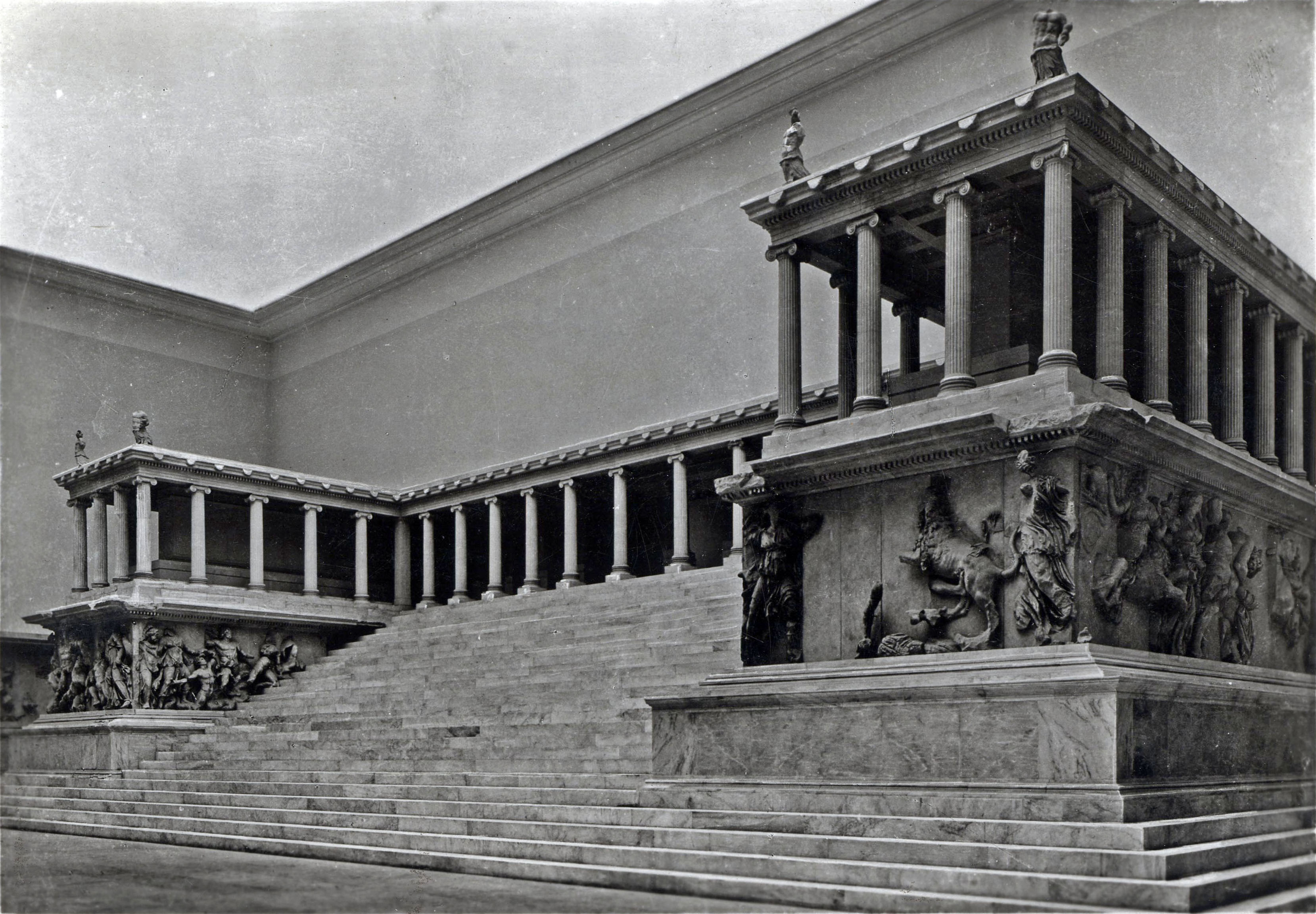
Altar to Zeus, Berlin Museum, 1949
More Roman History…The origin of the first book!
I found the Roman History in Sarton’s lectures as fascinating as the history of medicine, so I will include more here!
Pergamon was a literary-minded civilization and had public libraries to rival that of Alexandria. As ther Attalid patronage was dedicated to Greek Literature, Eumenes II established a Library. Ptolemy, however, did not want copies of his work to be placed in the Pergamon Library so he forbade the exportation of papyrus. This led to the discovery of a different kind of writing material using the skins (diphtheria) of animals, or parchment. This type of parchment was not easy to roll into a scroll and therefore the codex, or book, was developed (see Books and readers in ancient Greece and Rome by Frederick G. Kenyon, Oxford: Clarendon Press, 1951). So fun, so fun!
Now, back to Galen and why Thomas More would include his research in his personal library!
Galen’s Education
Galen was educated at an early age by attending philosophy lectures in the city with his Father. He attended courses of the four leading systems: Platonism, Aristotelianism, Stoicism, and Epicureanism (16). He undertook anatomical studies for ten years in Pergamon under Satyros, a famous anatomist of that day from Smyrna.
Galen then moved to Alexandria toward the end of 152 and studied there for five years with the anatomist Heracleianos and Lycos the Macedonian. He studied under Julianos who wrote 48 books on the Aphorisms of Hippocrates. In total, Galen studied for twelve years which was rare for medical students because of limited opportunities and resources at that time.
Possibly the most profitable training for medicine that Galen had was his time as the physician to gladiators (20). He provided his services as a surgeon to wounded gladiators with varied injuries. Part of his regimen was to supervise their diets and exercise in order to insure fewer injuries and faster healing.
After this service to gladiators, Galen sat under the teachings of the Aristotelian philosopher, Eudemos. He then became the court physician to Marcus Aurelius in 180.
Comparative Anatomy and Dissection
According to Sarton, Galen is most notably famous for his research and publication of Comparative Anatomy and Dissection. Galen understood the need of experiments-“the path is long but leads to truth”-he was one of the few Greeks who understood this. Unfortunately, his experiments were overlooked for 1500 years (49).
Galen determined that the three fundamental members of the body were : the liver, the heart, and the brain. Each of these organs is dominated by a special pneuma, or spirit. The liver has a natural spirit which provides nutrition, growth, and reproduction.
The heart has a vital spirit, a physical spirit, which is transmitted by veins and transformed in the heart by mixture with inspired air; it regulates the vital functions, conveying heat and life through the arteries. The vital spirit is submitted to a distillation in the brain and becomes the animal or psychical spirit regulating the brain, nerves, feelings, etc. This pneumatic spirit that Galen illustrates can be traced back to Hippocrates, to Cretan Diogenes of Apollonia, and to Anaximenes of Miletos (5 BC).
There are volumes upon volumes of medical research and teachings attributed to Galen. For the purpose of my Utopian quest, I will return to my original question:
How does a book of Medicine figure into the civilization of Utopia?
In Book II of Utopia, Thomas More describes the Utopian’s life of Pleasure in two distinct categories, Pleasures of the Mind and Pleasures of the Body:
“These pleasures fill the senses with immediate delight. For example, when organs have been weakened by heat and are restored with food and drink; eliminating the bowels; generating children; and relieving an itch by scratching and rubbing. ‘MUSIC also’ (74). Beauty, strength, and agility, as special and pleasant gifts of nature, they joyfully accept. The pleasures of the senses–sound, sight, smell– are special seasonings of life in which nature intended to be the particular province of man.
“The most important pleasures of the body are a calm and harmonious state of health when one is undisturbed by any disorder. In addition, when Health is not disturbed by pain, this gives pleasure without any external excitement at all. A life of peace. When people, in general, are easy-going, cheerful, and clever, they can be free from the burden of pain. In this way, they can better serve the welfare of others and expect a great reward from God (79)”.
To help the Utopians establish this life of beauty, strength, and agility, Thomas More bequeaths Hippocrates’ works and Galen’s Microtechne. He acquired these texts from his traveling companion Thricius Apinatus, who held Hippocrates and Galen in great estimation. More promotes the practice of Medicine as:
“Medicine, the most useful subject for though there is no nation in the world that needs physic so little as they do, yet there is not any that honors it so much; they reckon the knowledge of it one of the pleasantest and most profitable parts of philosophy, by which, as they search into the secrets of nature, so they not only find this study highly agreeable, but think that such inquiries are very acceptable to the Author of nature (79).”
Galen died in his home of Pergamon at the age of 70. His work and renown continue today in the medical field and philosophy. Thank you, Thomas More, for introducing me to him!
Work Cited
Adams, Robert M., trans. and ed. Utopia: A New Translation, Backgrounds, Criticism. By Sir Thomas More. A Norton Critical Edition. New York: Norton, 1975. Pp. xii + 239.
George Sarton. Galen of Pergamon. Logan Clendening Lectures on the History and Philosophy of Medicine. Third Series. University of Kansas Press, 1954.
 My French Quest
Thank you for opening our eyes to the story of this amazing man and physician. It is interesting that More envisioned a Utopia still in need of a doctor and medicine. It appears freedom and humanity together mean a doctor should be nearby.
I also marveled how the deadly gladiator games led to healing and hope in a broken, evil world. The thread of hope runs through the darkest places on the planet even on the floor of arena as men fought for their very lives.
Your quest for knowledge is a blessing to us all. Keep up the good work and your quest for more.