Why do we read literature and how do we judge it? What is the good of reading what anyone writes?
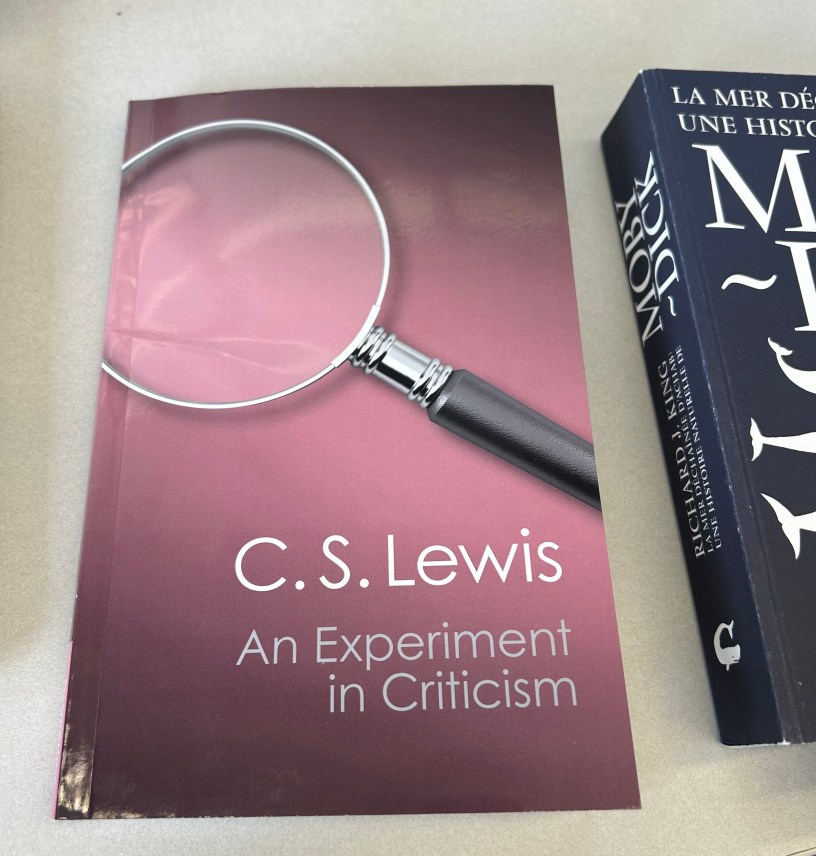
I recently discovered a treasure trove of books by C.S. Lewis in the Baylor University Bookstore, required texts for the Fall 2023 semester. I bought An Experiment in Criticism as it is a nice companion to Jerram Barrs’ book Echoes of Eden which is required reading for my World Literature seminary course that I am currently teaching. Lewis had the conviction that literature exists for the joy of the reader and that books should be judged by the kind of reading they invite. One must “lay aside expectations and values extraneous to the work, in order to approach it with an open mind”(back cover). For this blog, I will hit some high points which were relatable to me!
In An Experiment, Lewis encourages us to make a distinction between Readers or types of reading and our distinction between books. Lewis attempts to define a “good book as a book read in one way, and a bad book as a book which is read in another”(1). I like what Sartre said about the Reader’s important role in the determination of a “good book”:
“Writing and reading go hand-in-hand. You cannot have one without the other. This is obvious. It is the joint effort of author and reader which brings upon the scene that concrete and imaginary object which is the work of the mind (52).”
Lewis points out that the majority never read anything twice, therefore, to say “I’ve already read it” is a sure mark of an unliterary man. Bien sûr. These readers reject novels that they have possibly skimmed as if they were an old train ticket!
Whereas, those who read great works will read the same work ten, twenty or thirty times in the course of their life. [Are you already counting how many of these works are in your personal library?]
Secondly, many read as a last resource or an alternative pastime: these books are kept for “railway journeys, reading oneself to sleep, odd moments of enforced solitude”(2). And this was 50 years before instant streaming of media!
Contrast this with “literary people who are always looking for leisure and silence in which to read and do so with their whole attention. When they are denied such attentive and undisturbed reading even for a few days, they feel impoverished”(3). [Fortunately, pour moi, I am married to a professional orator who spends 15-20 hours per week, in the evenings and on weekends, researching and writing three sermons. This gives me plenty of leisure and silence in which to read “good books “and write blogs as I am doing at this moment in the Moody Library at Baylor University, our Alma Mater!].
I love his third definition of a “literary person”: the reading of some literary work is often, to the literary, an experience so momentous that only experiences of love, religion, or bereavement can furnish a standard of comparison (3). They have become what they were not before. Yes please! However, there is no sign of anything like this with “other readers” who after reading a story or novel, nothing much seems to have happened to them.
Finally, Lewis determines that the acme of a literary person is one who, as a natural result of their different behaviour in reading, what they have read is constantly and prominently present. A litmus test—Does one mouth over favorite lines and stanzas in solitude? Do scenes and characters from books provide one with a sort of iconography by which they interpret or sum up their own experience? Does one talk to others about books, often at length?
The other readers seldom think or talk of their reading. I like Lewis’ anecdote of a time he was talking about a great poet he admired to a man at a train station. The man interrupted him with “Good God, man, do you want to go on after hours? Didn’t you hear the hooter blow?” Where are my people? Who can I go on and on to about the writers and works that move me?
Lewis sees these same truths with other arts and natural beauty: many people enjoy popular music in a way that they go about humming the tune (guilty—I’m a hummer) and stamping in time. However, when a popular tune has once gone out of fashion, they enjoy it no more [to be fair, Lewis just missed the Beatles]
Those who enjoy Bach, according to Lewis, react quite differently. Similarly, some buy pictures so ‘the walls will not look bare’; but there are few who feed on a great picture for years!
In Lewis’ chapter on “False Characterizations”, he laments in the sad result of making English Literature a “subject” in universities as students sometimes see this as meritorious (10). This is a matter in my wheelhouse. A large part of my job as a Literature Professor is to introduce great works and great authors to young minds and to incite a love and passion for literature in their hearts; to read “wholeheartedly and make themselves as receptive as they can, to read in the same spirit that the author writ…to enjoy a kicksaw as a kicksaw and a tragedy as a tragedy”(11). Each semester, I see this evident in a few students, but not the majority. I want to instill a life-long desire for reading, to become a “literary person” as Lewis describes.
In Chapter four, Lewis defines the Reading of the Unliterary. These are most of my students. Just because you have read in your short life doesn’t mean you are literary, according to Lewis:
“There can never be a purely literary appreciation of literature as every piece of literature is a sequence of words. Sounds, or their literary equivalent, are words precisely because they carry the mind beyond themselves. That is what being a word means”(27).
Most unliterary students are simple carried through and beyond words into a non-verbal and non-literary reading. It is simply reading. Most of their subjects require reading of words. For example, the first note of a symphony demands attention to nothing but itself. Conversely, the first word of the Iliad directs our mind to anger; something we are acquainted with outside the poem (28). I love this.
We must, therefore, read with our eyes, our ears, our experiences, and our imaginations. To experience vicariously through the characters pleasure and happiness. This must be taught or modeled, not assumed. It is important to encourage a pursuit of higher vocabulary to help with the full comprehension of the meaning. To “receive” significant words is to “use” them, to go through and beyond them to an imagined something which is not itself verbal (89). Good word!
In Lewis’ “Epilogue”, he claims to be “writing about literary practice and experience from within, for I claim to be a literary person myself and I address other literary people”(130). One needs to read the Chronicles of Narnia, The Screwtape Letters, Mere Christianity to truly understand this declaration!
Lewis asks:What is the good of reading what anyone writes? It is to seek an enlargement of our being…it is to be more than ourselves. We want to see with our eyes, to imagine with other imaginations, to feel with our hearts, as well as with our own (137). This is good enough for me!
Work Cited
C.S. Lewis. An Experiment in Criticism. Cambridge University Press, 1961.
 My French Quest
Oh, this is lovely!
It’s so true that books change us, and that what we read is constantly and prominently present…
There is a meme called #6Degrees of Separation which knocks around our network of litblogs once a month, where, in the best of them, you can see this happening. From the starter book, ideas bounce off in all directions, with explanations or quotations from the text. X reminded me of Y, and Y segued to Z, because that book and that one and that one from our reading lives are part of our thinking processes now and we draw form what is “constantly and prominently present.” These chains provoke responses from readers exploring the same idea — often light-hearted because it’s meant to be for fun, but sometimes about serious matters.
Though we all do it sometimes when we are tired or busy, chains that consistently just bounce from a word or the colour of the book cover rather than from an idea or significant theme are perhaps by ‘other readers’.
Hi Lisa, is this meme #6Degrees of Separation a closed group? If not, how can one participate. I love this! Thank you for your response. Always good to hear from you! Robyn
Hi Robyn, great to see you here.
It’s not a group at all, it’s just a bunch of litbloggers who participate as and when they feel like it. You just start with the starter book (though you don’t have to have read it) and go where your imagination and reading history takes you. Some of us post our chains on social media, some of us just visit each other’s blogs.
LOL One of us is a Jane Austen enthusiast and she often manages to bring an Austen into her chain… so I wonder if Middlemarch will make an entrance one of these days?