
Five years ago, I wrote a blog about the complete obliteration of the town of Lidice, Czechoslovakia and its 500 inhabitants during WWII: “Hitler’s Message to the World: A Massacre at Lidice” [see post]. One of my readers recently saw this blog and invited me to an Annual Czech/Slovak Festival in her hometown of Phillips, Wisconsin which honors the memory of Lidice and the innocent victims.
My husband and I drove across the United states, from Texas almost to Canada, to attend the Memorial service for Lidice last month–it meant that much to us to honor the memory of these victims. My father fought four years in the Pacific during World War II to conquer this evil enemy and to keep this annihilation from happening to other towns and countries. This trip was to show honor to my Dad, as well.

I first learned about Lidice from Madeleine Albright’s deeply personal memoire Prague in Winter: A Personal Story of Remembrance and War, 1937-1948. In Prague, Albright reflects on her discovery of her family’s Jewish heritage many decades after the war, on her Czech homeland’s tangled history, and on the stark moral choices faced by her parents and their generation. A reporter at the Washington Post alerted her of this discovery shortly before she first started serving as secretary of state.
“No one who lived through the years of 1937 to 1948,” Albright writes, “was a stranger to profound sadness. Millions of innocents did not survive, and their deaths must never be forgotten. Today we lack the power to reclaim lost lives, but we have a duty to learn all that we can about what happened and why.”

One of the worst atrocities which Albright includes in her history of WWII was to come out of the Nazi regime — the complete annihilation of Lidice. This story affected me deeply.
Lidice was a small village in the Protectorate of Bohemia and Moravia, now the Czech Republic. Part of the Nazi occupation in World War II, Adolf Hitler and Reichsfuhrer SS Heinrich Himmler would order the complete destruction of the entire village in June, 1942. Why? Hitler became enraged after the assassination of the Reich’s Reinhard Heydrich, in which no one took responsibility for. This was Hitler’s way of “sending a message” to the world not to mess with his army. Unfortunately, he falsely chose this city because of rumors that Lidice harbored Resistance parachuters that possibly assassinated Heydrich.
Hitler’s order was that all 173 males from the village of Lidice who were over 15 years of age were to be executed and the 184 women and 105 children were to be deported to concentration camps. A few children who were considered racially suitable and thus eligible for Germanisation were handed over to SS families to be raised.
Hitler did not stop there. His purpose was to completely erase the town from the map and all inhabitants from its history. The whole town was burned; the cemetery plowed under and the name of the town was excised from the map.

Albright recounts the events of this massacre in detail and includes a haunting picture of Lidice taken before the massacre featuring a church steeple and the sharply slanted roofs of the residences in the Bohemian countryside (221)
After the war, many children came back to Czechoslovakia. If their mothers had survived the Ravensbruck concentration camp, they were reunited. There would be no Lidice to return to. As with most of the atrocities of the Nazi Regime, this is unthinkable.
Fortunately, Hitler’s goal of erasing this town off the map and out of our minds for eternity was not realized. Soon after the razing of the village, towns in various countries were renamed in Lidice’s honor: San Jeronimo Lidice in Mexico City, Lidice de Capira in Panama, several towns in Brazil, the English city of Coventry which was devasted by Luftwaffe bombing was renamed Lidice, a neighborhood in Crest Hill, Illinois in which a shrine was built remembering the victims, and Phillips, Wisconsin holds a Memorial service each July.


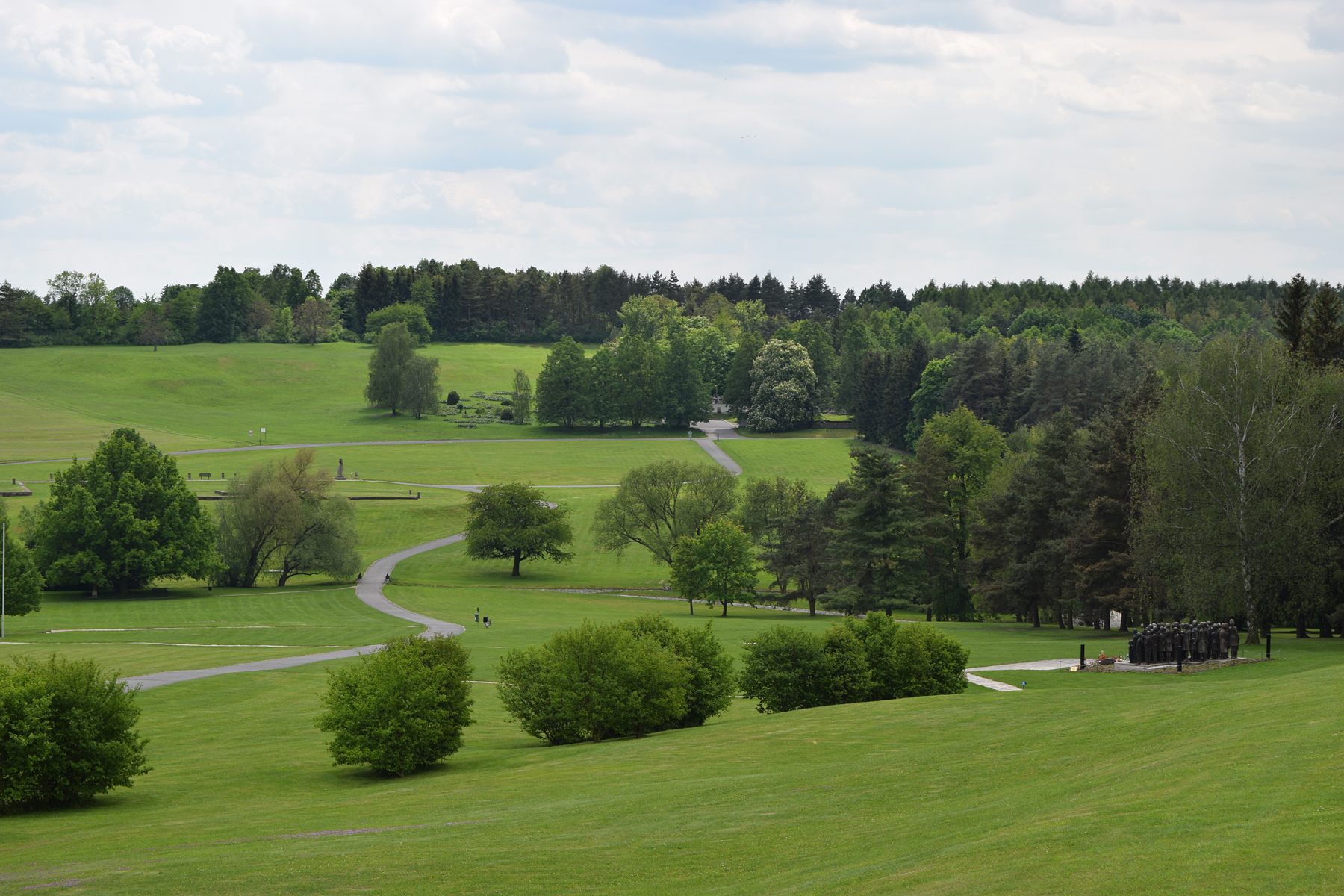
The Czech government contemplated rebuilding the city of Lidice after the war and chose to build a small village next to the site of the former Lidice instead. Their decision was to protect the place where the old village was as a calm, open space where people can reflect. Today there is a deeply somber, open plain where Lidice once stood which an adjacent museum. There is a rosarium which connects the old and new containing 25,000 roses.

Toni Brendel is the Secretary of the Phillips Czech Slovak Festival in Wisconsin and has organized this Memorial service for many years. Brendel met with three of the children and interviewed them at the 75th anniversary of the event. Mr. Vaclav Zelenka and Maria Supikova passed away in 2023. She is the kind reader who let me know about an annual Festival memorializing the village of Lidice on the third weekend every June. A monument in Sokol Park was constructed by members of the ZCBJ and Sokol organization and unveiled in 1944.
I had the privilege of meeting Toni at the Lidice Memorial service and was so grateful for her service to keep this memory alive and to the Phillips Czech/Slovak Community for making this possible.
See Phillips Czech/Slovak Community Festival for further information and a photo of the monument.
Hitler proclaimed, “ Lidice shall die forever “. This beautiful memorial and annual event is proof that will never happen.
Works Cited
Madeleine Albright. Prague Winter: A Personal Story of Remembrance and War, 1937-1948. New York: Harper. 2012.
Ian Willoughby. Lidice, 75 Years Later: “A Place of Hope and Tragedy.” Czech Radio. Retrieved 22 September, 2019.
https://www.radio.cz/en/section/czech-history/lidice-75-years-later-a-place-of-hope-and-tragedy
 My French Quest