
Voltaire (1694-1778) was a writer, historian, and philosopher during the French Enlightenment, known for his wit. In fact, in most paintings and sculptures I have seen of Voltaire, he is smiling!
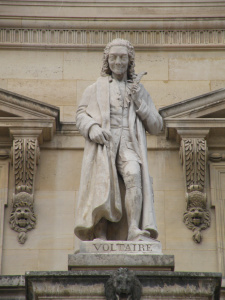
Voltaire used his pen name and the Latinized spelling of François-Marie Arouet (AROVET LI) to write more than 2,000 books and pamphlets which influenced many leaders of both the American and the French Revolutions. He was imprisoned in the Bastille for eleven months due to his satirical criticism of the government, but despite these circumstances, wrote one of his most successful plays, Œdipe.
My favorite work by Voltaire is Lettres d’Alsace, a compilation of 100 letters he wrote to his niece Madame Denis while he lived in Strasbourg and Colmar [see post]. I love to visit Alsace, my ancestral home, which Voltaire captured so vividly in Lettres through a daily journal of his time there. He was inspired during this year to write his great tragedies and comedies, including Candide and Siècle de Louis XIV.


Before Voltaire died, he wrote Adieux à la Vie (Farewell to life) as his Mass of requiem. Unlike his sharp, satirical works, this farewell is somber, intimate, and reflective. What he conveys personally is not just a resignation to death, but an attempt to situate his life, beliefs, and legacy in relation to eternity.
Voltaire was interred quietly at the Abbaye de Scellières by his family in Champagne because of his criticism of the Church; however, during the French Revolution, the National Assembly ordered that his remains be moved to the Panthéon, among other French statesmen, as a symbol of his fight for reason and freedom of thought. [I took the featured image photo of Voltaire’s tomb in the Pantheon in 2012] .
I have included the original French version and my English translation below.
Adieux à la Vie by François-Marie Arouet de Voltaire
Adieu je vais dans ce pays
D’où ne revint point feu mon père.
Pour jamais adieu, mes amis,
Qui ne me regretterez guère.
Vous en rirez, mes ennemis;
C’est le requiem ordinaire.
Vous en tâterez quelque jour;
Et lorsqu’aux ténébreux rivages
Vous irez trouver vos ouvrages,
Vous ferez rire à votre tour.
Quand sur la scène de ce monde
Chaque homme a joué son rôlet,
En partant il est à la ronde
Reconduit à coups de sifflet.
Dans leur dernière maladie
J’ai vu des gens de tous états,
Vieux évêques, vieux magistrats,
Vieux courtisans à l’agonie:
Vainement en cérémonie
Avec sa clochette arrivait
L’attirail de la sacristie;
Le curé vainement oignait
Notre vieille âme à sa sortie;
Le public malin s’en moquait;
La satire un moment parlait
Des ridicules de sa vie;
Puis à jamais on l’oubliait;
Ainsi la farce était finie.
Le purgatoire ou le néant
Terminait cette comédie.
Petits papillons d’un moment,
Invisible marionnettes,
Qui volez si rapidement
De Polichinelle* au néant,
Dites-moi donc ce que vous êtes.
Au terme où je suis parvenu,
Quel mortel est le moins à plaindre?
–C’est celui qui ne sait rien craindre,
Qui vit et qui meurt inconnu.
*Polichinelle is a character of the Neapolitan farce Punch.
MY ENGLISH TRANSLATION
Farewell; I’m going to this country
Whence my late father did not return.
Forever farewell, my friends,
Who will hardly regret knowing me.
You are laughing, my enemies;
This is a simple requiem.
You will test it some day;
And when on the dark shores
You will find your works,
You will make yourself laugh.
When on the stage of this world
Each man has played his part,
When leaving he is in the round
Renewed whistles.
In their last illness
I have seen men from all walks of life,
Old bishops, old magistrates,
Old courtesans in agony;
Vainly in ceremony
With his bell announcing
The paraphernalia of the sacristy;
The priest vainly anoints
Our old soul as it ascends;
The clever public mocking;
Satire for a moment spoken to
The ridiculousness of his life;
Then we will will never forget;
And so the farce completed.
Purgatory or nothingness
Terminated this comedy.
Little butterflies of a moment,
Invisible puppets,
Who fly so fast
From Polichinelle to nothingness,
Tell me, then, what you are.
At the end where I become,
Mortal is least to be pitied?
–It is he who fears nothing,
Who lives and who dies unknown.
Work Cited
Canfield, Arthur G., and Patterson, W.F. French Poems. New York: Holt & Co. 1941.
 My French Quest