Art comes from God”, states Dürer, “God created all forms of art and the attainment of true, artistic, and lovely execution in painting is hard to come unto…Whosoever, therefore, falleth short cannot attain a right understanding for it cometh alone by inspiration from above“–Dürer
Dürer began to draw at a very early age. He painted his father several times and his mother as a young boy. It was his conviction, however, that he must examine his own life by doing portraits of himself.
At a time when there were no traditional “mirrors”, Dürer made a self-portrait at the age of 13 which I recently viewed at the Albertina in Vienna. It is intriguing—what or who is he pointing at? It is amazing that he could capture such great detail in his clothing, his hair, and his expression at such a young age.

Self-Portrait at the age of Thirteen (Silverpoint, 1484), Albertina, Vienna
His “Self-Portrait with Eryngium Flower”, part of the Musée du Louvre permanent collection, was painted on vellum and, according to Peter Strieder in Dürer, this suggests that this portrait was painted in the workshop in Strasbourg. The date, 1493, also suggests that this was from his journeyman’s period when he was trying to impress on his fiancée in Nuremberg that he was handsome (10). He achieved this goal!
This self-portrait was my first introduction to Dürer. I knew very little about the life and work of Dürer before this clandestine meeting, but I was confident that he would quickly become one of my favorite artists! And it is still true 20 years later.
According to Goethe who had seen a copy of the painting in Helmstedt, the eryngium flower which Dürer is holding is a symbol of fidelity and has a great religious significance. Dürer’s inscription at the top of the portrait confirms this: “My sach die gat/Als es oben schtat” (My affairs shall go as ordained on high).
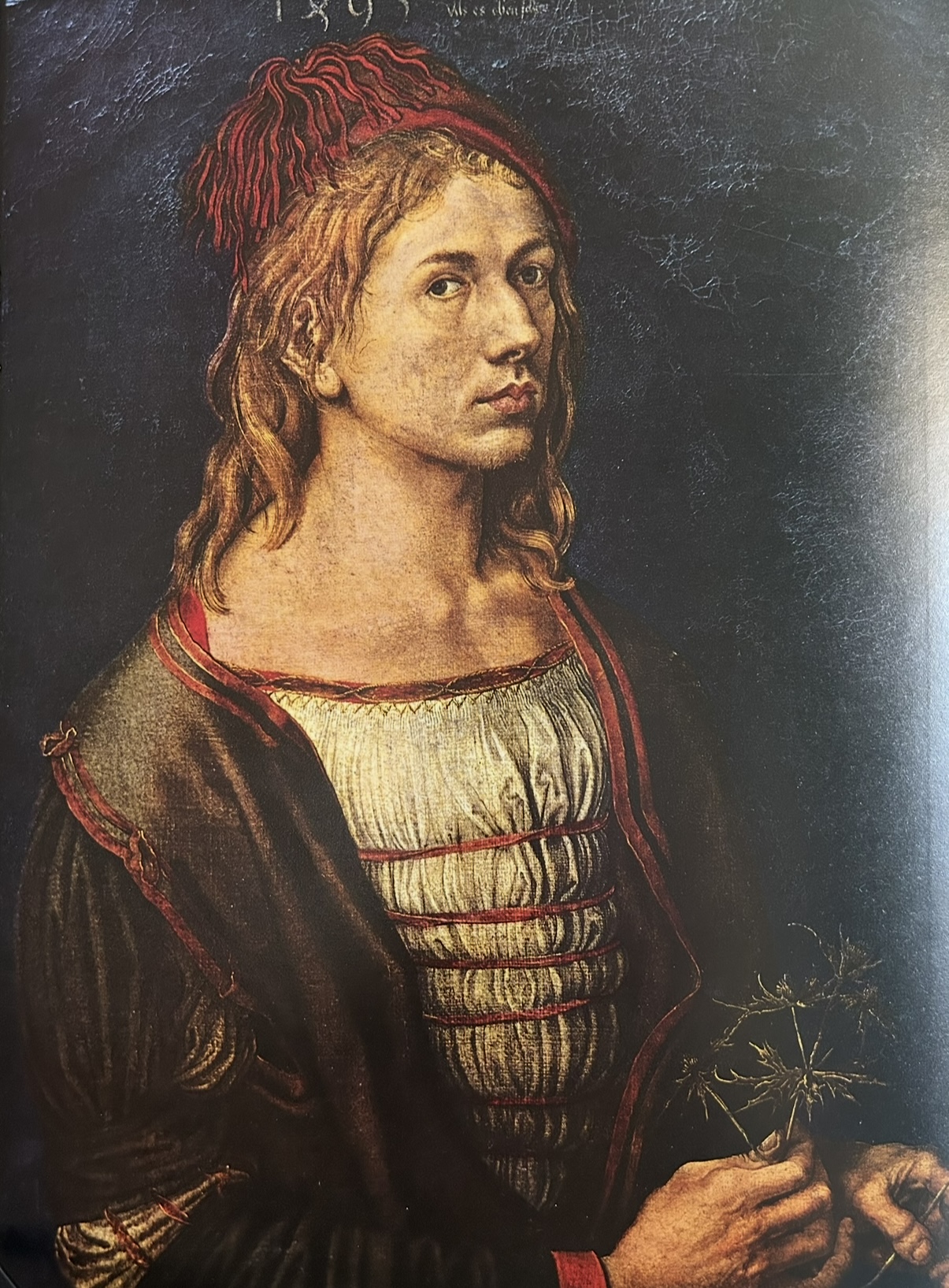
Self Portrait with Eryngium Flower (Oil, 1493), Louvre, Paris
The second Self-Portrait by Dürer was painted when he was twenty-six and included a landscape scene. It was presented it to Thomas Howard, Earl of Arundel by the city of Nuremberg as a gift for Charles I. Dürer’s skill as a draftsman and his imaginative powers, including scale of the landscape, are clearly evident in the red, green, and purple pen-and-ink drawings. This portrait was published in the nineteenth century and presented to the public for the first time in “Albrecht Dürer’s Christian and Mythological Drawings”.
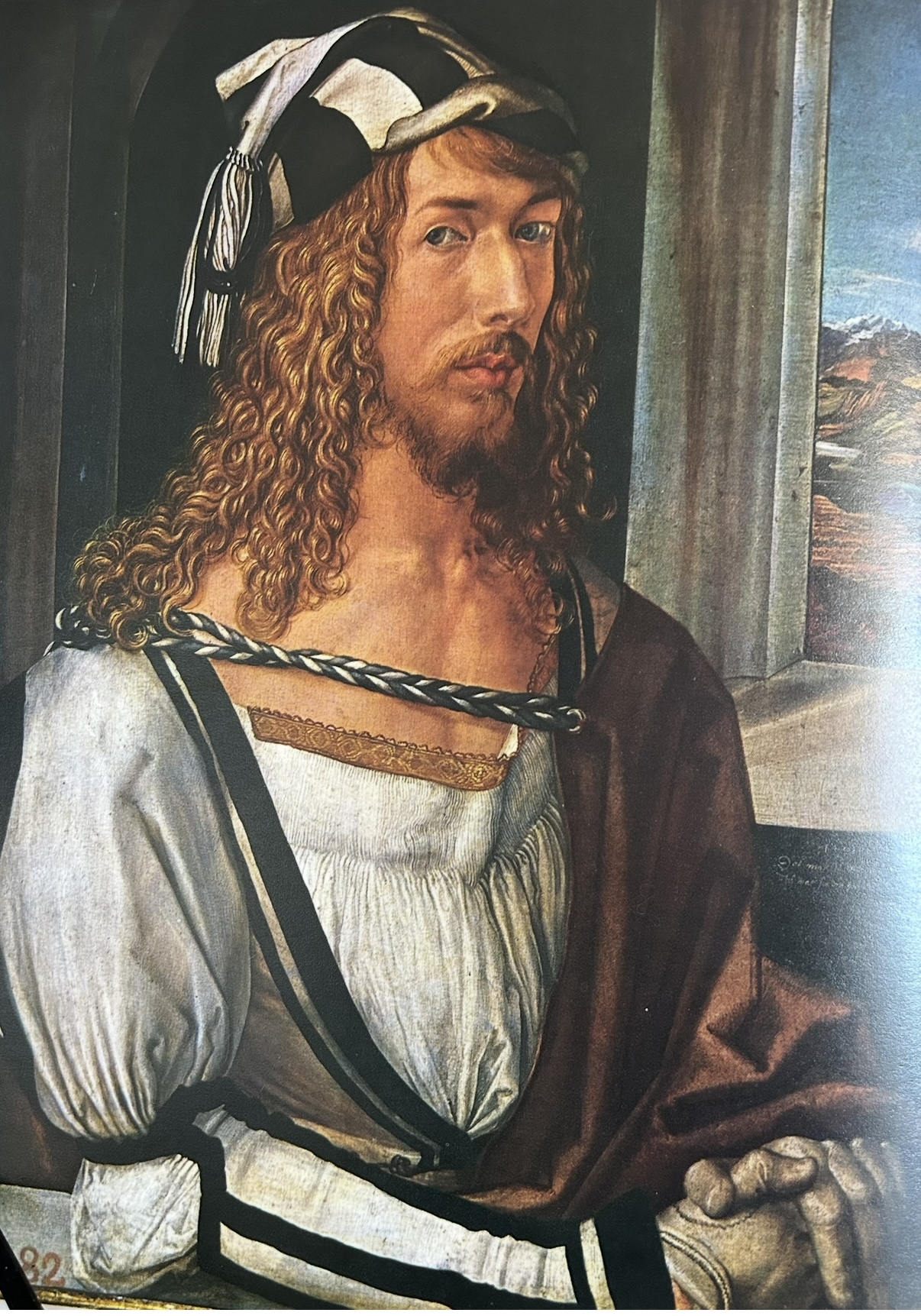
Self-Portrait with Landscape (1498) Prado Museum, Spain
The third and last self-portrait was painted in 1500 and is the permanent collection at Alte Pinakothek, Munich. Dürer rejects the formula of the three-quarters profile here and, instead, painted himself in a frontal pose, with his right hand held in front of his chest. He is gently fingering the soft fur trimming on his robe, which gave its name to the portrait.
Notice the date, 1500, in the top left of this portrait above Dürer’s monogram. This is an unusual time to paint a new self-portrait, explains Strieder, as Pope Alexander VI had proclaimed 1500 a holy year, the second half of the millennium, in which pilgrims would take an interest in “eternal salvation”(14).
Dürer gives further information about himself in this painting. Notice the Latin inscription on the right-hand side of the painting: it translates
“I, Albrecht Dürer from Noricum, painted myself with everlasting colors in my twenty-eight year”.
He wanted to hand down an undying image of posterity.
In addition, Dürer painted himself in a frontal pose with a symmetrical composition, the vera icon, true image, as he appeals to Christ,
“Art comes from God”, states Dürer, “God created all forms of art and the attainment of true, artistic, and lovely execution in painting is hard to come unto…Whosoever, therefore, falleth short cannot attain a right understanding for it cometh alone by inspiration from above”(Dürer, The Literary Remains of Albrecht Dürer)
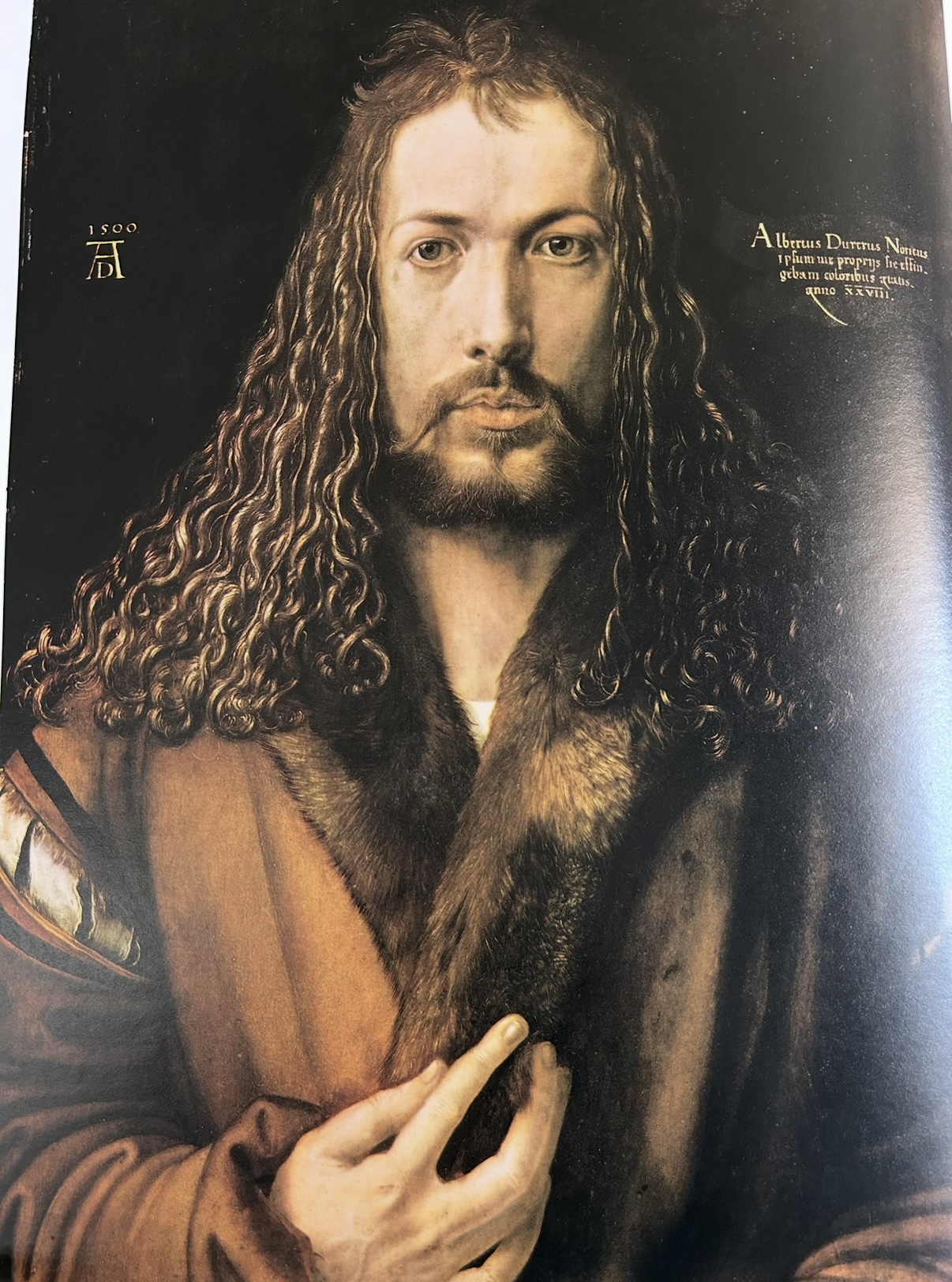
Self-Portrait in a Fur-Collared Robe (1500), Alte Pinakothek, Munich
Works Cited
Peter Strieder (1976). Dürer. Verona Italy: Masters Works Press.
The Literary Remains of Albrecht Dürer, ed. And trans. W. M. Conway. Cambridge, 1889.
 My French Quest