Napoléon Quest
Over the Christmas Break, I had a chance to revisit my Napoléon Bonaparte library. As a French sovereign that was the living embodiment of the passions and pursuits of the French people, Napoléon is one of my favorite figures in European history. I admire his leadership, courage, vision, tenacity, passion, and devotion to France. Of course, these very qualities ultimately shaped his tragic final campaign and downfall.
I recently published a poem by Victor Hugo, Napoléon’s Army After the Fall of Moscow, revealing the catastrophic carnage of Napoléon’s 1812 Campaign in Russia through the eyes of the soldiers [see post] and I will post more on Napoléon’s Russian Campaign in the days to follow.
Why Napoléon Bonaparte?
I have always been sympathetic to Napoléon Bonaparte as a leader of France. Even though he has a grande imperial ego and is often portrayed as a tyrant unable to relinquish power or glory, I believe that Napoléon saw it as his duty to guard the throne of France for his family and for his son. During the Cent Jours (Hundred Days), Napoléon also had a deeply held conviction that only his leadership could preserve France’s sovereignty against the restored European order. Unfortunately, this conviction ultimately led to the defeat at Waterloo and a second exile to St. Helena.
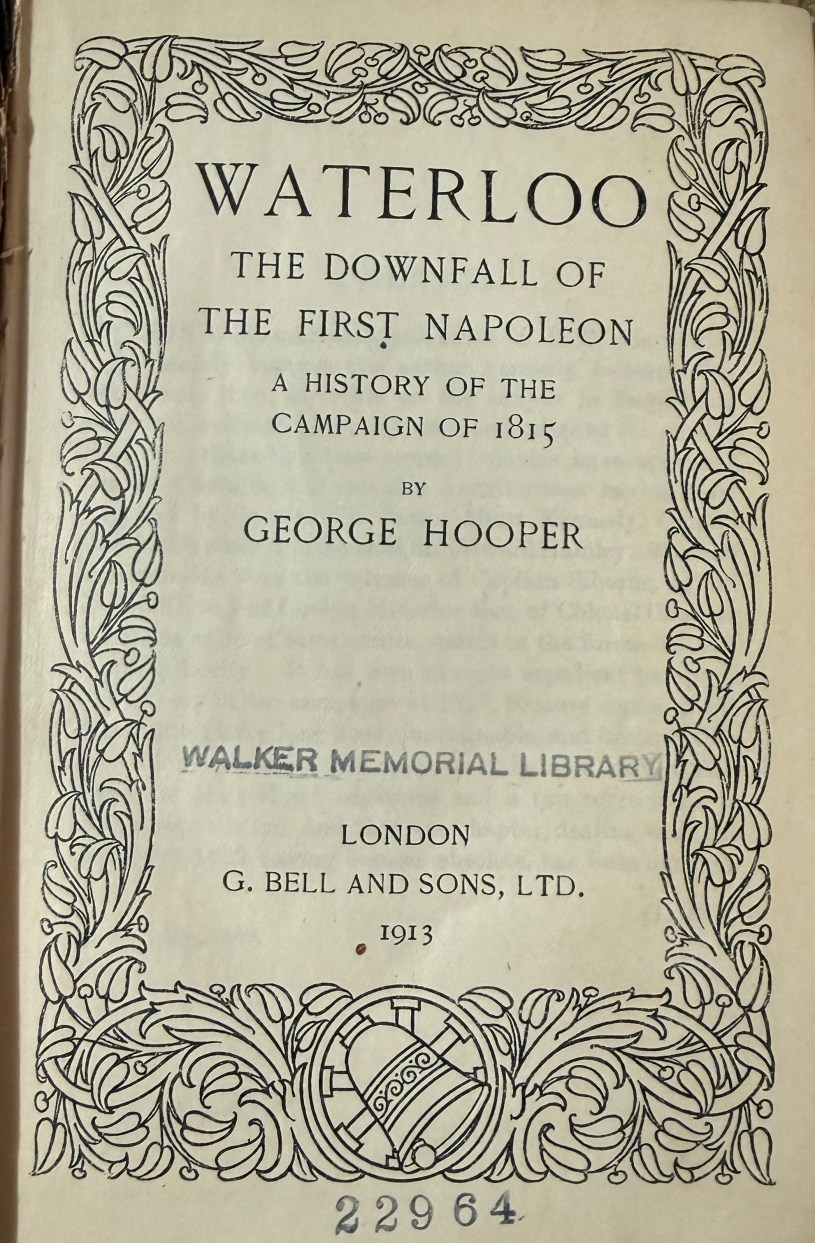
This blog is a retrospective of sympathy towards Napoléon combined with historical analysis. I will be referencing an early twentieth-century study of Waterloo in Waterloo: The Downfall of The First Napoleon. A History of the Campaign of 1815 (1913)by George Hooper. This lovely little treasure is a recent acquisition to my Napoléon library. It offers a framework through which Napoleon’s final campaign can be understood less as reckless ambition than as a calculated attempt to defend France’s political independence.
I was encouraged to find support of my thesis regarding Napoléon’s leadership. In Waterloo, Hooper examines the history of Napoléon’s leadership after the return from Elba in 1815 to his second exile to St. Helena. Hooper examines why Napoléon, knowing the odds, returned to France even after the events of Cent Jours, which were a futile attempt to resurrect an imperial dream already shattered by defeat and exile. As the events of the Waterloo campaign reveal, Napoleon fought in 1815 not to remake Europe, but to prevent Europe from remaking France.
Of course, to understand how Napoleon arrived at this conviction, it is necessary to return to the moment of his first abdication in 1814 and the conditions of his exile on Elba, where defeat did not extinguish his sense of political responsibility.
1814 Napoléon’s Abdication and exile to Elba
Napoléon selected Elba as a residence, “because he could keep an eye on France and upon the Bourbons” (Waterloo, 8). He made peace at Fontainebleau and looked forward to the project of an imperial restoration. Even in abdication, Napoléon framed his withdrawal not as surrender, but as a temporary retreat undertaken in the service of dynastic and national continuity.
He knew his army would always be devoted to him: “Our victories and misfortunes have established between me and an army an indestructible bond; with me alone, the army can obtain once more vengeance, power, and glory”. Yet this confidence in military loyalty was paired with a striking sense of personal accountability, as Napoleon increasingly cast himself as both the author of France’s suffering and the only figure capable of repairing it (9).
“C’est moi, he cried, qui suis cause des malheurs de la France; c’est moi qui dois les réparer”(9). [I caused the misfortunes of France; I ought to repair them.] Such reflections transformed Napoleon’s exile from a period of resignation into one of political calculation. Napoleon’s decision revealed that inaction itself had become a betrayal of France.
According to Hooper, Napoleon chose the 26th of February to escape from Elba because he was tired of inactivity and believed the favourable moment had arrived. During his exile, he had suffered from ennui and idleness and had much time to reflect on the causes of his fall. He had seen how eagerly France had accepted a charter from the Bourbons, and how deeply the French resented the conduct of the Bourbons in violating its letter and spirit (19).
Napoleon described himself to be “rien qu’un être politique” (nothing but a political being). He was still the Emperor of the soldiers, the peasants, and the plebeians of France. He cried, “Public discussions, free elections, responsible ministers, liberty of the press—I desire all that! The repose of a constitutional king will suit me; and will suit my son better”. (20). He saw his position as that to subdue Europe.
Cent jours: March 20, 1815 to July 8, 1815 (Louis XVIII’s restoration)
When Napoleon returned from Elba, he knew that the best troops of England were in America, that the German force on the Rhine was weak, and that the Russian armies were in Poland. He calculated that the Allied Powers would not be in a position to open the campaign, at the earliest, until the middle of July. He saw that by working on the feelings of his father-in-law, the Emperor of Austria, and by rousing the anger of the Emperor Alexander against his allies, he would be able to reduce his enemies to two powers—England and Prussia. He intended to have 800,000 troops by Autumn. I believe that these calculations reveal Napoléon as a ruler still thinking in continental terms—balancing diplomacy, dynastic ties, and military timing.
Napoléon’s real resources were prisoners of war, the veterans who had returned to France from distant garrisons at the conclusion of peace, old soldiers who had quitted the army at various periods, the officers who had not arrived at the higher grades, and the generals who hoped to become marshals. He had hoped for more enlistments from Alsace; he could only muster 19,000 instead of the 40,000 he had been promised (21).
Napoléon set sail for France and entered the Tuileries on the 20th of March. The army quickly restored Napoleon just as Louis XVIII was driving out of Paris by the road to St. Denis on the 19th. Louis XVIII soon became safe in Ghent just a few hours before Napoléon, on the 20th, drove in by the Barrier of Italy.
When hearing of this, he Duke of Wellington asked the important question, “Can the Bourbons get Frenchmen to fight for them against Frenchmen”(19)? The results showed that they could not. At that time, in the state of France, the army was master of France, according to Jaucourt in a letter to Talleyrand, Jan 20th, 1815. This was partly due to Louis and his ministers irritating the people instead of trying to conciliate them. The ease with which Napoléon reclaimed Paris exposed the fragility of Bourbon authority and underscored the degree to which the regime depended on foreign artillery rather than domestic loyalty.
By early 1815, the conditions Napoléon had been observing from Elba—Bourbon misrule, popular resentment, and Allied disunity—convinced him that the moment for return had arrived.
Napoléon has now occupied France. His leadership struck a great contrast to the weakness and inaptitude of the Bourbons. France, England, Austria were bound by a secret treaty to resist Russia and Prussia’s spoils offered by the powerless Poland and Saxony. The Duke of Wellington found that the prevailing sovereigns were determined to unite their efforts to support the “Peace of Paris”. He never doubted, therefore, that Napoléon would succeed in regaining a footing in France. Napoleon had broken the Treaty of Paris and declared war on Europe.
Napoleon’s renewed control of France thus posed an immediate dilemma for Europe: a ruler restored by national sentiment yet condemned by an international order determined to preserve the settlement of 1814.
In breaking the Treaty of Paris, Napoleon confirmed the fears of the Allied powers, but he did so in the belief that France’s independence could not survive under a peace imposed and enforced from abroad. War, in this sense, was not a choice but a consequence.
Cent jours (The Hundred Days)refers to the brief period in 1815 when Napoléon returned from exile in Elba on March 20, 1815, to reclaim power in France. Is it possible that he could not imagine France defended without himself at its center? Yes, I believe so. By 1814–1815, Napoléon had come toidentify France’s security, stability, and honor with his own person. This wasn’t mere ego; it was the product of nearly fifteen years in which France had been defended, expanded, and administratively unified under his command. He had repeatedly seen coalitions defeated only when he was present—and France unravel when he was not. Without him, France seemed leaderless, vulnerable, and exposed to foreign manipulation.
How was Napoléon to live in a world where he was no longer historically necessary? Of course, the very belief that only he could defend France ultimately placed France in greater danger. “Whatever may have been Napoléon’s intentions, we have only to deal with what he accomplished…He counted on the future without taking into his estimate the activity of his foes” (77).
During these 100 days, Napoléon fought key battles at Ligny, in which he defeated the Prussians; Wavre, and the most famous, Waterloo, the final decisive battle where Napoléon’s French Army was defeated by the Anglo-Allied forces under the Duke of Wellington and Prussian forces under Blücher, marking the end of his reign. Hooper argues that the war of 1815 was not fought against France as such, but against Napoleon ruling France (78).
Seen in this light, Napoleon’s final campaign appears less as the last act of imperial arrogance than as an effort to preserve France from an externally imposed order. His escape from Elba, the loyalty of the army, and the rapid collapse of Bourbon authority all testify to a ruler who believed that only his leadership could shield France from political humiliation and foreign domination. His decision to step aside rather than provoke civil war suggests that devotion to France, even in defeat, remained central to Napoléon. Waterloo ended that belief, but it does not invalidate the logic that guided him: “Napoleon fought in 1815 not to remake Europe, but to prevent Europe from remaking France.”
Work Cited
George Hooper. Waterloo: The Downfall of The First Napoleon. A History of the Campaign of 1815. G. Bell and Sons, 1913.
 My French Quest