“According to his custom, Napoléon walked along in front of the ranks. He knew what wars each regiment had fought with him. He halted before the oldest soldiers, mentioning to one the battle of the Pyramids…He inquired: ‘How many years of service? What campaigns? Any wounds? Any meritorious actions?’ Then he appointed them officers and had them installed immediately. This delighted the soldiers. They felt they were his true family. In this manner, Napoléon instilled in them the love of war, of glory, and of himself”—General Philippe-Paul de Ségur
This winter, I have been on a Napoléon quest and have revisited my Napoléon library in pursuit of learning more about him as a great captain of war.
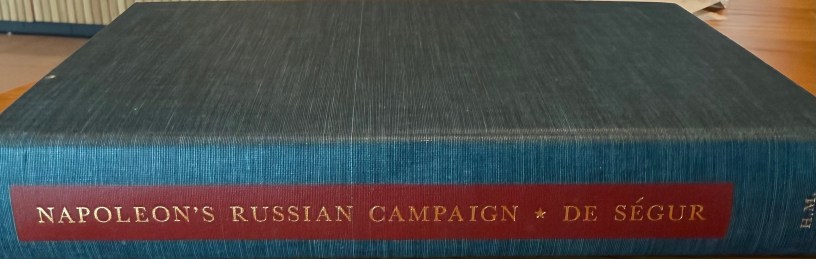
One treasure in my library is a book that I had not read previous to this new quest and, as it turns out, is one of the most factual accounts of Napoléon as a military leader.
Napoléon’s Russian Campaign has a curious history; it was originally written and published in 1873 by General Philippe-Paul de Ségur, who served as Napoléon’s aide-de-camp. What? How could that be—we have an eye-witness account from one of his soldiers? So cool.
Général Philippe-Paul de Ségur
Ségur was born in 1780 and died in 1873. He was a French General for Napoléon and spent his remaining days as a historian. Ségur served through most of the important campaigns of the First Empire, frequently on diplomatic missions, and was taken prisoner by the Russians in 1807 but was exchanged in the Peace of Tilsit.
He was promoted to colonel, wounded in Spain, and took part in the Russian campaign of 1812 and the campaigns of 1813 and 1814. He accepted a command from Napoléon during the Cent Jours [see my post] and retired in 1818.
Ségur was admitted to the Académie Française and became grand cross of the Legion of Honour in 1847. He served his remaining days as a historian of military campaigns, especially Napoléon’s. William Langer, a professor of History at Harvard, and wrote the Introduction to Napoléon’s Russian Campaign, states that “Comte de Ségur’s accounts have long been one of the most reliable and dramatic. Houghton Mifflin republished Ségur’s account in 1958. This is the text I will be referencing in this post. Pretty cool!
Napoléon’s Invasion of Russia
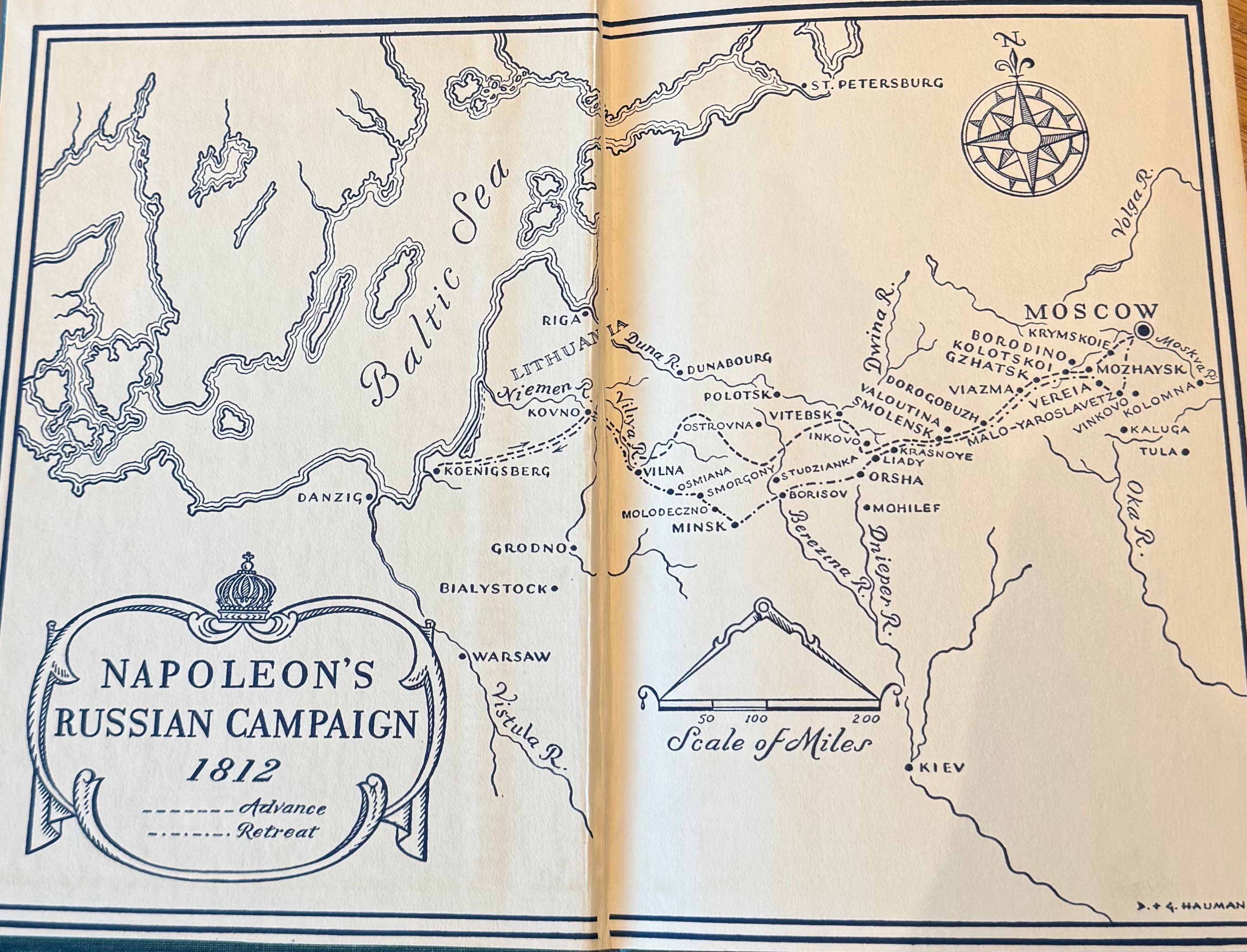
In Russian Campaign, Ségur gives a first-hand, vivid, and stirring account of Napoléon’s invasion of Russia, the French occupation of Moscow, and the Grand Army’s disastrous retreat in 1812. Though a great admirer of the Emperor, he was by no means uncritical of him and his despotic regime. Ségur served as Quartermaster-General and therefore had unusual opportunities to see and hear what went on in Napoléon’s headquarters.
Langer asserts that the picture that Ségur gives of Napoléon is an extremely human one which eminent historians have found psychologically convincing (vi).
This book is not only history and literature. Told in narrative form, it is vivid, dramatic, and moving. “It evokes brilliantly the character of the period and the epic suffering of the great expedition”(vii).
Ségur’s first-hand accounts of Napoléon’s campaigns
As Napoléon’s aide-de-camp, Ségur was able to observe the great man at close range—an intelligent witness of both Napoléon’s triumph and defeat. Ségur confesses:
“I was less an actor than a witness in this campaign, never leaving the Emperor’s side for more than a few feet, and then only to deliver several of his orders to see that they were carried out”(viii).
In the pages of Ségur’s historical account, Napoléon emerges far more vulnerable, far less heroic, than the figure generally encountered in biography and legend. I found the same true in a recent account of Napoléon’s siege and defeat in Waterloo: The Downfall of The First Napoléon by George Hooper (see Cent Jours post above).
Ségur’s account represents Napoléon in a state of moral and physical collapse—so reduced at times that “the reader will find himself almost pitying the giant”, according to Hooper. Instead of pity, however, this depiction prompted a different response for me: Napoléon appears more relatable; as his vulnerability reveals a figure stripped of imperial grandeur, he emerges as recognizably human.
Hooper proposes that Tolstoy may have had a copy of Napoléon’s Russian Campaign by him when he was writing War and Peace, as both authors drew upon a common source (ix). However, it was Ségur that historians later turned for those details of behavior and conversation which only an eyewitness could provide. Yes, yes.
In Napoléon’s Russian Campaign, Ségur recounts Napoléon addressing his troops in Poland, of which there were six hundred and seventeen thousand men:
“According to his custom, Napoléon walked along in front of the ranks. He knew what wars each regiment had fought with him. He halted before the oldest soldiers, mentioning to one the battle of the Pyramids…He inquired: ‘How many years of service? What campaigns? Any wounds? Any meritorious actions?’ Then he appointed them officers and had them installed immediately. This delighted the soldiers. They felt they were his true family. In this manner, Napoléon instilled in them the love of war, of glory, and of himself”(2).
All saluted him with their usual Vive l’Empereur!
Napoléon was impatient. He did not want to wait out seven months of winter before attacking Moscow. His men felt the same way. To have come this far and wait was unthinkable. The boredom of inaction and the discomforts of their wretched camps were real torture. To remain in Vitebsk seemed unbearable; to retreat, impossible; there was no choice but to move forward (24).
Against opposition from his officers, he wanted to act now. He wanted t to take control of the entire country of Russia: “In Moscow, we will destroy everything; in St. Petersburg, we’ll keep everything” (22).
During this campaign against Moscow, Napoléon received great news from Paris that his son, the King of Rome, had been born. He set up a picture of his newborn son outside, his tent and shared the news with the seasoned troopers as a symbol of hope in the presence of grave danger.
Even this good news, unfortunately, could not relieve the soldiers of the miserable conditions they were living in. Ségur found Napoléon one night in his tent, sitting with his head in his hands, reflecting on the vanity of glory. Napoléon exclaimed: “What is war? A barbarous profession whose art consists in being stronger than the enemy at a given moment”(63). Napoléon’s misery was compounded by a painful attack of a cruel disease with which he had been afflicted for a long time—dysuresis.
Napoléon: After the battle, The Emperor and his retinue were riding on ground so littered with corpses that it was impossible to avoid stepping on them. Napoléon, terribly depressed by the sight of so many victims, suddenly exploded with cries of indignation for the poor soldiers. Someone, to appease him, remarked that ‘after all it was only a Russian. Napoléon replied, “There are no enemies after a victory, only men!”(83).
The Army Enters Moscow
Upon finally entering Moscow after months of fighting, Segur recounts:
“The Russian capital, rightly called by the poets City of Golden Domes, was a vast and fantastic jumble of some two hundred and ninety-five churches and fifteen hundred palaces with their gardens and dependencies” (90). There were rows and rows of brick mansions, thatched cottages, and attractive wooden houses for several miles. Most were roofed with sheet iron, burnished or painted.
The churches of Moscow epitomized the history of the Russian people: “Here was Asia with its religion, at first victorious, then vanquished, and after that the crescent of Mohammed, with the cross of Christ triumphant over all” (90).
Alexander had spoken to his people with a proclamation that “Napoléon was a betrayer, a Moloch who, with treachery in his heart and loyalty on his lips, had come to wipe Russia from the face of the earth” (91). Governor Rostopchin was doubtful, however, of the leadership of Alexander as he saw Napoléon’s advance as a weapon of revolution against the Czar. The silence of Alexander during this time has left historians doubtful as to whether he approved the establishment of an intermediate class, a class for and by whom the French Revolution was made. Did the consequence of despotism lead to the fall of Moscow?
Moscow Burns
Napoléon entered Moscow at nightfall just before the great fire had broken out. The sight of the Romanov and Rurikov palaces—part Gothic, part modern—with their thrones still in place and the cross of Ivan the Great soaring over everything, revived the hopes of Napoléon. According to Ségur, his ambition was flattered by such a conquest :“At last I am in Moscow, in the ancient palace of the Czars, and in the Kremlin”, Napoléon exclaimed for all to hear (107). He quickly composed a letter of peace to Emperor Alexander.
The next morning, Napoléon looked from his window in the Kremlin to see flames sweeping through the city, toward the Kremlin. Had Alexander dared to entangle Napoléon in this catastrophe? Did this justify the sacrifice of all Moscow in exchange for a victory?
Ségur confessed that “The cry of horror all over Europe pointed towards us [Napoléon’s army]…we had been reduced to an army of criminals on whom heaven and the civilized world would be avenged”(110). Napoléon felt himself defeated. The conquest for which he had sacrificed everything was like a phantom he had been pursuing, which had vanished into the air in a whirlwind of smoke and flame: “What a horrible sight! To do it to themselves! All those palaces! Why are they Sycthians!”(112).
As the Kremlin was ablaze, Napoléon and his men escaped through a “floor of fire”, Ségur recounts. “The intense heat burned our eyes, but we had to keep them open and fixed on the danger”(114). The army fled to Petrovski. The next morning, Napoléon looked anxiously toward Moscow, hoping to find the inferno had subsided; but he saw it raging as violently as ever. Sunk in gloomy despair, he exclaimed, “The forbodes great misfortune for us” (115).
The second half of Ségur’s historiography recounts the remaining days of Napoléon’s campaign, including the Army without Napoléon. Ségur remains until the bitter end.
“After fifteen hundred years of victories, the Revolution of the fourth century (that of kings and nobles against the people) had been overthrown by the Revolution of the nineteenth century. Napoléon was born of this conflagration. He commanded the Revolution as if he were the genius of that terrible element.
The Revolution united all Europe under his rule, driving Russia within its ancient boundaries.
“In his powerful effort, his strength failed him just as he reached the frozen wastes of Europe” (300).
Ségur concludes with his purpose of this history:
“Comrades, my task is finished. I leave it to you to attest the truth of the picture I have painted…But who among you does not know that an action is always more eloquent than any account of it, or that great historians are far rarer than great men, of whom they are born? (300).
Work Cited
Philippe-Paul de Ségur.(1958). Napoléon’s Russian Campaign. Introduction by William Langer, Professor of History, Harvard University. Translated from French by J. David Townsend. Houghton Mifflin Press.
 My French Quest
Napoleon is one of those historic figures that stir a wide range of emotions. Having visited his tomb in Paris, it is obvious that to many he continues to be a hero, but he was also very human as your post observes. As the Civil War general Sherman exclaimed: “War is hell.” It is hard to imagine, the strength of character needed, and the devotion stirred that could inspire Napoleon and his soldiers to wage war on the scale of their history. Excellent job in helping us to see Napoleon through new eyes.
Thank you, David, for your insight and encouragement. Reading these accounts from his aide de camp has helped humanize Napoleon and appreciate his courage and patriotism!
Oh I thought I had read passages by this aide de camp, but I realize it was another one: Mémoires du général de Caulaincourt! I read excerpts of his diary in Sylvain Tesson’s Berezina. Same title in French and English. Absolutely fascinating (well, like all of Tesson’s books). I suggest you read it to compare
Thank you for the recommendation. I will look for these additional accounts of Napoléon’s aides.