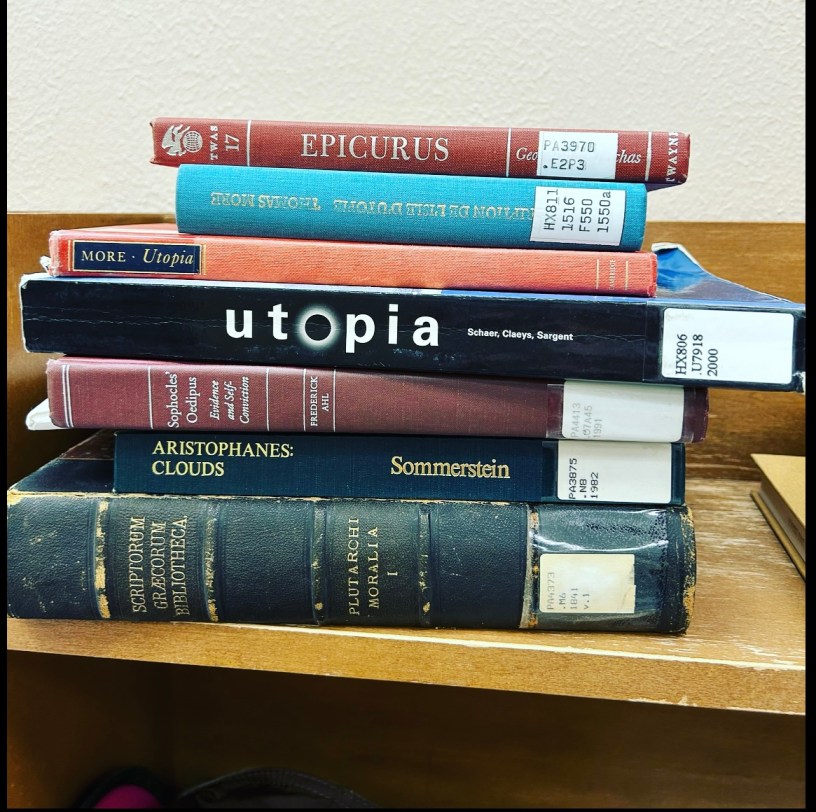
In Book II of Utopia, More describes the Utopian’s life of Pleasure:
“Lead a life as free of anxiety and as full of joy as possible, and to help all fellow men towards the end… Nothing is more humane than to relieve the misery of others, assuage their griefs, and by removing all sadness from their lives, to restore them to enjoyment, that is, pleasure (70).”
The Utopians distinguish several classes of true pleasure—pleasures of the mind and pleasures of the body:
- Pleasures of the mind:
The first class of pleasure is of the Mind: knowledge and the delight that arises from contemplating the truth, gratification on looking back on a well-spent life, and the unquestioning hope of happiness to come. These pleasures of the mind arise from the practice of virtues and consciousness of a good life.
To gain knowledge, Utopians sought to be instructed in Latin and Greek! This is an unusual ability to have perfect control of a language and read the best Greek authors, according to More. Before embarking on his fourth voyage, More gave the Utopians works by: Plato, Aristotle, Theophrastus’ book on Plants, Lascaris’ Grammar, the Dictionaries of Hesychius and Dioscorides; Books from the Poets: Aristophanes, Homer and Euripides. On History: Thucydides and Herodotus. On Medicine: Tricius Apinatus, Hippocrates, and Galen’s Microtechne. [This is quite a Library! In order to gain knowledge from these Classics that I have not yet read, I recently checked out from the SMU Library: Aristophanes’ Clouds, and Euripides’ Book of Plays (Vol 1). I am still searching for Hesychius’ Dictionary,]
Their intellectual pursuits are tireless (74).
2. Pleasures of the body:
The second class of pleasure is of the body.
These pleasures fill the senses with immediate delight. For example, when organs have been weakened by heat and are restored with food and drink; eliminating the bowels; generating children; and relieving an itch by scratching and rubbing. “MUSIC also” (74). Beauty, strength, and agility, as special and pleasant gifts of nature, they joyfully accept. The pleasures of the senses–sound, sight, smell– are special seasonings of life in which nature intended to be the particular province of man.
The most important pleasures of the body are a calm and harmonious state of health when one is undisturbed by any disorder. In addition, when Health is not disturbed by pain, this gives pleasure without any external excitement at all. A life of peace. When people, in general, are easy-going, cheerful, and clever, they can be free from the burden of pain. In this way, they can better serve the welfare of others and expect a great reward from God. (79)
I am also pursuing a “calm and harmonious state of health”, a life of Peace!
Work Cited
Adams, Robert M., trans. and ed. Utopia: A New Translation, Backgrounds, Criticism. By Sir Thomas More. A Norton Critical Edition. New York: Norton, 1975. Pp. xii + 239.
 My French Quest
Well, I have a very long way to go with Latin (which in my retirement I have resumed learning), and am yet to embark on any study of Greek, but I do think that pleasures of the mind are more enduring than those of the body. Old age and injury can stop the sports fanatics in their tracks, and then they are at a loss for how to spend their days.
Hi Lisa, I agree that pleasures of the mind are more rewarding! I remember you sharing with me about your Latinquest several years ago! Bon courage! I did attempt learning Latin at that time, but changed my focus to German and Russian instead. Utopia: How cool to imagine giving books from your library to a civilization to expand their minds. What books from your Library would you bestow? Always a pleasure to hear from you! Robyn
Actually…
As my age and with covid still lurking, one worries more about how to bestow the collection once I go to the great library in the sky. People don’t read so much any more, and when they do they are downsizing so they’d rather not have actual books cluttering up their Kondo lifestyle. When I was young I would have been ecstatic to inherit a collection like mine, but in real life, I don’t know anyone who reads like I do…
Wow, so true, I feel the same way. We are considering downsizing to a smaller house which means I will have to cull my Library–who do I leave behind? My Library is full of old, unique (mainly to me) treasures that not many would cherish.
Reading fluently both Latin and Greek I agree with you that enjoying the tiny linguistic details of some philosophers is something that should be sought for.
Thanks for sharing this amazing post!