In 1929, G.K. Chesterton published Generally Speaking, a collection of essays exploring the quirks and complexities of human thought. Among these essays, “On Writing History” stands out as a particularly incisive reflection on how we record and interpret the past.
Chesterton proposes that there are three ways of writing history:
- The Old Victorian way which is picturesque but largely false;
- The Enlightened way, adopted by academic authorities, which allow themselves to be false to avoid being picturesque; these enlightened think that so long as a lie is dull, it will sound as if it were true, and
- The Picturesque way, which is a perfectly natural instinct of man for what is memorable
Which version do you prefer?
As an avid reader of world history, particularly European, I found this chapter fascinating. Chesterton argues that most written history gives a “false picture” rather than a true picture—“it is to tell the reader what the picturesque incident really meant, instead of leaving it meaningless or giving it a deceptive meaning” (Generally Speaking 180). Oh my. This raises some questions: Does this pertain to just British History or is this ALL History? Have I been reading “false pictures” all these years?
The Battle of Hastings
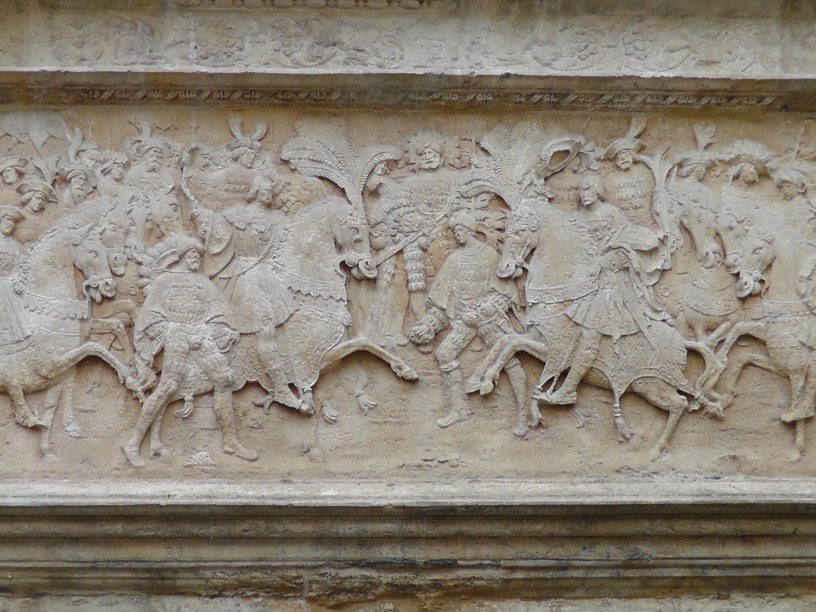
Chesterton begins with a familiar example from “the first pages of our first history-books”—The Battle of Hastings. As he recalls the battle was taught in “picturesque detail” in which Taillefer the Jongleur went in front of the Norman Army, throwing his sword in the air and catching it again, and singing the Death of Roland.
As a student of French History, I am very familiar with the Battle of Hastings and Roland, and this statement resonated with me. In fact, I recently completed (and soon to be published!) an Introduction to a new edition of The Song of Rolland for a publisher in London, researching several historical references of the grand battle which Roland fought for King Charlemagne and for France. Interestingly, Chesterton himself wrote the introduction to Charles Scott-Moncrieff’s 1919 translation of Roland, which makes his reflections here even more meaningful to my own study.
Chesterton explains that when reading this “first-history” as a young lad, he did not know what jongleur meant (a juggler or minstrel) and therefore missed about half the point of meaning of the story. He also did not know who Roland was and missed the whole meaning of the “Song” and the soul of the man who sang it. He now knows that most of what was told in the story was historically inaccurate:
“I was told that there was a great nation of Saxons, who were very noble because they were really Germans). I was told there was another nation of Normans, who were also very noble because they were not really Frenchmen; they were Scandinavians, and therefore were also really and truly Germans” (181).
As a young college student, Chesterton read the story of Roland again, this time in the Cambridge Modern History, and discovered that Tailfer was left completely out of it. The early version of Roland that he read added picturesque detail, but gave no explanation of it. The later version, by Cambridge, took out the picturesque detail and gave no substitute for it. Instead, the author put in a number of lists and catalogues and calculations of numbers, all tending to the suggestion that the whole affair had been much more trivial than tradition suggested.
The later version was just the same sort of dead and dehumanized falsehood as the war between the Saxons and Scandinavians. “The new histories were quite as unreliable as the old histories” (182).
I also found this paradox in my own research of various translations The Song of Roland. Some author’s treat it as pure myth; others as a retelling of an actual event. In my Introduction, I included evidence from both editions (1904 and 1919) to let the reader decide for themselves.
Back to Chesterton.
I love his conclusion to this essay, “what I wanted when I was a boy is what I still want now that I am a man– is not to be told less about the sword-thrower, but more about him… to not just be told about the Battle of Hastings, but a hundred battles beyond it” (183).
To summarize Hastings, Chesterton states that it is a great battle in the background, against barbaric and heathen religions, which gave an indirect dignity to all these feudal raids. He is a true writer of History!
Work Cited
G. K. Chesterton. Generally Speaking. New York: Dodd, Mead & Co. 1929.


Marvellous summary, Robyn! I’m a longtime fan of Chesterton, inclduing his perspective on history.
Hi Mitch, thank you for reading! I just discovered Chesterton’s works a few years ago and I can’t get enough. I checked out “The Man Who Was Thursday” and “The Wisdom of Father Brown” from the library for my next reads. What is your favorite work of his?
I loved The Man Who Was Thursday, and relish his essay collections.
That is my next read, excited!
The old adage is that the “winners” get to write the history. Chesterton challenges those seeking to know the “truth” about the past to examine closely the sources we use and trust. As a student of the Bible, it encourages me that the stories recounted on the pages of history reveal the deep flaws and struggles of the heroes. History about humanity will be a story mixed with inspiration and even despair. Thank you for raising this issue in our day of “fake news” and the movement to “rewrite” American history.
This is interesting, David. I have never thought about the deep history in the Bible having a point of view a we see in literature. Thank you for this insight!