
As I make my way down a list of Greek authors from Thomas More’s personal Library that he bequeathed to the Utopians (Utopica, published in 1516), my next stop is the Greek playwright Euripides (480-406 BCE). I chose his most famous play, The Bacchae, to better understand More’s purpose in including Euripides in the education of the Utopian society “if all were well” [see post].
For research, I included a 1900 edition of Ευριπίδης Βάκχες The Bacchae of Euripides by John Edwin Sandys LITT.D –Fellow and Tutor of St John’s College and Public Orator in the University of Cambridge, Hon. LITT.D. Dublin Examiner in Greek in the Victoria University and in the University of London- again, thank you to SMU Fondren Library for keeping these treasures in your permanent collection, so cool!
In addition, I am referencing The Bacchae: A City Sacrificed to a Jealous God by Richard Schechner (JSTOR).
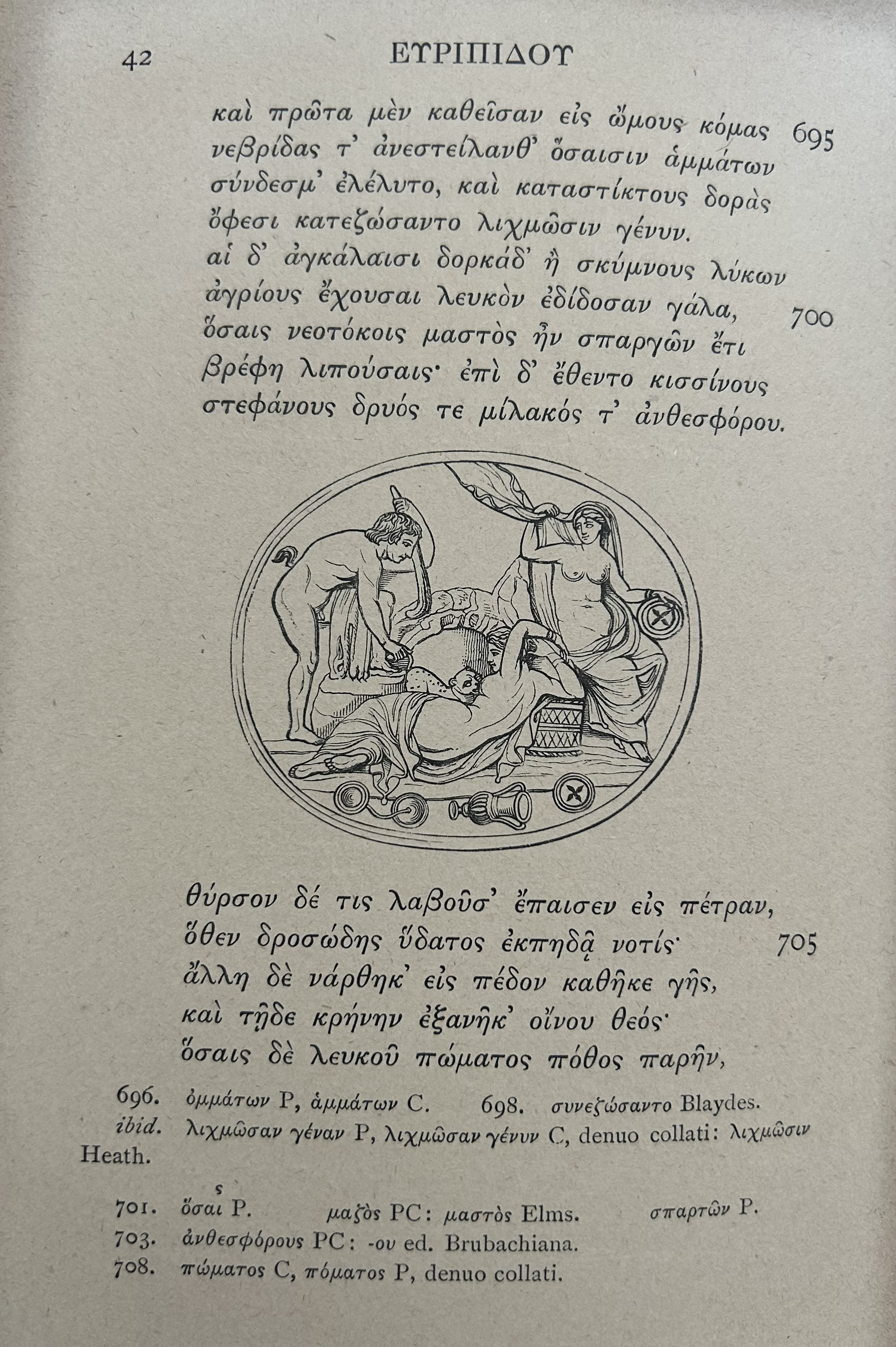
According to Sandys, Euripides composed the play The Bacchae in 407 BCE in a compliment to his patron King Archelaus. The conclusion of the play was purposed to haunt the Muses of Pieria, which was part of the king’s dominions—the hallowed slope of Olympus (the most prominent object of the Pierian landscape); and to the swift stream of Axius between the Scardus and Orbelus ranges, in the primitive seat of Macedonia (xxxviii). This plain of lower Macedonia is celebrated by Euripides as “‘the land of noble horses,’ ‘fertilized by fairest waters’ “(Tozer, Geography of Greece, pp. 200-202).
The theme of The Bacchae would have found an appreciative audience in Macedonia who would have been well acquainted with the story of Lycurgus and the legend of Pentheus. The worship of Dionysus, the protagonist in The Bacchae, would also have been met with an enthusiastic reception here.
Who invented the myths of the Greek gods?
Much credit is given to Homer as the creator of the myth of Greek gods in the 8th century BCE through storytelling and oral traditions (both single-author and collective-author theorist); I have always assumed it was Homer. However, as I have just discovered, the myths of the Greek gods were not invented by a single individual but developed over centuries through a combination of cultural, religious, and literary influences. Over time, these stories evolved and were adapted by various poets, bards, and playwrights, such as Hesiod, Aeschylus, Sophocles, and Euripides, who added their own interpretations and hyperboles.
The Origins of Dionysus
Euripides was not the first to write of the Greek god Dionysus. Hesiod, an early Greek poet who lived around the same time as Homer, was possibly the first playwright as he briefly refers to Dionysus in his poem “Theogony” as the son of Zeus and the mortal woman Semele.
Homer: In the Iliad, Dionysus ‘son of Semele’ is described as a ‘joy to mortals’ (XIV 325). As Andromache rushes forth from her loom to learn the fate of Hector, the poet compares her to a wild maenad. The second reference is in the flute of Dionysus’ worship from the music of Ilium heard in the Grecian camp by the sleepless Agamemnon. Here Homer assigns the instrument to the Trojans only, not the Greeks. (Schechner, 125).
The Bacchae
In The Bacchae, Euripides revolves his play around the god Dionysus, the deity of wine and revelry. He is seeking vengeance upon Pentheus, king of Thebes, by unleashing a frenzy of wild women from the city into the wilderness in a display of devotion.
In Euripides’ play, Dionysus is depicted as a complex and mysterious figure who introduces his worshipers, called Bacchae or Maenads, to frenzied rituals involving wine, dance, and music which lead to a state of ecstasy with the divine.
Pentheus then attempts to suppress this Bacchaic cult. Dionysus’ manipulation of events shows his divine power of divinity and humanity. Dionysus lures Pentheus into disguising himself as a woman and observing the Bacchic rituals on Mount Cithaeron. In doing so, Dionysus manipulates Pentheus’s arrogance and curiosity, ultimately leading to the king’s demise as his mother, Agave, driven by the Bacchic frenzy, unknowingly kills him, believing him to be a lion.
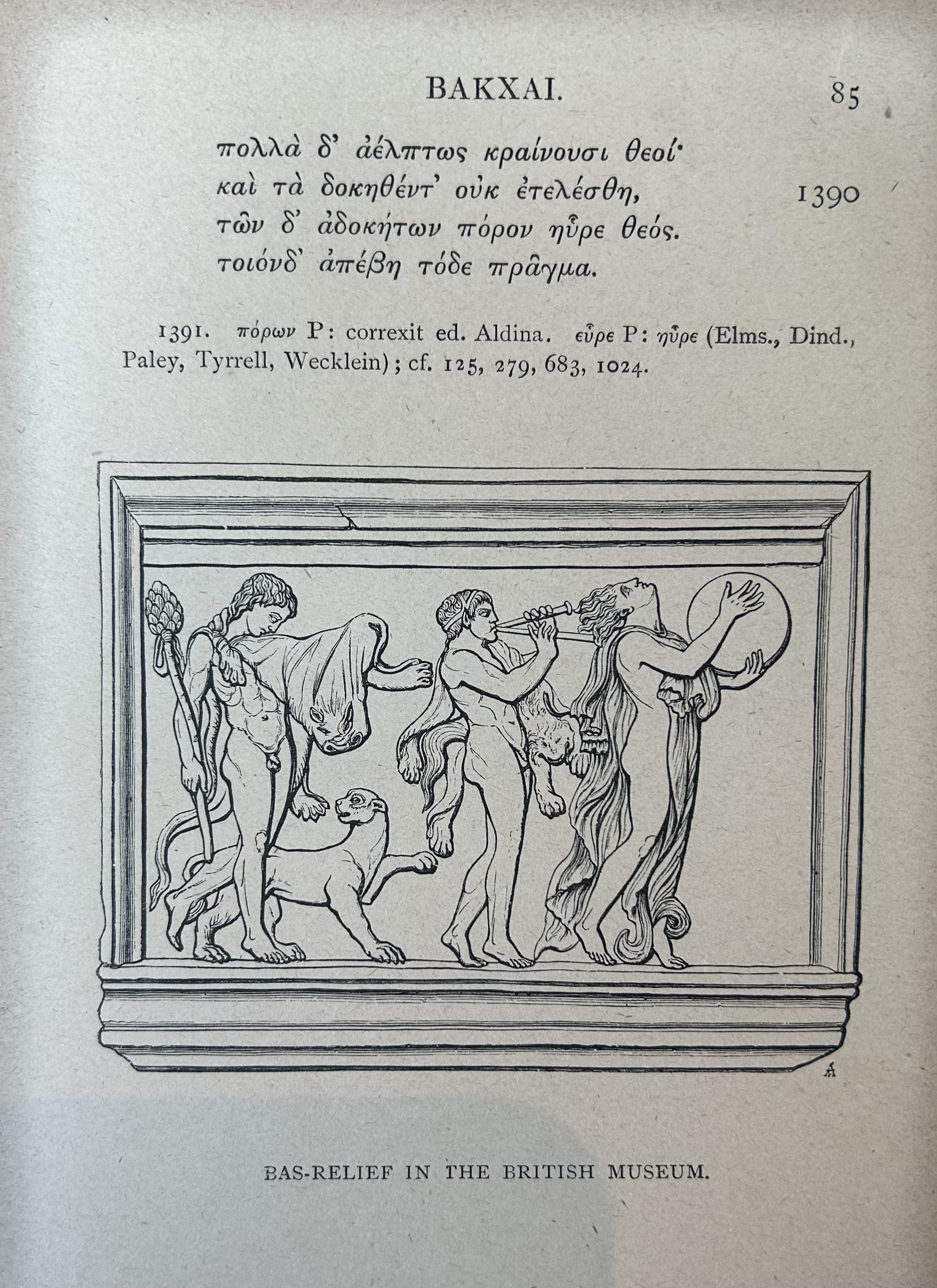
Sandys’ states that Euripides is showing the revelry between the Dionysian and the Apollonian order—between the mortal and divine realms. The character of Dionysus in The Bacchae has fascinated scholars and artists for centuries due to its exploration of the interplay between ecstasy and restraint. Euripides shook the Greek world as his play represented a form of religious ecstasy and liberation that challenged the structured and established Greek pantheon. This led to discussions and reflections on the nature of divinity, the legitimacy of different religious practices, and the role of gods in human affairs (Sandys,42).
Greek gods in a time of Yahweh
As I was reflecting on the god Dionysus from Euripides’ play, I thought about the Greek world, both historical and Biblical, at that time. When the Greek gods were introduced by Hesiod, around 8th century BC, the Temple in Jerusalem had just been completed, David and Solomon had been ruling in Babylon, [this was the time before the Prophets Elija, Elisah, Joel, Isaiah], Rome was founded by Romulus (750ish BC), First Olympic games (776), and the Greeks would soon dominate the world: Sparta, Corinth, Crete, Ephesus, Troy. The Jewish people, who worshipped Yahweh, were centered in the Kingdom of Judah and Israel in the eastern Mediterranean region and the Greeks, who worshipped/recognized Zeus (?) were primarily in the Greek city-states. The Jewish people worshipped Yahweh. Hebraism vs Hellenism.
In addition, the Kingdom of Israel was conquered by the Assyrians which led to the dispersion of the ten tribes of Israel. Some of these displaced people could have come into contact with neighboring cultures, including Greek ones. [The major period of Greek-Jewish interaction would come later, during the Hellenistic era, which began in the late 4th century BCE after the conquests of Alexander the Great, which saw the spread of Greek culture throughout the conquered lands, including the eastern Mediterranean where the Jewish communities were situated. The translation of the Hebrew Bible into Greek (the Septuagint) and the establishment of Greek-influenced cities like Alexandria in Egypt are notable outcomes of this period.]
Whew. In Schechner’s, The Bacchae: A City Sacrificed to a Jealous God, he contrasts Dionysus to the God of the Old Testament:1) Dionysus recognizes other divinities—but he still requires to be first in the Pantheon, above Zeus; 2) He is a capricious god which leads to his immorality; 3) His laws are improvised; and 4) He is humiliated.
A few years back, I did a deep-dive into the gods and men of Homer and the Apostle Paul [see post] in which I looked at the pagan traditions of the Greek gods in the world in which Paul and Barnabas traveled and preached the Gospel of Jesus Christ.
Sandys ends his critical essay with a tribute to one of the most famous Greek playwrights, even to this day. Euripides died in BC 406 at 75 years old and was buried in Arethusa at a spot where two streams meet: one with healthy water, one was death to drink. His tomb was struck by lightning. Upon hearing of his death, Sophocles put on the mourning at a public theatre where he ordered the actors and chorus to lay aside their crowns; and all the people wept.
His countrymen built a cenotaph in his honour with the following inscription:
Euripides, all Hellas is a monument to thee;
Thy bones hath Macedonia, that saw thy latter days,
And yet, thy home was Athens, the heart of Hellas she,
And thou, the Muse’s darling, hast won the meed of praise.
Works Cited
John Edwin Sandys LITT.D. Ευριπίδης Βάκχες The Bacchae of Euripides. Fellow and Tutor of St John’s College and Public Orator in the University of Cambridge, Hon. LITT.D. Dublin Examiner in Greek in the Victoria University and in the University of London. Cambridge University Press, 1900. PA3973.B2 1900.
Richard Schechner. The Bacchae: A City Sacrificed to a Jealous God: The Tulane Drama Review , Jun., 1961, Vol. 5, No. 4 (Jun., 1961), pp. 124-134 Published by: The MIT Press Stable URL: https://www.jstor.org/stable/1124822
 My French Quest