
La Galerie de Paléontologie et D’Anatomie Comparée, Paris
When visiting Paris, where would one go to see Dinosaurs, Whales, and Ammonites? When visiting Paris, why would one go to see this collection?
One of my favorite places to visit in Paris is La Galerie of Paléontologie et D’Anatomie in the Jardin des Plantes (Latin Quarter, rue Cuvier and rue Linée). This Royal Garden was created by Louis XIII in 1635 to constitute a reservoir of plants useful to health and to train doctors, apothecaries, botanists, chemists, and anatomists. It continues to be a place of training today!
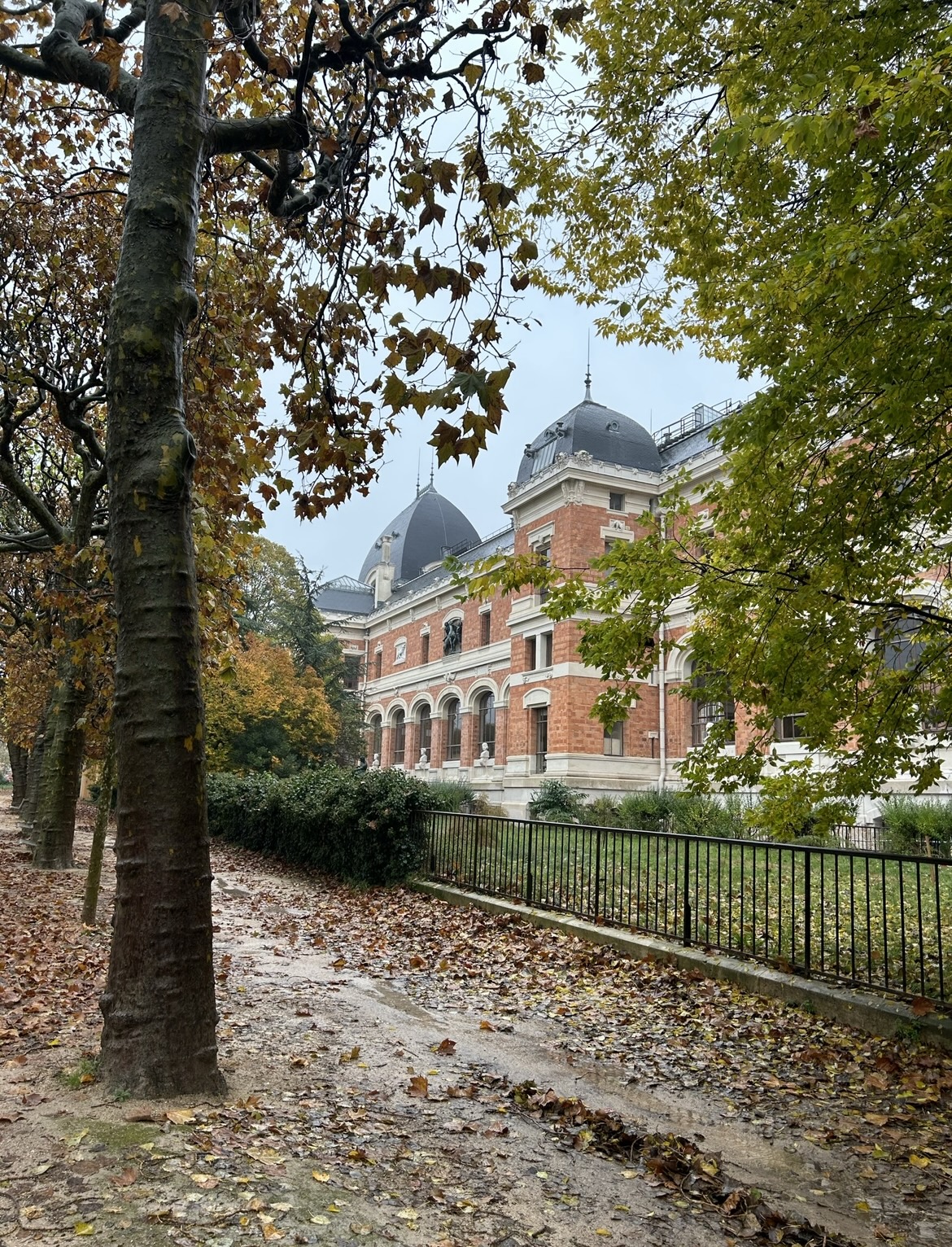
The Galerie has a famous collection of fossil vertebrates, invertebrates and plants that attempts to restore a temporal order of the history of Life and the Earth and how they mutually influence each other. Etienne Geoffrey Saint-Hilaire, professor of zoology of mammals and birds, and Georges Cuvier, professor of comparative anatomy and founder of vertebrate paleontology and botany created the first laboratory in the Galerie to study animal life.
Etienne Geoffrey Saint-Hilaire and Georges Cuvier
I first became acquainted with Saint-Hilaire after reading Nina Burleigh’s Napoleon’s Scientists and the Unveiling of Egypt. In 1798 Napoleon Bonaparte led 50,000 soldiers across the Mediterranean in the ongoing competition among European countries to claim territory. Egypt was then a gateway to Africa and Asia and the Nile provided great resource. According to Burleigh, one of the main reasons for Napoleon to claim the territory of Egypt was to beat the British there (36).
For me, however, the most fascinating reason of Napoleon’s expedition to Egypt was, just as his hero Alexander the Great before him, Napoleon would take over 50 “Savants”on this journey which included scientists, artist, philosophers and botanists. After three years of hunger, hardship, uncertainty and disease, these French scholars would return to France with
After three years of hunger, hardship, uncertainty, and disease, these Savants would return to France with their research and specimens. Two of these Savants were Geoffrey Saint-Hilaire, who would procure collections of flora and fauna and, with his collaborator and fellow botanist Georges Cuvier, would install this data and specimens in the Jardin des Plantes, Cuvier in La Galerie de Paléontologie et D’Anatomie Comparée. Hilaire stated about this expedition,
“The beauty of the sky, the perfume of oranges, the softness of temperature, add more agreeableness to these gatherings, sometimes prolonged into the middle of the night. It is our garden of Academus. More great thoughts, more true philosophy, more scientific discoveries are being born… (73).”
Geoffroy Saint-Hilaire would write of his theory of animal organization after he returned from this expedition and become a member of L’Institut de France in which he would also receive a professorship.
Just as in my purpose for my Frenchquest, I felt a connection to these explorers, scientists, who were on their own quest of discovery. The idea that these savants were able to travel with the Emperor Bonaparte-most of them personally chosen by him-to an unknown world is exciting! There previous knowledge came from years of studying the discoveries of others; books and specimen’s that were available to them. This was now a chance to make discoveries of their own, in the Far East, and to publish their impressions of these discoveries for the future worlds.[For more on Napoleon’s expedition to Egypt, see my post from 2019]
**Fun fact, the Obelisk in Place de la Concorde was brought back to Paris from Egypt by Napoleon’s troops.
For those of you who faithfully follow my blog, you will note that close to one-half of my posts are related to the Jardin des Plantes in Paris including: Victor Hugo’s poems about his daily strolls in the Jardin with his grandchildren [see post]; the Galerie d’Evolution (this post) the influence of the study of the unity species on Balzac’s La Comédie Humaine; and my own personal experiences as this was my neighborhood garden when I lived in Paris. This wonderland has been a great influence on my Frenchquest.
La Galerie de Paléontologie et D’Anatomie Comparée
For this blog, I am referencing La Galerie de Paléontologie et D’Anatomie Comparée, a guidebook that I purchased on my last trip to Paris in November.
For this post, I will highlight my favorite exhibits in the Galerie: the Cetaceans, a Diplodocus, and Ammonites.
Cetaceans
I have always loved whales. As a young aquaphile, I spent many hours underwater, in somersaults and dives, descending to the deepest point in the pool as my lungs allowed, eventually competing on my high school swim team just to be near water. In some ways, I longed to imitate these Cetacea mammals in a world of movement and silence.
This love of all-things-whales led me to Melville’s experiences as a New England Whaler in his novel Moby-Dick. I first read the abridged version in high school; but returned to this 1,946-page tome with a new appreciation and verve in May, 2018. Herman Melville studied the works of Cuvier while writing Moby Dick and these are a great companion piece while reading the novel.[see my posts on Moby Dick].
The first time I visited La Galerie of Paléontologie, I was mesmerized by the collection of whales from all over the world, in all climates, and at all depths. These Cetaceus fossils were brought to the Galerie by George Cuvier in 1802 and opened to the public in 1806. In this grouping, one finds cetaceans which still have hind limbs, from the Cynthiacetus as well as those without. The more recent cetaceus fossils have disc-shaped terminal vertebrae, or front limbs, which transformed into swimming paddles.
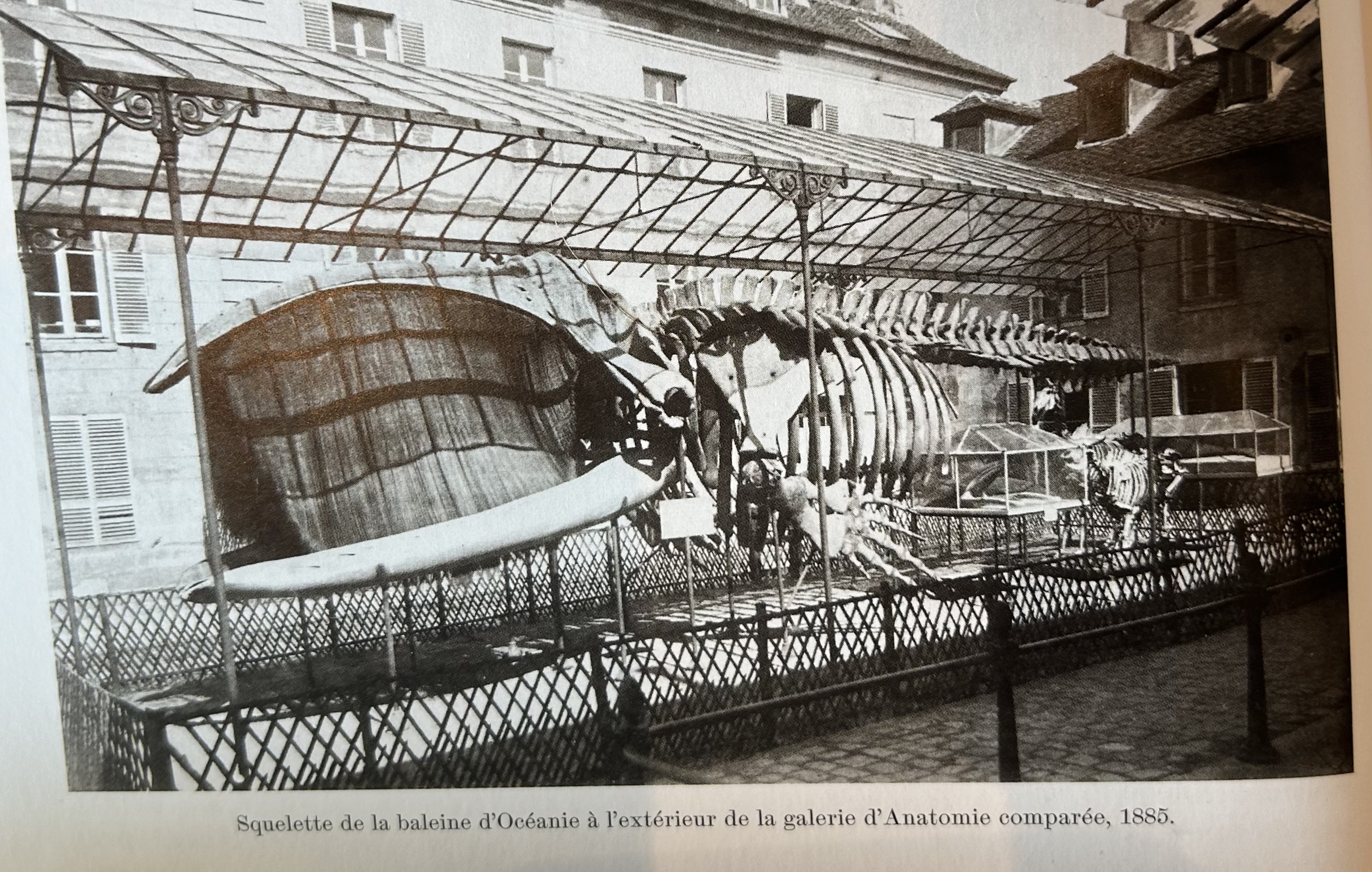

The skeleton of the Oceanian whale on the first floor is one of my favorite exhibits.
Dinosaurs

One flight up, is La Galerie de Paléontologie, which is the home to Dippy, my Diplodocus. I saw my first model of a Diplodocus at the 1964 World’s Fair in New York City and brought home a green, plastic replica as a souvenir and have been fascinated with dinosaurs since. Now that I have three grandsons, George, Jack, and David who love dinosaurs, it has been a fun connection. And now, I can visit the skeleton of an actual Diplodocus offered to the Galerie by Andrew Carnegie in 1908. In this Galerie, Dippy has many friends—a T Rex, Allosaurus, Iguanodon, Triceratops, Carnotaurus, Tarbosaurus, and several fossils of extinct animals like Sarcosuchus, Woolly Mammoths, and many others.


AMMONITES

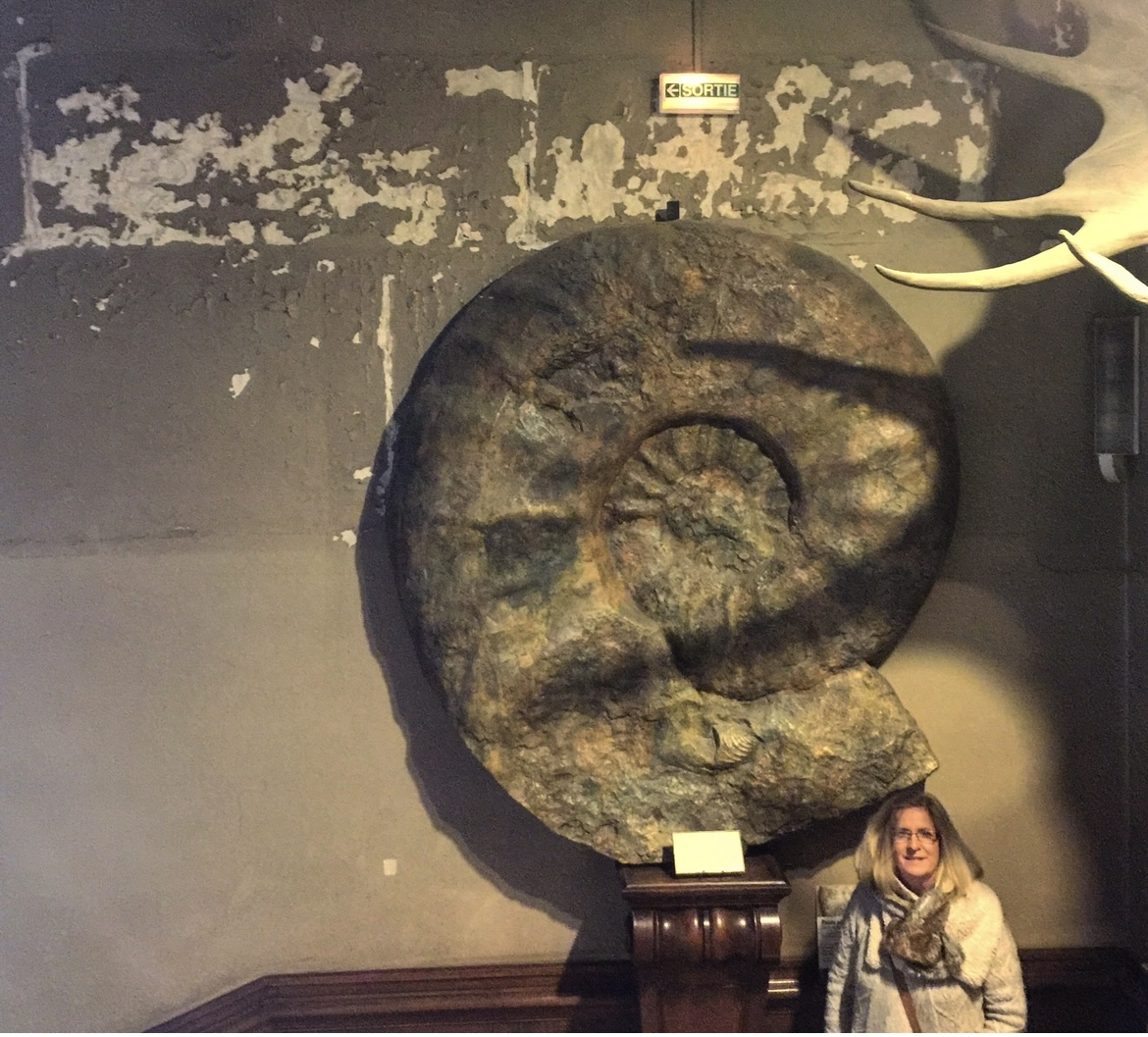
In 1982, a retired science teacher gave me several fossils that she found when digging up potatoes on her farm in North Texas. She used these fossils in her classroom when teaching science and wanted to pass this treasure on to me. And oh, what a treasure: Ammonites which possibly developed during the Mesozoic period and populated all the seas of the world. During the 150 million years of their presence, their shells have a wide variety of sizes, (from a few millimeters to almost two meters-see photos below), shapes, and ornamentation (La Galerie 78). So that’s pretty cool.
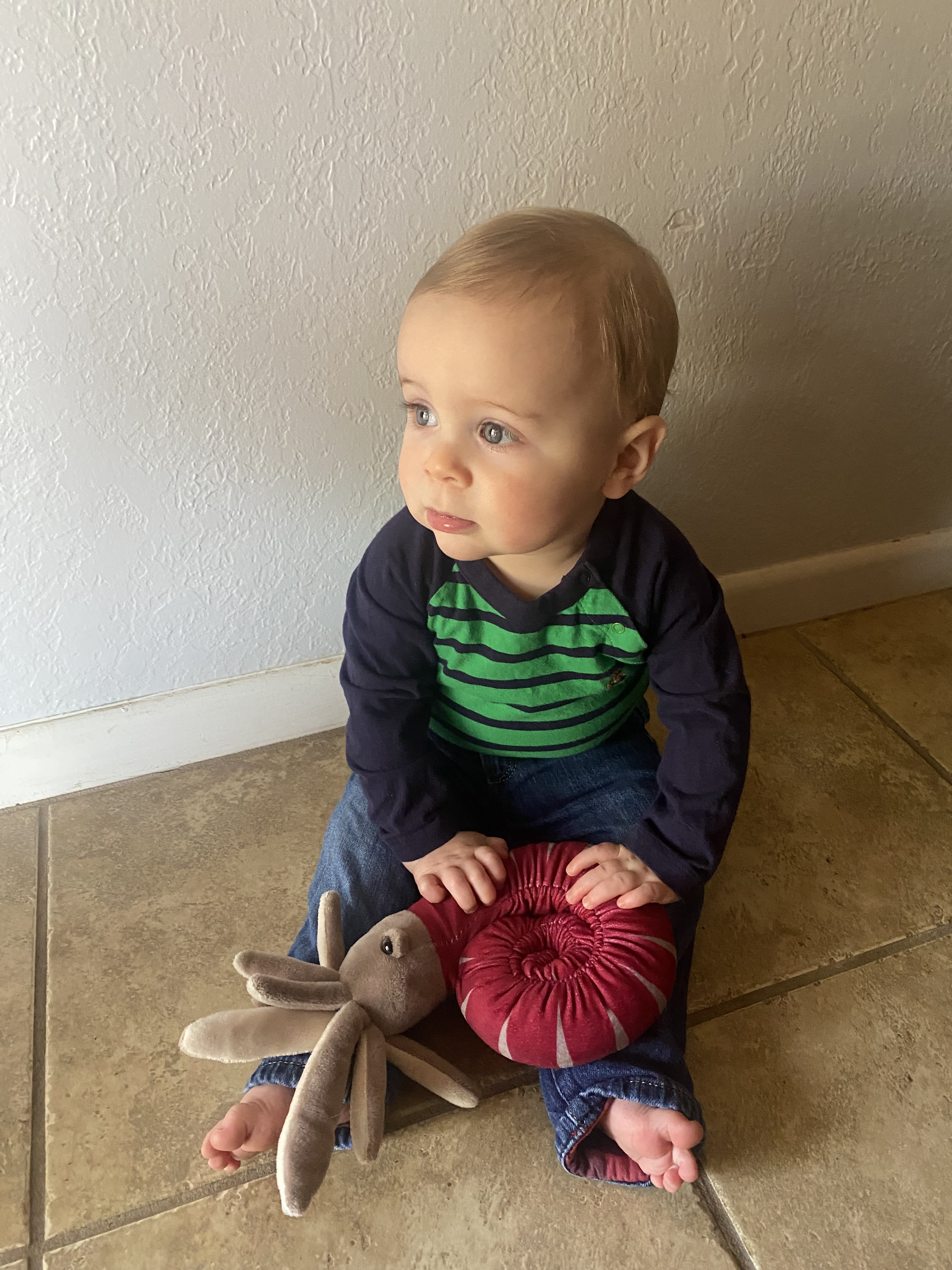
Imagine my exhilaration when I climbed to the deuxieme etage of the Galerie, or third floor, and found a room FILLED with Ammonites! Row after row of cabinets with specimens of ammonites labeled with their age and location of discovery. Oh my, to have one of my ammonites in this collection would be ideal. But alas, a greater purpose for these extinct fossils has been to share them with my grandchildren as we explore the mysteries of our world!

Work Cited
La Galerie de Paléontologie et D’Anatomie Comparée.Museum Naturelle, 2018.
 My French Quest
Thanks 👍
Looks like you had a most interesting time in that boneyard!
Do you think the Raiders of Egypt and India, should give back their trophies they carried back to Europe!
Many of these treasures, according to Nina Burleigh, have been returned. Yes, I believe that history should be preserved in a culture; but sadly, due to wars and even political divisiveness, these monuments are destroyed.
I believe your are right about this.