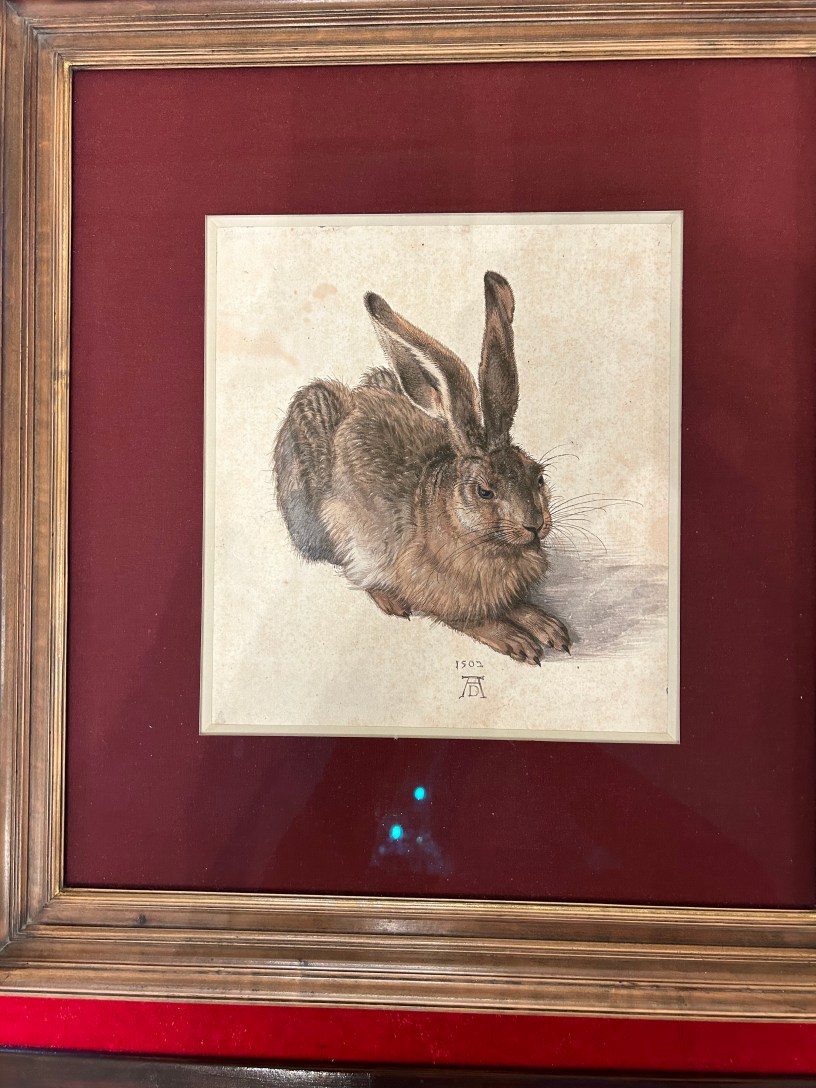
Young Hare is my favorite watercolor by Dürer. I was immediately drawn to the details, almost photographic, of the hare’s fur which lay in different directions with mottled patches of light and dark. How does Dürer manage to keep the hare still in order to sketch it? Is this from memory or imagination?
In Dürer, Peter Striederk, a leading Dürer scholar and head conservationist and vice-director of the German National Museum of Nuremburg (in 1976), walks the reader through the techniques which Dürer used in this still-life watercolor,
“The combination of watercolor, which allows the colors to blend into one another, with the technique of using a pointed brush and opaque colors to draw in details with meticulous accuracy makes the creature’s fur look so soft, that you feel you could touch it”(136).
This is an almost scientific study of the animal but with a warm glow of yellow hues. He is so lifelike, cowering timidly, warily on the lookout and ready to leap up and race off. The reddish and grayish tones stand out from the white of the paper. I was able to view the original watercolor in April of last year at the Albertina! So cool.
The watercolor of a hare bears the date 1502 and Dürer’s monogram, “so he clearly thought of it as an independent work of art”, explains Strieder, “thus raising the animal kingdom to the level of valid subject matter for a work of art”(134).
The effectiveness of this watercolor lies in the fact that it records and reproduces the hare’s appearance and characteristic features in a lifelike manner. Strieder supposes that Dürer must have used a stuffed hare as a model, but there is no trace of taxidermy in the finished drawing (136).
This drawing of the hare has been reproduced so often, usually out of context with the rest of Dürer’s work, that many people wrongly believe that Dürer had an idyllic view of nature. He was particularly preoccupied with discovering and studying nature early in his career stating in his Treatise on Proportion:
“But life in nature manifests truth of these things. Therefore observe it diligently, go by it and do not depart from nature arbitrarily, imagining to find the better by thyself, for thou wouldst be misled. For verily, art is embedded in nature; he who can extract it has it” (136).
Work Cited
Peter Strieder (1976). Dürer. Verona Italy: Masters Works Press.
 My French Quest