You have a thought. You want to communicate that thought. You need language to communicate it. And you need reason to communicate language—Herder.
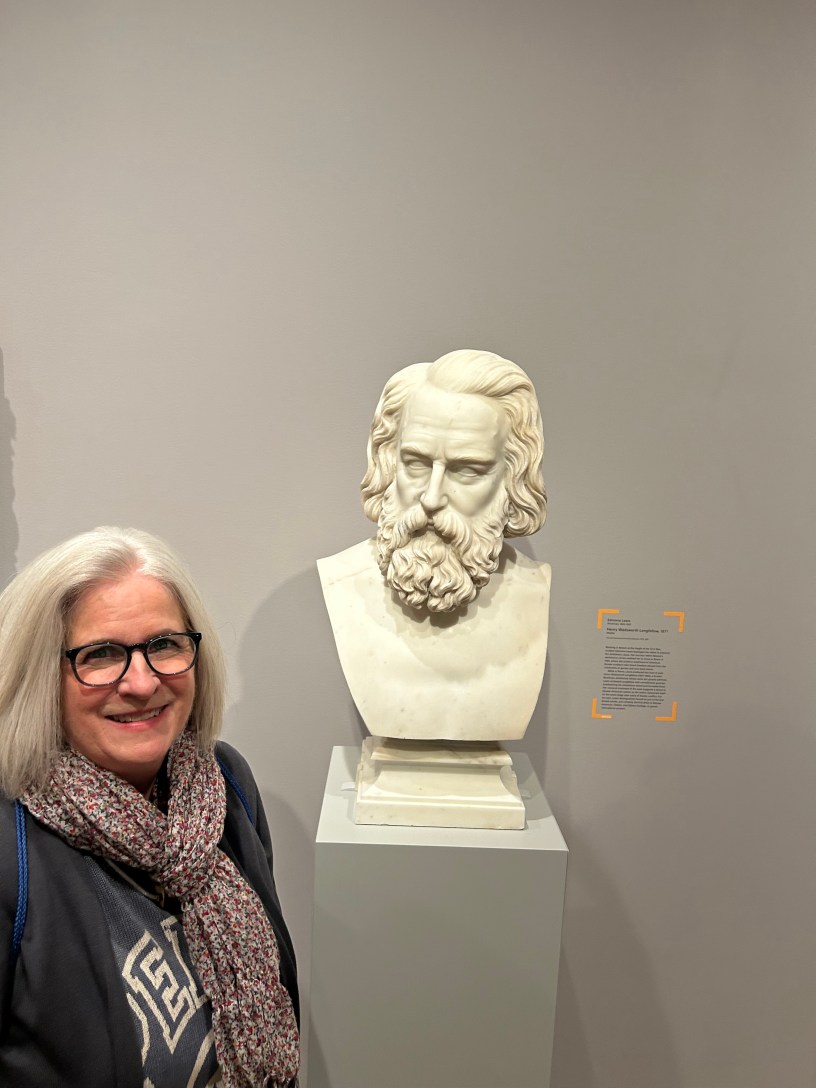
I recently revisited one of my favorite books by my favorite author in my library– Henry Longfellow’s The Poets and Poetry of Europe. I am always delighted to explore this compilation of rich European literature (all 800 pages) through Longfellow’s translations and discover new treasures to invest my time in! My new discovery: the German writer, Johann Gottfried Von Herder. This recent visit to his early nineteenth-century works and scholarship did not disappoint.
This book is the arduous labor of Longfellow, the result of his three years of study, travel, and observation abroad, establishing new standards of academic achievement for himself and for the institutions where he would later teach.
Longfellow made an important discovery while visiting Germany in his time abroad: “As to studying at a German university, there is absolutely more learning in Germany than in all the rest of the world” (The Poets, 62).
I love that Longfellow became immersed in these cultures to better understand the origin of languages. He also studied these languages to better understand the challenges his students faced in second language acquisition.
One of Longfellow’s favorite cultures and languages to study was German. He first introduced German as a subject of study at Harvard in 1825. Even though American scholars had been reluctant to encourage German literature in university life due to their doubts about the religious and moral views of these works, interest in German subjects was rapidly increasing.
Longfellow offered six lectures on German literature, mainly works by Goethe.
For this post, I am examining the works and philosophy of Johann Gottfried Von Herder from Longfellow’s study and translation.
In addition to Longfellow’s The Poets and Poetry of Europe, I will be referencing a scholarly Journal on Herder’s Philosophy of Language, Interpretation, and Translation: Three Fundamental Principles by Michael N. Forster (The Review of Metaphysics, JSTOR, 2002).
According to Forster, Herder was one of the first to study modern philosophy of language, interpretation (“hermeneutics”), and translation, and has many things to say on these subjects. As a Linguist and Translator, I find this subject absolutely fascinating!
Language and Cognition
“Language is the form of cognition, not merely in which but also in accordance with which thoughts take shape, where in all parts of literature, thought sticks to expression, and forms itself in accordance with this. Language sets limits and contours for all human cognition,” states Herder (Forster, 325).
What exactly is the connection between language and mode of thought? Herder was greatly influenced by French authors on the origin of human knowledge, which argues that whoever surveys the whole scope of a language surveys a field of thoughts, and whoever learns to express himself with exactness precisely thereby gathers for himself a treasure of determinate concepts (325).
Through this influence on human knowledge, Herder adopted a doctrine on the philosophy of language by observing an infant’s ability to reason without a grasp of language. For example, can an infant have a thought without the acquisition of language? If there is no language, then what are their thoughts composed of?
We know that newborns are unable to communicate without language, but are they able to reason their thoughts without language? Herder asserts that children who do not have a grasp of language cannot reason…it is demonstrated that reason, self-consciousness, slumbers when they cannot imitate. When a child attains their mental constitution, they learn to speak and, precisely as a result and in the same way, to think. Whoever has observed children, how they learn to speak and think, the peculiar anomalies and analogies which are expressed in the process, will hardly have any further doubts (338).
Okay, stay with me!
When I first began learning French at 42, I felt like an infant who could not understand or communicate with a native French speaker. Even after I spent years amassing vocabulary, studying grammatical rules, conjugating verbs, listening to conversations on tapes (yes cassette tapes!!), I still struggled with reasoning, thinking, and communicating in this second language. I am confident that I have reached Gladwell’s “10,000 hour” mark in learning French, which included living in Paris for six months and studying in a graduate program at the Sorbonne; however, it has taken many years to think and reason like a native French speaker and translate works of literature from French to English.
Language, Cognition, and Translation
The part of Herder’s doctrine that is of most interest to me is his philosophy of language and his theory of translation. Herder’s fundamental principle of the theory of translation states that “translation’s goal of faithfully reproducing a work’s meanings in a different language requires a reproduction of the original work’s usages, which, if they are not already afforded by the language into which the translation is to be done, must be achieved by a ‘bending’ of the closest pregiven word-usages from this language performed over the course of the translation”(343).
Concerning the connection between language and thought, Herder asserts that whoever learns to express himself with exactness precisely gathers for himself a treasure of determined concepts; “The first words that we mumble are the most important foundation stones of understanding”(344).
If concepts or meanings are just usages of words, and “grasping concepts or meanings” is being competent in usages of words, then the linguistic dependence on these concepts and meanings is essential, Herder explains.
The third doctrine and most important, according to Forster, is in the philosophy of language: the theory of meanings or concepts, according to their nature, based on “perceptual sensation”(351). For example, in his essay On the Origin, Herder acknowledges that animals and people just beginning to learn language do have “sensations” of a kind. But the process of language acquisition transforms the nature of a person’s sensations. Consequently, Herder’s position (similar to Hume) is that a person has the sensations first and then the concepts follow. In looking back at his theory of language acquisition in an infant, this makes sense. An infant will experience sensations of hunger, pain, sleepiness, isolation, fear, etc., and then will establish the concept of need-based reactions in order to ease or abate these sensations before any language-learning can occur.
Translation
Herder’s third doctrine, the philosophy of language, has important consequences for the theory of interpretation and translation in understanding another person’s concepts. Herder explains that an interpreter “must not only master the person’s word-usage in an external way but must also, in some manner, recapture the person’s relevant sensations”(354).
Herder states that in order to really understand the Greeks, we must learn to “see like them”. People’s concepts of happiness and pleasure are based on “temperament”, “feeling nature”, and “sense of rapture”. We must recapture these affective states of their imaginations (354).

[I found this to be true when interpreting Victor Hugo’s Le Poème du Jardin des Plantes, which he wrote 150 years ago! Hugo daily walked the paths of this incredible garden with his grandchildren, who he was raising, George and Jeanne, after the untimely death of their parents. In order to “recapture the relevant sensations” of Hugo, as Herder describes, I visited the Jardin in 2017 before I began the translation of Hugo’s poems [see post]. I walked these same garden paths that led to a Ménagerie, which was built in 1794, the second oldest zoological garden in the world (the first is the Tiergarten Shönbrunn, Vienna).

I go to this garden because it is pleasing/To Jeanne, and that I am helpless against her/ I’m going there to study two chasms, God and childhood.—Hugo
I translated the whole book of these lovely poems after this trip to the Jardin des Plantes, Paris, and tried to paint the images in English through Hugo’s eyes and “sensations” as he communicated this historic world to his grandchildren!]
Longfellow and Herder
I am grateful to Longfellow for introducing me to Herder. In the section on “German Poetry”, Longfellow gives a short biographical sketch of Herder, highlighting his “sublime genius” in his works on the Bible, on politics, on education and manners. “All these works are distinguished both by the truth and clearness with which the subjects are brought and never leave an unsatisfying feeling behind (Longfellow, The Poets and Poems of Europe, 269). Longfellow translated the following poems of Herder from German to English: “Voice of a Son”, “Esthonian Bridal Song”, “Chance”, “To a Dragon-Fly”, “The Organ”, and “A Legendary Ballad”(my favorite—a tribute to Mary and her baby Jesus).
Works Cited
Herder’s Philosophy of Language, Interpretation, and Translation: Three Fundamental Principles Author(s): Michael N. Forster Source: The Review of Metaphysics , Dec., 2002, Vol. 56, No. 2 (Dec., 2002), pp. 323-356 Published by: Philosophy Education Society Inc. Stable URL: https://www.jstor.org/stable/20131819
Longfellow, Henry W. The Poets and Poetry of Europe: Philadelphia: Carey & Hart, 1845.
 My French Quest