Summer Reading 2023 from SMU Fondren Library Permanent Collection
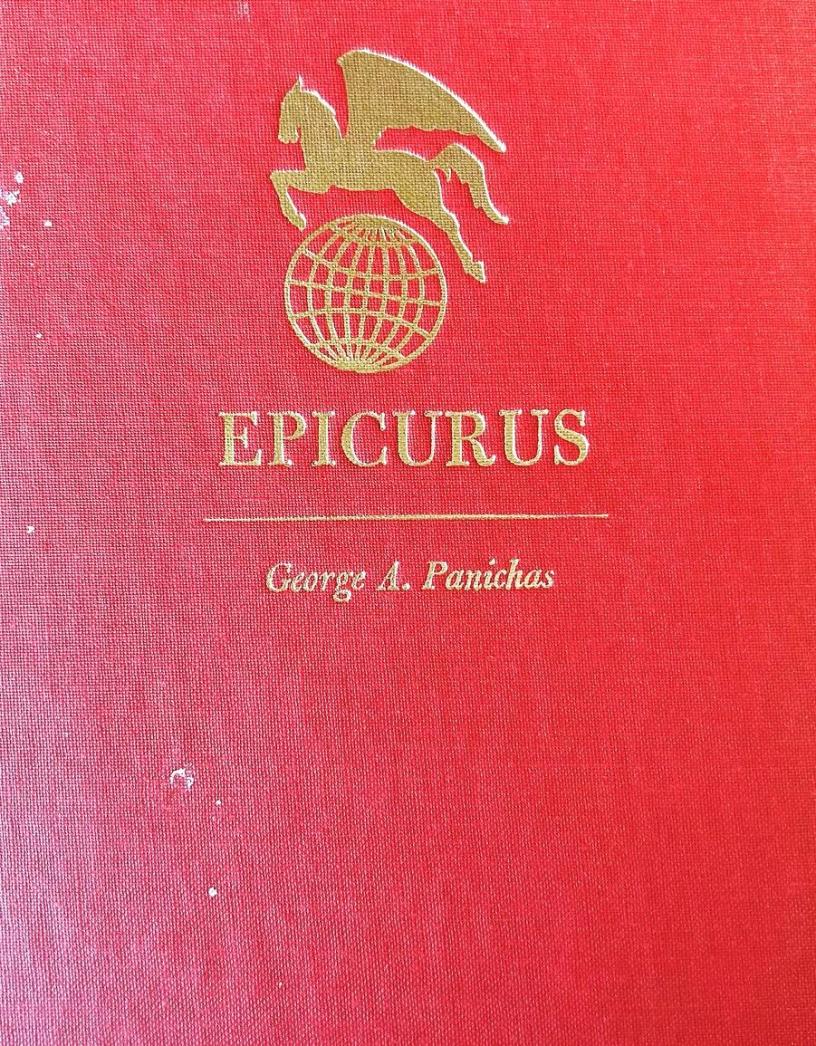
My third Summer Read from the SMU Fondren Library collection is a critical study of the Greek Philosopher Epicurus, who had a significant influence on Western civilization in the 4th century BC. When I first saw this book, my immediate thought was the quote “eat, drink, and be merry, for tomorrow you will die” which I wrongly attributed to him. His teachings were adopted by many of the ancient Greek thinkers such as Aristotle and Plato, and they continue to influence modern thought today.
Epicurus was born in Samos Greece in the fourth century BC. He wrote over 300 works (on “rolls”) which unfortunately, except for writings preserved by Diogenes Laertius, Herodotus, Pythocles, and Menoeceus, only few have survived. He wrote about the sciences–natural philosophy, meteorology, ethical theory—and the soul—happiness, friendship, and theology.
Epicurus was not well thought of according to the 3rd century Greek Biographer, Diogenes Laertius. He was regarded as a “flatterer of persons in important positions, a plagiarizer of the doctrines of atoms and pleasure, a teacher of effeminacy, a lewd letter-writer, and a nasty name-caller” (17). So how could someone so disrepute in the 4th century still be so renowned today?
Based upon this critical essay, Epicurus, by George A. Panichas, Epicurus’ teachings about the importance of pleasure and the avoidance of pain have been highly influential in modern philosophy, psychology, and even economics. Despite his apparent moral shortcomings, Epicurus’ philosophy has lived on and continues to shape the way people think about life and the pursuit of happiness.
For this blog, I will focus on the following philosophies of Epicurus which I find of interest!
Biblical reference
Some scholars attribute the writers of Ecclesiastes and Isaiah to Epicureanism. The writer of Ecclesiastes in 8:15 writes “Then I commended mirth, because a man hath no better thing under the sun, than to eat, and to drink, and to be merry: for that shall abide with him of his labour the days of his life, which God giveth him under the sun.” Even though this is similar to Epicurus’ philosophy of life, which was to focus on pleasure and happiness without indulging in excess–the happiest life was one that was lived with moderation, Solomon wrote this 400 years before Epicurus was born.
Epicurus believed that the highest pleasure was to be found in the pursuit of knowledge and friendship. He also believed that a life without pain was the greatest measure of happiness. This idea is echoed in Ecclesiastes 8:15, where the writer encourages people to find joy in life’s simple pleasures.
In addition, a second attribution to Epicurus by some scholars can be found in Isaiah chapter 22:13: “But see, there is joy and revelry, slaughtering of cattle and killing of sheep, eating of meat and drinking of wine! Let us eat and drink, you say, for tomorrow we die!” This statement is meant to be an example of how one should live life to the fullest, as death is inevitable. Epicurus also said that pleasure was the chief good and that one should strive for a simple life, free from fear and anxiety.
Did Isaiah use the teachings of Epicurus in Ecclesiastes? ? It is not possible as Isaiah was written in 700BC, again, 400 years before the birth of Epicurus.
Cosmology:
According to Epicurus, the natural laws that govern the universe are eternal and unchanging: “It is the task of natural science to determine with precision the causes of the most important phenomena and that our happiness is linked with a casual knowledge of the universe“. In his discussion of cosmology, he emphasizes the importance of mental composure and self-reliance and the study of the origin, evolution, and ultimate fate of the universe (61).
At the time of Epicurus’ writings in 300 BC, there had not yet been a Christian movement. According to Jewish belief of that time, God created the Earth, had a plan for the universe, and that it was His will that determined its fate. They believed that God had the power to intervene in the natural order of the universe and alter its course.
However, the Modern Philosophers of the day believed that the universe was created by something else. Philosophers such as these argued that the universe is governed by natural laws rather than by a divine being. They believed that the universe was infinite and eternal, and that the gods were symbols of the natural order of the universe. Furthermore, they believed that the universe was rational and that it could be understood through reasoning and logic.
Epicurus argued that the gods were distant and unconcerned with the lives of humans. He believed that the goal of life was to seek pleasure and avoid pain. Epicurus taught that pleasure was the highest good and that it could be achieved through living a simple life.
The Origins of Language (my wheelhouse!!):
Epicurus believed that words did not receive meanings by design; nor were the names of things created by convention. On the contrary, Epicures argues “on experiencing their own peculiar emotions and sensory impressions, uttered sounds conforming to these various emotions and impressions…corresponding to the geographical differences of the groups (58)”. These ethnic groups gave particular names to sounds as to make their meanings and intentions understandable and concise. (not unlike the Neanderthals who used vocalizations and gestures to communicate basic needs and emotions?)
Fast forward to the Greek language of Epicurus in 3rd century BC which was the standardized system of language developed by the Stoics, a group of Greek grammarians. The Stoics began to study the elements of language, including the sounds that make up words and developed a system of symbols to represent the sounds of speech, which they called “phonemes”. This system of symbols was the basis for the modern understanding of phonemes and the development of modern grammar. As the Stoics, began to study the elements of language using these phonemes, they were able to develop a more standardized language which also saw the beginnings of the Greek alphabet system (which is credited to Plato).
The Stoics believed that the alphabet could be used to represent the philosophical concepts they were advocating, and it was an effective way of expressing ideas and communicating their principles. This was seen as the first step to understanding and living in accordance with their philosophy. As a result, the Stoic alphabet system had a profound effect on the development of language and communication. So cool!
The Soul
As a Christian who lives in the 21st century, this chapter was very fascinating to me. As a Christian, I believe that following Jesus brings eternal life and forgiveness from sin. I have a personal relationship Jesus Christ based on faith. Because I grew up in a Christian environment with teachings and testimonies of this Faith, I learned about Jesus at an early age and had the opportunity to make a person commitment based upon this knowledge and the urging of the Holy Spirit working within me.
Who would have shared the message of Elohim, our Creator God, to the Gentiles at this time? If one was not of the Jewish faith, what teachings of God would they have access to? I do know that the Ancient Greeks were polytheistic, focusing on the worship of deities and heroes such as Zeus, Athena, and Heracles and that Zoroastrianism, Hinduism, and Buddhism. What were the religions in Greece in the 4th and 3rd centuries at the time of Epicurus, Plato, Aristotle?
Did the Greeks rely on the teachings of Homer from the 8th century BC, who wrote about the gods of Zeus, Poseidon, and Hades in the Iliad. Homer taught that the gods were real and powerful and could influence their destiny and were the ultimate authority in Greek society. The power of fate and destiny and were connected to natural forces and phenomena, such as storms, oceans, and earthquakes[ see my post “Did Homer use Biblical Language and Ideas in the Iliad?” ].
According to Panichas, although Homer sings of heroes and their exploits, he speaks of the mystery of what happens to the soul after death. Although his heroes are glorified in feats, he cannot escape the realization that there exists a realm in which “dwell the senseless dead” as Achilles tells Odysseus in his descent into Hades. (87). Life and death have been brough closer to life on earth but has also lost its power and intensity.
Epicurus’ concept of the soul, however, was in stark contrast with Homer’s concept of the soul as descending into the “hateful darkness” of the kingdom of the dead, ruled over by the detested Hades and Persephone.
He was also in contrast with Plato’s concept of the soul as finally descending into the light of a higher realm in a Heavenly Pilgrimage from which it originated (87). In Phaedo, life is preparation for death; death marks the point at which the soul in no longer ‘nailed and glued to the body’ and purity, eternity, and immorality are her kindred and with them she ever lives (89). Plato believes that the soul is older than the body. “That soul…herself invisible, departs to the invisible world—to the divine and immortal and rational (90)”.
Epicurus’ concept of the soul was as a healer of pain. His aim was always to overcome the enemies of happiness and tranquility; to lessen the pain of loss and to push aside the agitating desires for immortality that come with thoughts of the death of the body and the release of the soul.
Happiness–Some Epicureanisms:
“It is not possible to live pleasantly without living prudently and honorably and justly.”
“Pleasure is the highest good: it places resignation side by side with beatitude, melancholy with optimism; seeks its foundation in thought; is scornful of scientific truth; bases conduct on the knowledge of nature; combats superstition, and preaches a faith.”
“He who has learned the limits of life knows that that which removes the pain due to want and makes the whole of life complete is easy to obtain.”
“The stable condition of well-being in the body and the sure hope of its continuance holds the fullest and surest joy for those who can rightly calculate it.”
“Nothing is sufficient for him to whom what is sufficient seems little.”
Reputation and Influence
The spread of Epicurus’ doctrine and philosophy took place over seven centuries, especially between 300B.C. to 150 A.D. not only in Greece by in the whole Greco-Oriental world, in Rome, and Italy. As is obvious in previous sections, Epicurus clashed with Platonists, Stoicism, and also Christianity. His philosophy eclipsed during the thousand years of the Middle Ages. It is scorned in Dante’s Inferno but herald by Augustine.
Epicurus died 200 years before the ministry of St. Paul. Paul called himself “The Apostle to the Gentiles”: “He chose me to be a servant of Christ Jesus for the Gentiles and to do the work of a priest in the service of his good news. God did this so that the Holy Spirit could make the Gentiles into a holy offering, pleasing to him” (Romans 15:16, CEV). Paul was well aware of the teachings of Epicurus and the influence his philosophy had on the world.
In St. Paul and Epicurus, DeWitt argues that Epicurus acted as a bridge from Greek philosophy to the Christian religion. The Apostle Paul quotes Epicurus in his writings in Acts 17:18:
Some of the Epicurean and Stoic philosophers also conversed with him. And some said, “What does this babbler wish to say?” Others said, “He seems to be a preacher of foreign divinities”—because he was preaching Jesus and the resurrection.
“May we know what this new teaching is that you are presenting? You are bringing some strange ideas to our ears, and we would like to know what they mean.” (All the Athenians and the foreigners who lived there spent their time doing nothing but talking about and listening to the latest ideas.)
Paul then stood up in the meeting of the Areopagus and said:
“People of Athens! I see that in every way you are very religious. For as I walked around and looked carefully at your objects of worship, I even found an altar with this inscription: to an unknown god. So you are ignorant of the very thing you worship—and this is what I am going to proclaim to you.
“The God who made the world and everything in it is the Lord of heaven and earth and does not live in temples built by human hands. And he is not served by human hands, as if he needed anything. Rather, he himself gives everyone life and breath and everything else. From one man he made all the nations, that they should inhabit the whole earth; and he marked out their appointed times in history and the boundaries of their lands. God did this so that they would seek him and perhaps reach out for him and find him, though he is not far from any one of us. ‘For in him we live and move and have our being’ [Epimenides]. As some of your own poets have said, ‘We are his offspring’ [Aratus].
“Therefore since we are God’s offspring, we should not think that the divine being is like gold or silver or stone—an image made by human design and skill. In the past God overlooked such ignorance, but now he commands all people everywhere to repent. For he has set a day when he will judge the world with justice by the man he has appointed. He has given proof of this to everyone by raising him from the dead.”
Work Cited
EPICURUS: George A Panichas/ Twayne Publishers. New York, 1967


Intriguing overview, Robyn.
Thank you Mitch!