What would you consider to be the most important literary monument that the American mind has produced in all the periods of its history? This is intriguing: is there such a thing as an “American mind”? In relation to literature?
As a follow-up to my blog on the great National Epic of France, The Song of Roland, I am reviewing a treasure from my library, a 1901 edition of the great German epic Nibelungenlied. According to William H. Carpenter, Professor of Germanic Philology at Columbia University, the Nibelungenlied is one of the “most important literary monuments that the German mind has produced in all the periods of its history” (1901, Carpenter Intro to Nibelungenlied).
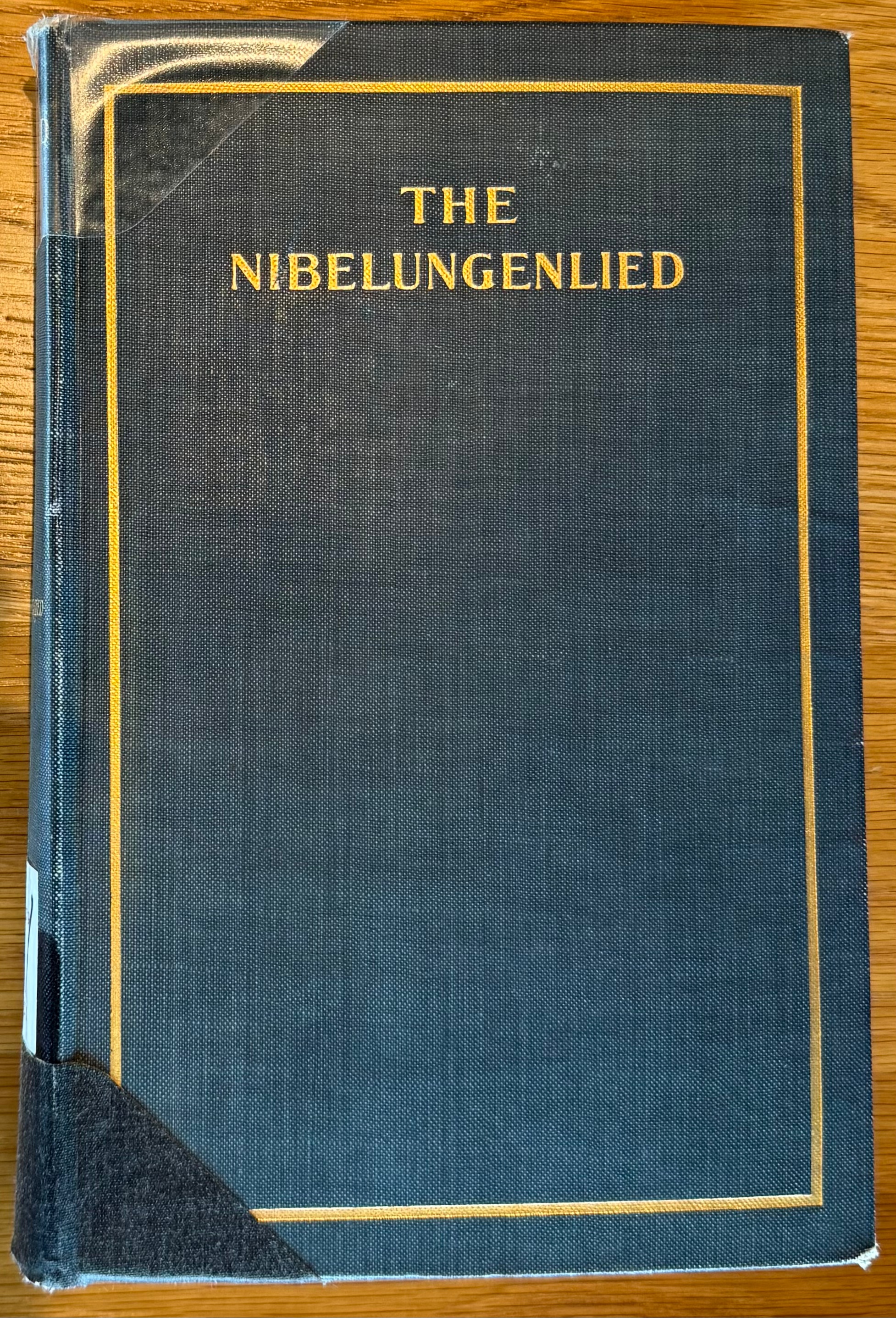
In addition to Carpenter’s Special Introduction, I will also include a review of Henry Longfellow’s notes of translation and an excerpt of Nibelungenlied that he included in The Poets and Poetry of Europe in 1845.
Carpenter defends his acclaim for this epic by stating that it is one of the world’s greatest classics “because of: the universal intelligibility of its story, the broad human sympathy which must be felt with its characters and their motives of action, and for the sustained poetic treatment of the whole in the long poem” (iii).
He compares the Nibelungenlied to the Iliad as the foremost picture of the national life and national soul. I see these same similarities in the French epic “The Song of Roland”. Roland was part of the medieval French environment in his manners and customs, his religion, and his ethics. This is also true of Siegfried, the hero of Nibelungenlied, for the fifth and sixth centuries of the Christian era in Germany.
In both epics, there is a real story of ancient inheritance that is tragic with battle, murder, and sudden death. Unlike Roland, who was believed to be a real knight, the story of Siegfried is a myth, a creation and impersonation of a poet’s imagination. In addition, the poets of both epics are unknown. Carpenter and Longfellow both believe that a single poet wrote The Nibelungenlied.
Nibelungenlied
The name Nibelungenlied is said to be derived from an ancient and powerful Burgundian race, whose terrible downfall is the subject of the work. The traditions upon which it is founded are connected with the old Scandinavian sagas, particularly the “Wilkina-Saga”(Longfellow, The Poets, 217).
The Nibelungenlied was first published in Zurich by Bodmer in 1757, in Middle High German. The first translations of parts of the epic in English were published by Weber in 1814 in Edinburgh and later by Thomas Carlyle in the “Westminster Review” in 1831.
The scene of the poem is on the Rhine, in Austria and Hungary. Siegfried is the son of King Siegmund and Queen Sieglind in the land of the Franks. The author is unknown but believed to have been an Austrian knight of about 1140. It was during this era of Germanic court lyric poetry, or Minnesangs Frühling, that the fullest expressions in all of its history of German life and thought were contained.
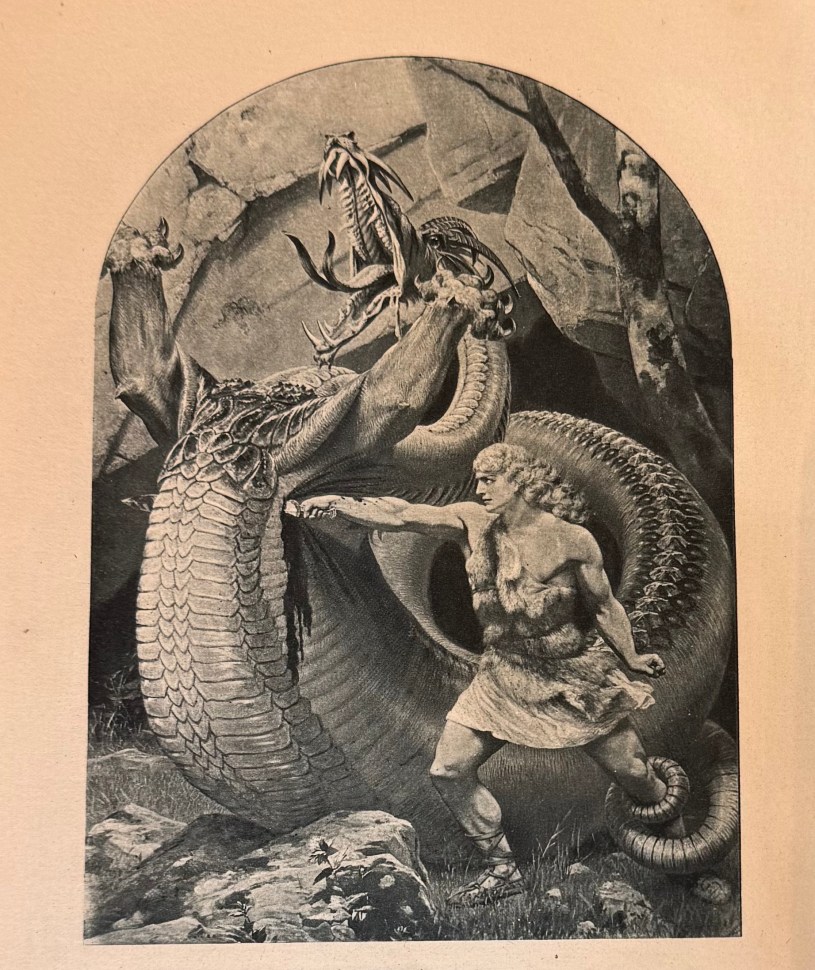
The central plot of the poem is that Prince Siegfried slays a dragon, gains a magical treasure (the Nibelung hoard), and bathes in the dragon’s blood. This renders his skin nearly indestructible. This “invisible cloak”, or Tarnkappe, allows Siegfried to perform valiant feats to support King Gunther and help secure and stabilize the Burgundian court. Even though Siegfried is a fictional character, the destruction of the Burgundians under King Gunther by the Huns did occur in 437 and took place during the lifetime of Attila (Carpenter, xv). Carpenter states that the facts of this poem, “that may have been ultimately historical have been freely used by the poet and his predecessors until it is no longer possible to tell where legend begins and history ends. C’est la vie!
Carpenter concluded his Special Introduction in 1901 stating, “The ‘Nibelungenlied’ is not yet sufficiently well known among us, but has been indicated, in its widest sense, an epic of the German race”(The Nibelungenlied, xxii). I wonder if this is still true.
Longfellow’s Review
Longfellow states that “this great romantic epic is a poem well calculated to rouse the enthusiasm of a people like the Germans (the Germans of 1845!). At the time that the poem was written, Longfellow reminds us, “the newborn nationality of German feeling rose to an unexampled pitch and led to an excess of admiration for everything that belonged to German antiquity” (The Poets, 221). I love this. It reminds me of the fervor and popularity of the musical Hamilton, which appealed to my admiration of everything that belonged to our American History (I’m not sure one could refer to our nascent country antiquity!).
Like Carpenter’s admiration of this epic, Longfellow sees the The Nibelungenlied as a “most interesting and remarkable account of early Teutonic genius”(221).
“The gigantic figures of the chivalrous heroic age are set before us in all their majestic proportions; their passions are delineated with a tremendous strength of expression; and their superhuman deeds are told with a confidence equal to that of Homer”(221). Quite commendable praise!
Heinrich Heine, in his amusing letters on German literature in 1826, said, “For a long time, nothing else was spoken of but the ‘Nibelungenlied’”(translated by Haven).
What silence there befell I cannot sing or say,–
Heathens bold and Christians full sorely wept that day,
With many a swain and lady, and many maidens young,–
Here ends the tale adventurous, hight the Niblung song. The Nibelungenlied
Works Cited
Longfellow, Henry Wadsworth, editor. The Poets and Poetry of Europe. Carey and Hart, 1845.
The Nibelungenlied. Translated by A. G. Foster-Barham, George Routledge and Sons, 1901.

