
In a casual conversation with his friend George Sand, Gustave Flaubert compared the excitement of “contemplating a wall of the Acropolis—a completely bare wall in which you ascend up the Propylaea”—to that of his excitement in writing Trois Contes, three short stories which he published in 1877.

The Legend of Saint Julien l’Hospitalier was one of these three stories. Flaubert describes this story as “words and images that speak to us of love and madness, of everyday life and the sacred, and of our inexorable need for eternity” (my translation, Trois Contes, 95).
After researching the legend of Julien l’Hospitalier, it is easy to understand this comparison by Flaubert. I particularly enjoyed his narrative style through a historical period (I am reminded here of the similarities in Mark Twain’s Joan of Arc [see post].
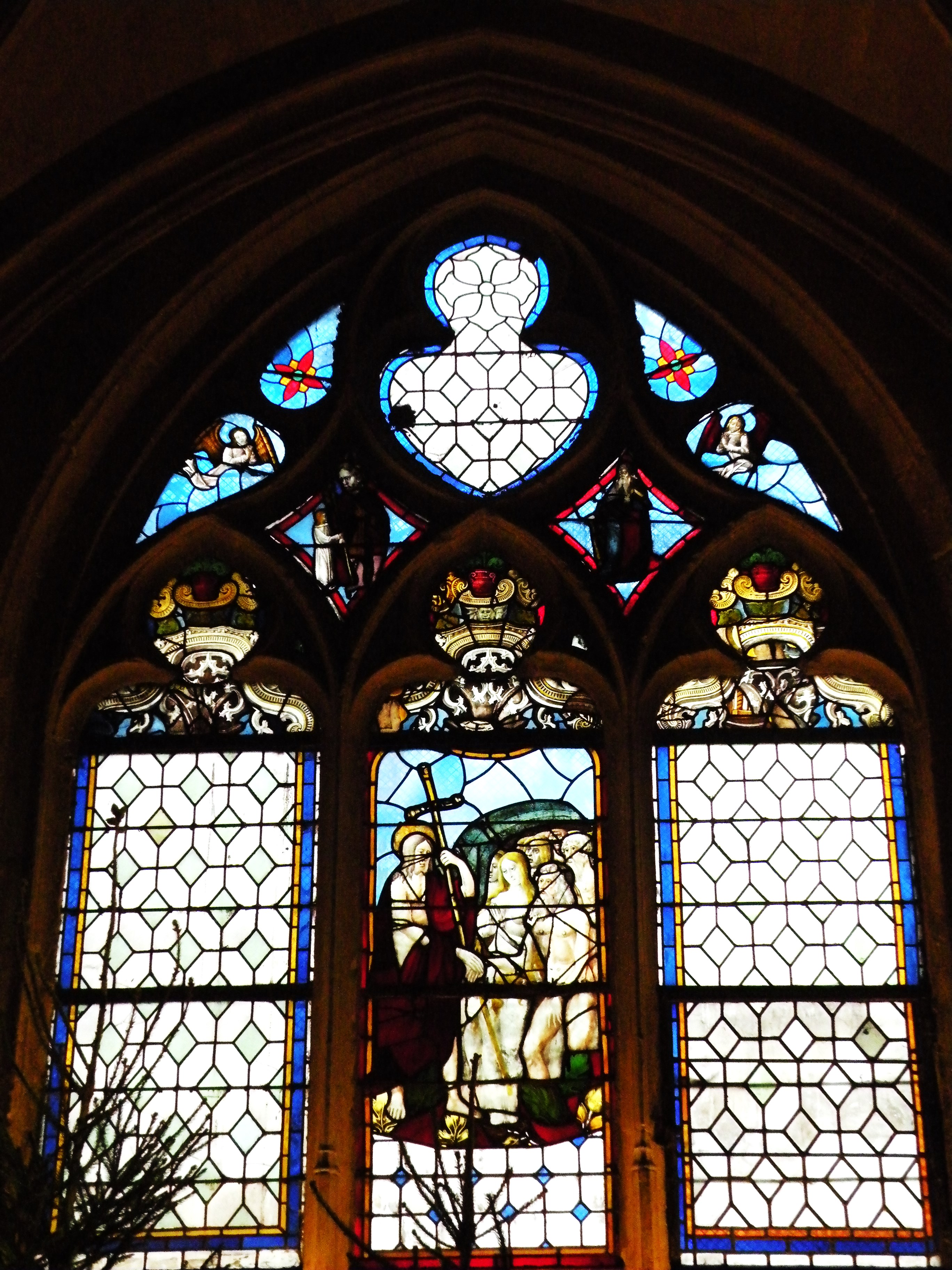
There are several points of view about where this legend originated: the French, bien sûr, claim France as the primary birthplace and the Belgians claim its origin and preservation from the Middle Ages. One can find many paintings, stained glass windows, and frescoes across France and Belgium depicting Saint Julian.
Summary of Saint Julien
Saint Julien was a nobleman whose life was marked by violence, prophecy, tragedy, and ultimately redemption through repentance. According to the French legend, Julien was born to wealthy and noble parents after their prolonged prayers for a child. Shortly after his birth, a prophecy revealed that he would one day kill his own parents. Julien’s parents, shocked by the prophecy, tried to protect him from such a fate. However, as he grew up, Julien developed a passion for hunting, becoming exceptionally skilled but also increasingly cruel in his killing of animals.
One day, while hunting, Julien encountered a large and majestic stag. The stag spoke to him, cursing him with the prophecy that he would murder his father and mother. Horrified by the curse and seeking to prevent its fulfillment, Julien fled from his home, distancing himself from his family and seeking a new life. He eventually married a noblewoman and became a respected ruler in a distant land.
Years later, while Julien was away, his parents, who had been searching for him, arrived at his home. His wife, unaware of who they were, welcomed them and offered them a place to sleep in Julien’s own bed. When Julien returned and found two strangers in his bed, he was seized by a fit of rage and, thinking they were intruders, killed them both. It was only after the murders that he realized he had slain his own parents, thus fulfilling the prophecy.
Overcome by grief and guilt, Julien renounced his former life and sought forgiveness through acts of extreme penance. He withdrew to a remote area, where he built a small shelter near a dangerous river and devoted his life to helping travelers cross safely. This act of selfless service eventually became his defining feature, earning him the title of “Hospitaller” (one who offers hospitality).
Julian’s Redemption
Julien’s final act of redemption comes when he offers hospitality to a poor leper. This leper, near death, asks for food, drink, and warmth. Julien offers him all he has, and finally, when the leper asks to lie in Julien’s own bed, Julien agrees. As Julien tends to the leper, the man reveals himself to be Christ in disguise, and Julien is granted divine forgiveness for his sins. After his death, Julien becomes venerated as a saint, and his story is seen as one of redemption through humility, charity, and the rejection of worldly pride.
Flaubert’s Themes
Gustave Flaubert was fascinated with medieval legend and themes of spirituality. In Trois Contes, he delves into the themes of spirituality, morality, and redemption. Julien’s arc—from sinner to saint reveals how religious and moral struggles manifest in the human psyche. Julien had a passion for killing animals, a primal instinct of his violent nature, but had to examine this passion after he accidently murdered his parents.
Can people really shape their own lives or are there forces beyond their control that they are bound to?
This story of redemption reminded me of Hugo’s Jean Valjean in Les Misérables. Both men went from a life of guilt and penance to redemption and salvation. Like Hugo, Flaubert also found comfort in Christian theology and grace but took issue with organized religion. Flaubert, however, leaned more into the psychological dimensions of religious experience whereas Hugo, in Les Mis, shows the emotional and spiritual side of grace [see post].
Flaubert wrote about the Christian legend of Saint Julien twenty years after writing his tawdry novel, Madame Bovary.
Why the shift? As I was reading Saint Julien, I kept thinking of Flaubert’s famous novel and how these two narratives came from the same author.
The contrast between Madame Bovary and La légende de Saint Julien l’Hospitalier is quite stark, and it does seem like Flaubert might have been attempting a kind of “palate cleanse” by shifting from the gritty realism and moral complexities of Bovary to the more spiritual, allegorical, and medieval world of Saint Julien-just my opinion! Perhaps Flaubert needed to explore the themes of spiritual redemption with purer, elevated themes of transformation.
In a sense, this shift offered Flaubert a refreshing catharsis-moving from the morally ambiguous and tragic outcomes of Madame Bovary to a more hopeful exploration of human goodness and divine forgiveness. Or perhaps, it was only cathartic for moi-même!
Work Cited
Gustave Flaubert. Trois Contes. Classiques de Poche, Paris.
 My French Quest
I believe I read Trois Contes, but I can’t remember this one, well, that would have been a few decades ago.
I love the idea of “palate cleanse” after Madame Bovary!