“I doubt whether any one can enter that enclosure, where repose the dust and ashes of so many great and good men, without feeling the religion of the place steal over him”. Longfellow
In 1832, Henry Wadsworth Longfellow visited the Père La Chaise cemetery in Paris which he compares to the Westminster Abbey in London: “Both are dwellings of the dead, but one is a temple of art and the other a temple of nature” ( “Père La Chaise”, Outre-Mer 55).
Longfellow dedicates a whole chapter to his visits in Père La Chaise in Outre-Mer. As a visitor of La Chaise many times over the past twenty years, I can understand why Longfellow’s visits impacted him so much.
As is still true today, Père La Chaise is the only cemetery in the world that the sole purpose is to honor the men and women who contributed to its advancement and heritage. The great French philosophers, historians, musicians, warriors, poets and military heroes have continued to be interred and honored here.
“As I gazed on the sculptured forms before me, my busy memory swung back the portals of the past…What a lesson for those who are endowed with the fatal gift of genius!”
These statesmen who exalted the character of their native land with “political intrigue, the dream of science, the historical research, the ravishing harmony of sound, the tried courage, and the inspiration of the lyre”—they leave behind grand memorials which will remind us of their valor (Père La Chaise website (my translation).
Balzac in Père La Chaise
I was first introduced to Cimetière du Père-Lachaise in Honoré de Balzac’s famous novel, Père Goriot (1835). At the end of this novel the protagonist Rastignac stands by Goriot’s grave and looks out onto the city of Paris.
Fifteen years after writing this novel, Balzac was buried in this same cemetery. I first visited Balzac’s grave in 2006 to try and identify what the author was imagining as he wrote this doleful scene of at the end of Père Goriot’s life in which his protagonist, Rastignac, gives a challenge from a view of Paris: “A nous deux maintenant!” (It is between us now)

Longfellow in Père La Chaise, 2006
Longfellow also stood on this summit of the hill in Père La Chaise and looked out over the city of Paris. These were his reflections:
“Beneath me in the distance…rose the countless roofs and spires of the city. The distant murmur of the city rose upon my ear, and the toll of the evening bell came up, mingled with the rattle of the paved street and the confused sounds of labor. What an hour for meditation… What a contrast between the metropolis of the living and the metropolis of the dead” (90).
What graves did Longfellow visit in 1830? “There were graves of Fourcroi and Haüy; of Ginguené and Volney; of Grétry and Méhul; of Ney and Foy, and Masséna; of La Fontaine and Molière, and Chénier and Delille and Parny”(58). Longfellow honors these men “What had wealth to do there? Why should it crowd the dust of the great? “Material wealth gives a factitious superiority to the living, but the treasures of intellect give a real superiority to the living”(59).
I am not familiar with most of these great men of Longfellow’s list. It is interesting that most of the graves I paid tribute to were celebrated after this time for art, literature, and science. They were men of intellect AND wealth at the time of their death.
In « Père La Chaise », Longfellow doesn’t spend much time on these memorials. Most of these great men and women that are buried in Père Lachaise were still living or had not even been born. Instead, Longfellow describes the beauty and serenity of his walks through this historic landmark, a repose in green alleys beneath the open sky:
In Père La Chaise, “the soft melancholy of the scene is rendered still more touching by the warble of birds and the shade of trees, and the grave receives the gentle visit of the sunshine and the shower…the twilight steals through high and dusky windows; and the damps of the gloomy vault lie heavy on the heart, and leave their stain upon the mouldering tracery of the tomb”(55).
My experience in Père La Chaise
Like most tourists, my first visit to Père La Chaise cemetery was a treasure hunt: try to find as many memorials plotted on a very confusing map before my feet wore out. As I was new to French history and culture, I relied on the suggestions from the “tour guides” such as: Oscar Wilde, Jim Morrison, Moliere, Abélard and Héloise, Edith Piaf, Gertrude Stein, Chopin, etc.
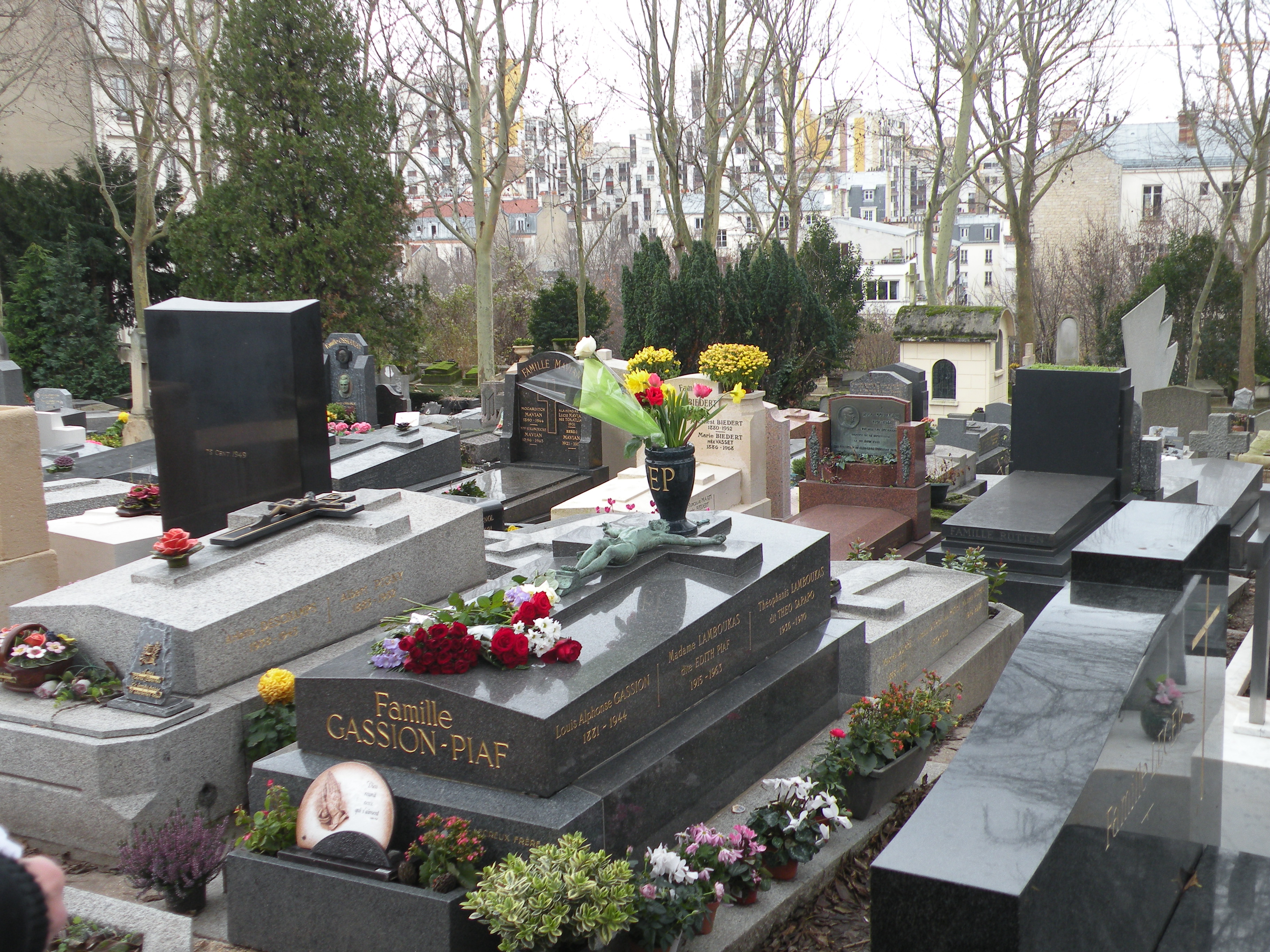
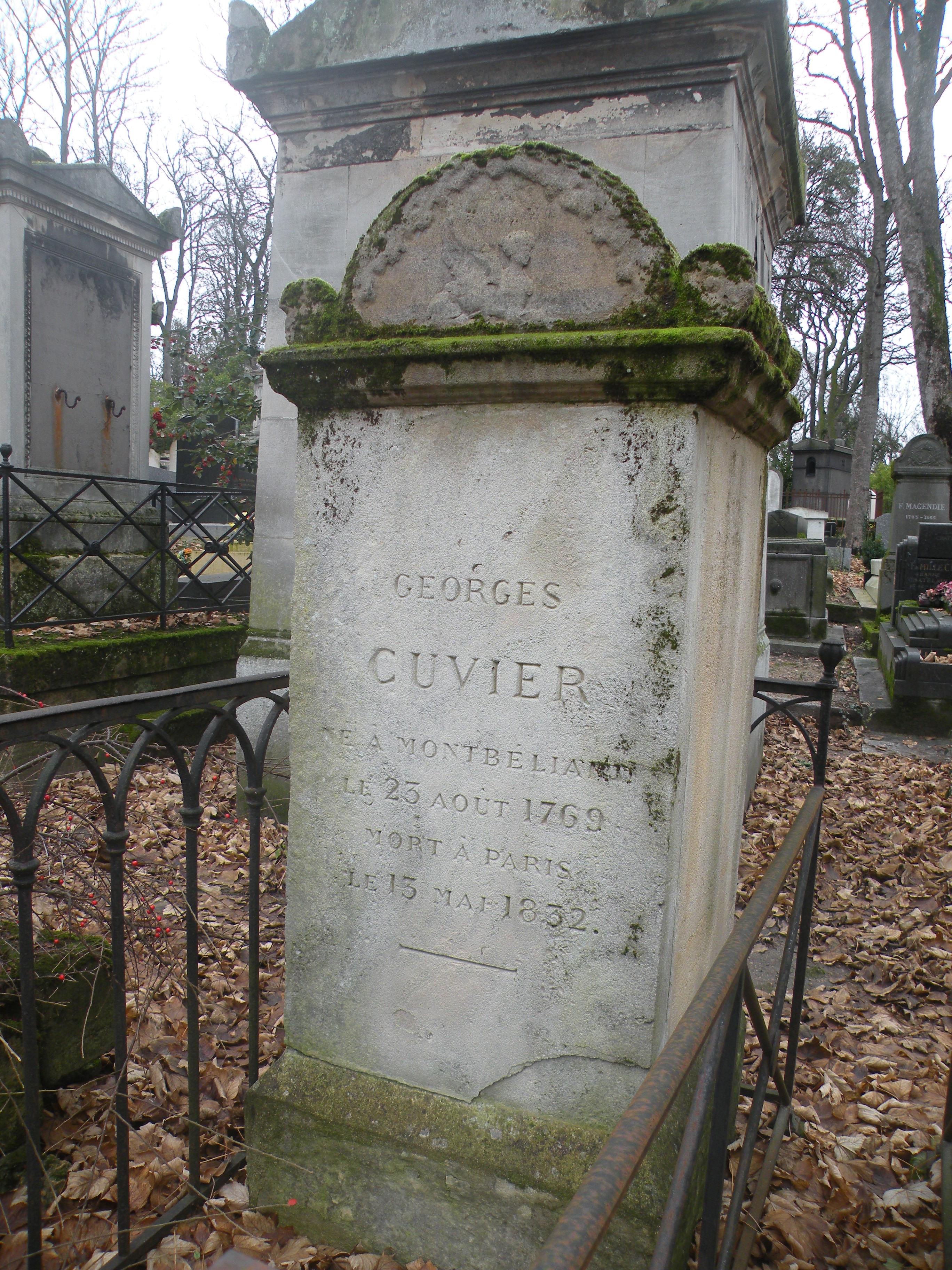

However, the more I studied French history and culture, each subsequent visit to this temple of nature became more meaningful.
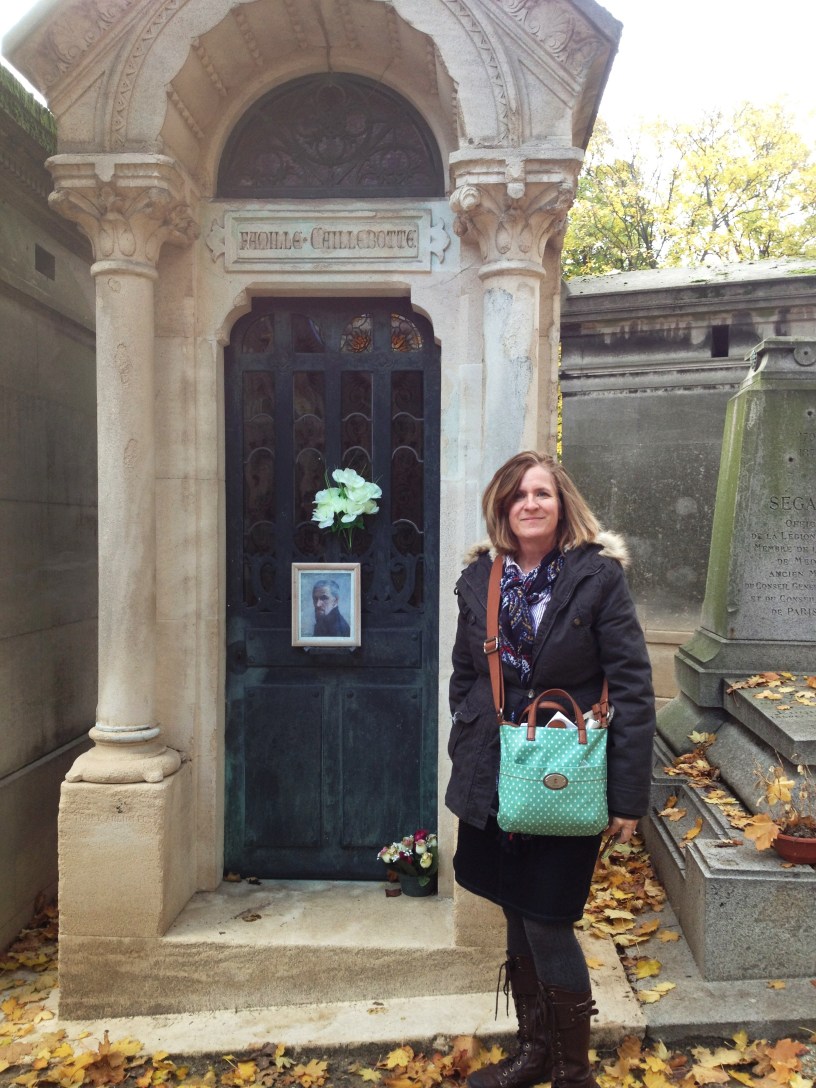
My new searches included the great artists Gustave Caillebotte and Georges Seurat; literary figures La Fontaine, Zola, Proust; and men of science Étienne Geoffroy Saint-Hilaire and Georges Cuvier, founder of paleontology and cetology; Melville used his research for Moby-Dick.
Other Musicians buried here include Bizet, Cherubini, Poulenc, Rossini, and Dukas, as well as opera singers Maria Callas, and dancer Isadora Duncan.
Artists are among the largest group buried here in Cimetière du Père-Lachaise. They include Caillebotte, Corot, Pissarro, Modigliani, Jacques-Louis David, Gericault, Ingres, Georges Seurat (Paris, La Grande Jatte), Signac, glass sculptor Lalique, Max Ernst, Delacroix, photographer Nadar, and sculptor Cartellier.
Philosophers, Scientists, and Statesmen include: Abelard, Cuvier (the founder of paleontology), Étienne Geoffroy Saint-Hilaire (who accompanied Napoleon on his expedition to Egypt see my blog post here) , Gay-Lussac, Georges Haussmann (architect who rebuilt Paris in 19th century, see post), and Thiers.
I have seen most of these memorials on my list, but it has taken many visits to find them! The fall is my favorite time as the cool autumn wind blows through the fallen leaves. It is so quiet and peaceful, even with its many visitors. Longfellow describes it much better”
“There are numerous gravel-walks, winding through shady avenues and between marble monuments; a thick mass of foliage half conceals each funeral stone; the sighing of the wind, as the branches rise and fall upon it,–the occasional note of a bird among the trees, and shifting of light and shade upon the tombs beneath, have a soothing effect upon the mind. A pathway in the deep shade of heavy foliage, where the branches of the yew and willow mingled, interwoven with the tendrils and blossoms of the honeysuckle. Beyond the level rays athwart the dusky landscape, sank the broad red sun”(63, 64).
The Parting Look
In Longfellow’s last, parting look as he was leaving the cemetery, he can distinguish only a chapel on the summit of the hill; atop this chapel is “a lofty obelisk of snow-white marble, rising from the black and heavy mass of foliage around, and pointing upward to the gleam of the departed sun, that still lingered in the sky, and mingled with the soft starlight of a summer evening”(63).
In the Père Lachaise Cemetery, two great writers were awakened with deep emotions in their hearts and I with a new appreciation for a great temple of nature.
Work Cited
Henry Wadsworth Longfellow. Outre-Mer: A Pilgrimage Beyond the Sea. New York: International Book Company, 1899.
 My French Quest
It’s a beautiful place. Aside from all the fabulous doors, it’s very peaceful and invites contemplation.
Yes, Sheree, it is one of the few peaceful places out-of-doors to contemplate in Paris! Thank you for your comment! Robyn
Pleasure Robyn
I think I found the grave of the playwright Pierre Augustin Caron de Beaumarchais (1732-1799), but the inscriptions were quite weathered, so I’m not sure. https://operasandcycling.com/pere-lachaise-cemetery/
That’s cool. I will look for this next time. I appreciate your link to the post. I wondered when I read Longfellow’s account if he was familiar with Balzac’s Père Goriot at that time. This was the first French novel I read when I was learning French. Such a heartbreaking story.
Neat!
I love this place. I did a post on it over 10 years ago – the text is mostly wikipedia, but the pictures are mine. I so love the detail on “time flies!”.
And the last picture is my husband – I love this picture:
https://wordsandpeace.com/2012/06/14/i-love-france-22-pere-lachaise-cemetery/
Thank you for sharing your link and pictures!
Loved your post. I will go back to Paris this year and I will definitely visit the cemetery. Thanks for sharing!.