
The beginning of the nineteenth century found France experiencing economic and class struggles as a direct result of the Revolution, as well as a new political and ideological order. The French government underwent several changes during the First Republic, following the fall of Louis XVI and the monarchy, including the National Convention, the Reign of Terror, the Thermidorian Reaction, the Directory, and finally the Consulate. However, France continued to decline economically and lost important territories such as Canada and the Indies. This is a very confusing time in French political history. What a mess! Who would rescue France and lead it back to power?

The answer came in the unlikely form of a war hero by the name of Napoleon Bonaparte. Napoleon had just led a military expedition to Egypt in 1798 in order to establish a French presence in the Middle East. He conquered the Ottoman province and, more importantly, launched modern Egyptology through discoveries made by his army.
Nina Burleigh gives a thrilling account of Napoleon’s expedition in her book Mirage, including the 151 “savants” that he took along- geologists, mapmakers, naturalists, artists, and musicologists. These scholars not only discovered the Rosetta Stone, they also compiled a 24-volume encyclopedia, Description de l’Égypte ($90 on Amazon), about the natural history of Egypt’s people, Pyramids, daily life, species, and agriculture. This encyclopedia led to a worldwide “Egyptomania” and the acquisitions of: Cleopatra’s Needle in NY, the Luxor Obelisk in Paris, the mummies at the Metropolitan, British, and Louvre museums. (I love, love, love this book; it is a fascinating read!)[see post]

In 1799, Napoleon Bonaparte engineered a coup and took power in France. He signed a Concordat with the Pope to restore the catholic religion, which had been abolished since the Revolution. In 1804, Napoleon became Emperor of the French, but there are differing historical accounts regarding who performed the actual crowning! According to my French history professor, Mme Kessler, at the Sorbonne University in Paris, Napoleon was crowned by Pope Pius VII.
However, most American references claim that Napoleon took the crown from the Pope and placed it in on his own head ! The contemporary French painter Ingres sketched the ceremony of Napoleon’s wife, Josephine, being crowned Empress, and then proceeded to paint a very large tableau which hangs in the Louvre Museum.
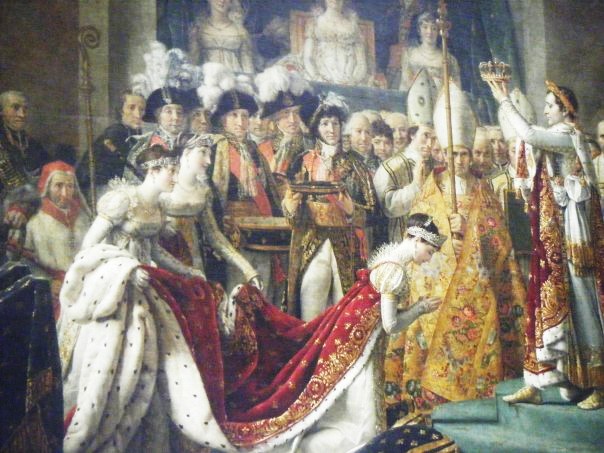
Musee du Louvre

Josephine’s necklace
Musee du Louvre
Napoleon created a new court of officers for the French army, as well as a court for the bourgeoisie nobles. He subsequently reported many military victories in Austerlitz, Iéna, Eylau, and Wagram. Reliefs of these victories can be seen on the Arc de Triomphe and in paintings which surround his tomb in the Invalides in Paris. By 1811, Napoleon ruled over 70 million people across an empire that included Europe and maintained these alliances through family appointments: brothers Louis in Holland, Joseph to Spain, and Jerome to Westphalia; sisters Caroline to Naples and Elisa to Etruria. He even created a new aristocracy in France and allowed the return of the nobles who had been forced into exile by the Revolution.
Of course, there are numerous victories through military campaigns that Napoléon led, which I am not including in this post. Further Reading: War and Peace by Leo Tolstoy, Campaigns of Napoleon by David Chandler, or Napoleon on the Art of War by Jay Luvaas.
Napoleon brought about many postive changes to France, becoming the “maître de l’Europe occidentale”. He created a new currency the Banque de France along with une nouvelle monnaie “le franc”, created “le Code civil”. He also founded many new schools, the Legion d’Honneur and divided the state into individual “departments” facilitate governance.
Unfortunately, Napoleon experienced a significant defeat in Leipzig in 1813, abdicated his throne in 1814, and was sent into exile on the island of Elba. He returned to France for a brief period and was once again defeated at Waterloo after being captured by the British and sent to prison at Sainte-Hélène, where he died at the young age of 51. Even in his short reign as Emperor, Napoleon is honored as a hero for restoring France to power.
There is much evidence of this honor to Napoleon Bonaparte in Paris through paintings, statues, and monuments:
1) The Vendome Column : in Place Vendome stands a bronze plated column from 1,250 cannons captured from Austrian and Russian troops during the Battle of Austerlitz, considered one of Napoleon’s greatest victories
2) #3, rue D’Antin: Napoléon and Josephine were married on the 2nd floor of this mansion when it was the office of the Mairie.
3) Church of Saint-Sulpice: the “Temple of Victory” at the time, General Napoleon was honored here at a banquet. Directly behind the church is rue Bonaparte.
4) Luxembourg Palace: where Napoleon and Josephine lived for a time.

5) Site of Tuileries Palace: between the Arc du Carrousel and the Jardins du Tuileries. Napoléon lived here for 14 years.
6) Rue de Rivoli: Napoleon created this large street to ease the heavy traffic of rue Saint-Honoré, one block over. This rue runs from place de la Concorde to the place du Palais-Royal. It is named for one of Napoléon’s victories in Italy.
7) Notre-Dame de Paris: where Napoleon and Josephine were coronated as Emperor and Empress of France. A triumphal arch and golden statues of Charlemagne were erected outside the cathedral with elevated platforms of scarlet canopies for their thrones.
8) Arc de Triomphe de L’Etoile : Napoléon ordered a new monument dedicated to the Grand Armée built on one of the old city gates in Paris. At the time there were 5 roads leading to villages outside of Paris. Today there are 8 grand boulevards including Champs-Elysées. Names of the battles won by Napoléon are engraved around the arch’s top and 386 generals and the names of those who died in action are underlined.
9) Hotel National Des Invalides & Napoleon’s Tomb : Napoléon requested a crypt to be buried in of black marble. After his death on Saint-Helene, Napoléon’s coffin was moved to a few locations and eventually was placed in the Invalid Dome. Napoléon’s body is encased in six coffins of: zinc, mahogany, lead, ebony and oak.
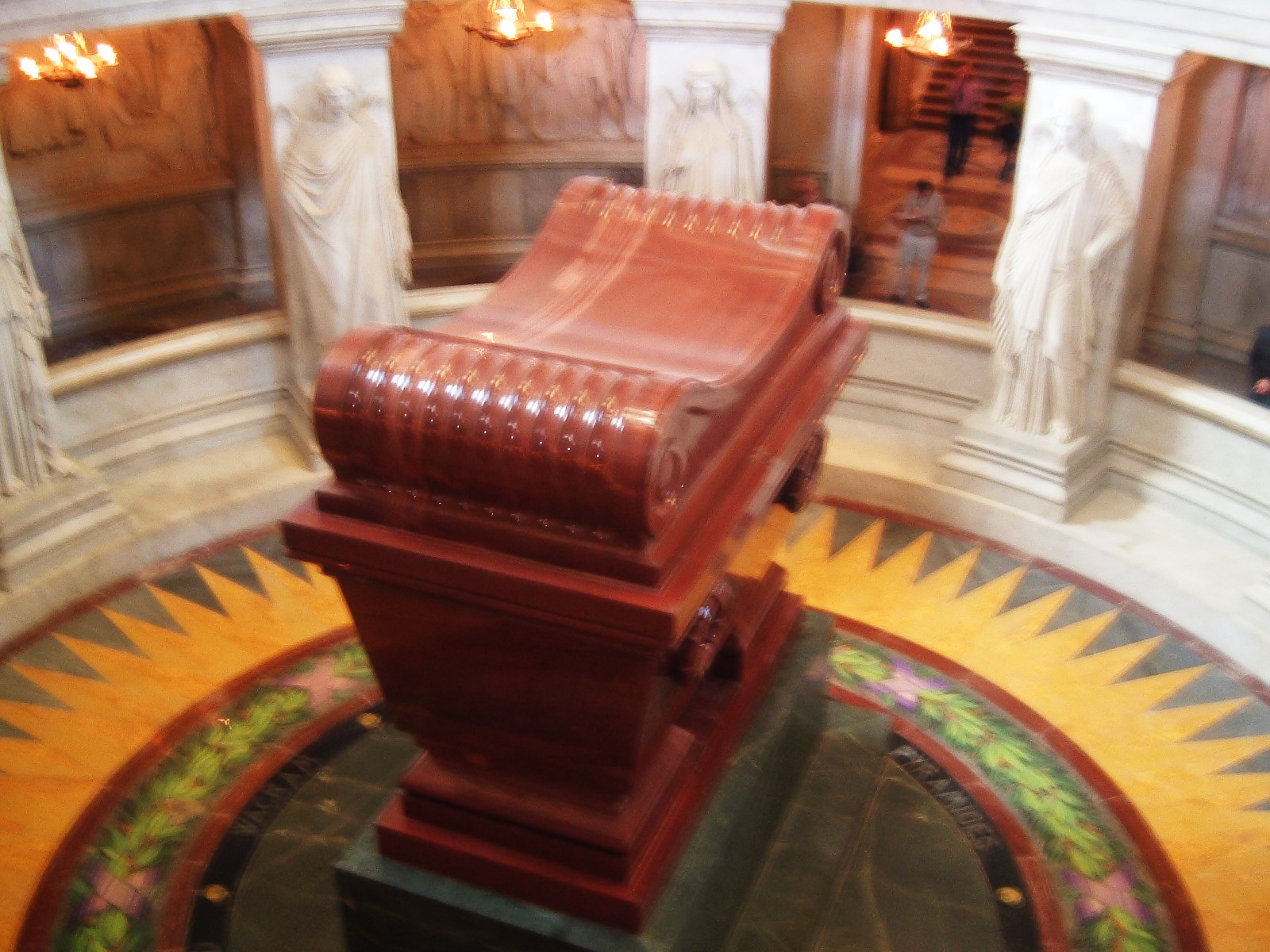
Paris, France
Fortunately, the 19th century brought about many positive changes in France: political, literary, artistic and scientific. I will address these in my next blog ” History Review France: La Première Moitie du XIX Siècle, Littéraire France Victor Hugo and Honoré de Balzac”.
Works Cited
Burleigh, N. (2007). Mirage: Napoleon’s scientists and the unveiling of Egypt. New York: Harper.
Clark, Priscilla P. Literary France. The Making of a Culture ( University of California Press, 1987)
 My French Quest
Your posts are so good, they need to be shared more.
I see you are not sending the links of your posts to our MrLinky (you only did it for your July 13 post) in https://wordsandpeace.com/2025/07/01/parisinjuly2025-all-the-links/
So I’m doing it for you for your posts on July 16-17-18.
But I really don’t have tons of time, so if you could do it for your next posts please. Thanks
Thank you so much for your encouragement and for reposting my posts, wordsandpeace. Yes, I will submit them to your MrLinky for the series of History of France. Robyn
We spent quite some time wandering around Hotel National Des Invalides when we visited Paris a couple of years ago!
Visiting from Paris in July!
Did you see the War Museum at the Invalides? My husband spends hours there when we visit. Robyn