I just finished a reread of Shakespeare’s play Hamlet after watching the movie, Hamnet, which is based on Shakespeare’s masterpiece. In Hamnet, the relationship between the father, William, and son, Hamnet, is portrayed as emotionally distant due William’s absences from working in London. After the son’s tragic death, William is riddled with grief and guilt. Over time, William and his wife, Agnes, find healing and a renewed connection through the creation of the play “Hamnet”, which William wrote as a memorial to his son.
I wondered, then, if there was a connection between Shakespeare’s play “Hamlet” and the fictional representation in Maggie O’Farrell’s Hamnet? Before King Hamlet died, did Hamlet have a close personal relationship with his father? Did Shakespeare reveal much about the relationship between Hamlet and his father in the play? I believe he did.
I love the devotion that Hamlet has to his father.
Throughout the play, Hamlet eulogizes his father beyond human limits. Could any man on Earth measure up to his father? Hamlet elevates him to the divine status of a Greek god:
“So excellent a king, that was to this/ Hyperion to a satyr, so loving to my mother…”(Act 1.2, 140).
Hyperion represents divine beauty and perfection, which is in stark contrast to the vulgar “satyr”, Claudius.
Also in Act 1, Hamlet exclaims: “He was a man, take him for all in all,
I shall not look upon his like again.”
We see Hamlet compose his father’s image in Act 3 with the authority and power of Jupiter (Jove), Mars, and Mercury. What human could live up to this standard?
“See what a grace was seated on this brow;
Hyperion’s curls; the front of Jove himself;
An eye like Mars, to threaten and command;
A station like the herald Mercury
New-lighted on a heaven-kissing hill…” (Act 3.4).
Unfortunately, the closeness between Hamlet and his father possibly brought an added burden of extreme grief by avenging his death.
In Shakespeare’s play, Hamlet is commanded by his father to avenge his death. Does he succeed or does he fail?
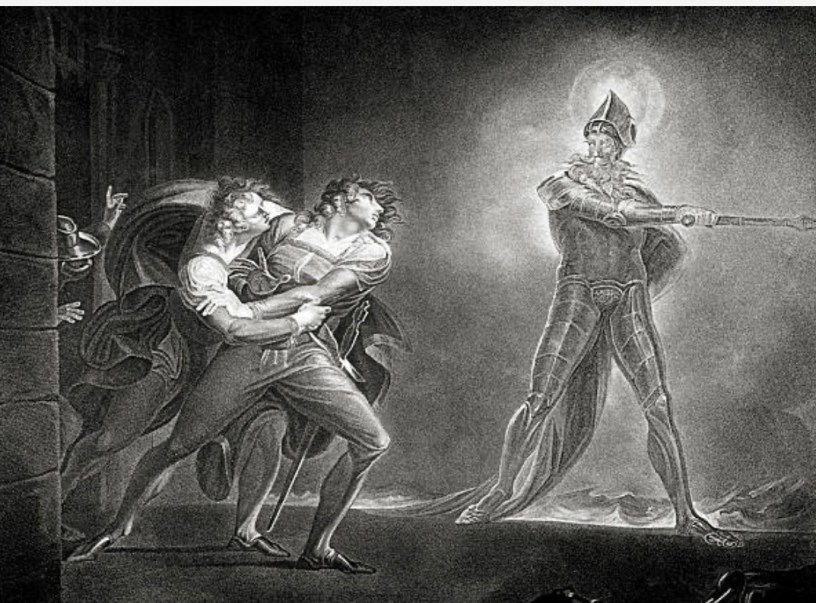
In Act 1, Scene 5, the Ghost of King Hamlet reveals the truth of his death and commands Hamlet to avenge his death.
“If thou didst ever thy dear father love—
Revenge his foul and most unnatural murder.”
In this command, King Hamlet gives an appeal of why Hamlet should avenge his death, which is directly tied to Hamlet’s identity as his son. The King’s death was a “foul and unnatural murder”. He warns, however, that in avenging his death, Hamlet must not corrupt his own soul and must not involve his mother.
“But howsoever thou pursuest this act,
Taint not thy mind, nor let thy soul contrive
Against thy mother aught; leave her to heaven…”
So, Hamlet must avenge his father’s death while staying morally pure. This is a true test of Hamlet’s integrity. As this command comes early in the play, we do not know much about Hamlet’s integrity or moral stance. Is this call to avenge due to patriarchal loyalty? Does this reflect medieval codes of vengeance?
As we see at the end of the play, Hamlet avenges his father’s death by killing Claudius. The command is fulfilled, the murderer is punished, and justice is served. Even as Hamlet worries that Claudius’ soul could go to Heaven and, therefore, not be punished eternally, he goes forward with the plan of murder. So, He succeeds!
Or does he?
We also see the result of this vengeance at the end of the play: Hamlet dies; Gertrude, his mother, dies; his love, Ophelia, dies (by her own hand); and his cousin Laertes dies. In consequence, the royal line collapses. Did King Hamlet even see these consequences as a possibility or turns of fate? Did he care? King Hamlet knew the corruptness of Claudius’ heart in plotting his death; how could he not foresee that in carrying out this vengeance, his loved ones could die?
Hamlet fulfills his revenge on Claudius only after he has been mortally wounded. If there are any repercussions to this murder, he will not be affected by them. He will be dead.
Did Hamlet have to die? Come on, Shakespeare…
I hate sad endings. This play is a tragedy and this is what happens in a Tragedy. Why does Hamlet have to die? I understand that it is part of the moral and dramatic logic of the play—with all of the corruption in the court, his death was inevitable. In the larger sense, I also see that culturally, the only way for the political order in Denmark to be restored is for Hamlet to die and for the royal line to end.
Perhaps there was no other possible outcome but for Hamlet to die.
As I stated, we don’t know a lot about Hamlet’s character before his father’s death. Shakespeare gives us a sketch of Hamlet’s credible past pieced together through his memory and the testimony of others in Hamlet. We can infer that he was a relational, respected, even promising young prince as we look at his relationships with his love, Ophelia, his mother, and his friends, Horatio, Rosencrantz, and Guildenstern. The fact that those who were close to him commented on the stark contrast they saw in his character once revenge began to consume him and replace his identity also gives us the sense that he was a man of great character.
Even though we don’t know much about Hamlet’s character before his Father’s death, we do see a transformation in him throughout the play. Hamlet becomes what he hates. In order to avenge his Father’s death, as he is commanded to do, he becomes corrupt like Claudius. His focus is now on murder and death.
Hamlet’s Thoughts of the Afterlife
In Hamlet’s soliloquy which begins, “To be or not to be; that is the question“, is Hamlet considering that death may be preferable to life? Since he has been grieving his father’s death and contemplating killing Claudius, does the afterlife bring comfort to Hamlet?
“The slings and arrows of outrageous fortune…To die, to sleep—/No more, and by sleep to say we end/ The heartache and the thousand natural shocks/ That flesh is heir to—”
In death, Hamlet could escape the pain and suffering of losing his Father. Of course, there is no guarantee of what the afterlife brings. Hamlet has brief interactions with his “Ghost” Father, which is evidence that there IS an afterlife, if only briefly. It seems, however, that Hamlet’s Father was still suffering. This would dispel Hamlet’s supposition that in the afterlife, “not to be”, there is no more suffering. We see the Ghost of King Hamlet is suffering in the afterlife in Act 1, Scene 5:
“I am thy father’s spirit,/Doomed for a certain term to walk the night,/
And for the day confined to fast in fires…Till the foul crimes done in my days of nature
Are burnt and purged away.”
As much as Hamlet wants to continue interacting with his father after his death , he begins to question whether the Ghost is truly his father. We read in Act 2, Scene 2:
“The spirit that I have seen/May be the devil, and the devil hath power/T’ assume a pleasing shape; yea, and perhaps/Out of my weakness and my melancholy, /As he is very potent with such spirits,/Abuses me to damn me…”(Act 2, Scene 2). Is the “Ghost actually a demon? Is he being tricked into murdering Claudius?
Conclusion
Whether the “Ghost” was really Hamlet’s father or a demon, Hamlet wanted to avenge his father’s death. He loved his father; he idolized him. Perhaps this act of vengeance would ease his grief—instead of just “feeling” bad, he would “act” on it.
Good night, sweet prince,/ And flights of angels sing thee to thy rest.—”
Shakespeare, William. Hamlet. The Oxford Shakespeare: The Complete Works. Edited by John Jowett, William Montgomery, Gary Taylor, and Stanley Wells, 2nd ed., Oxford UP, 2005

