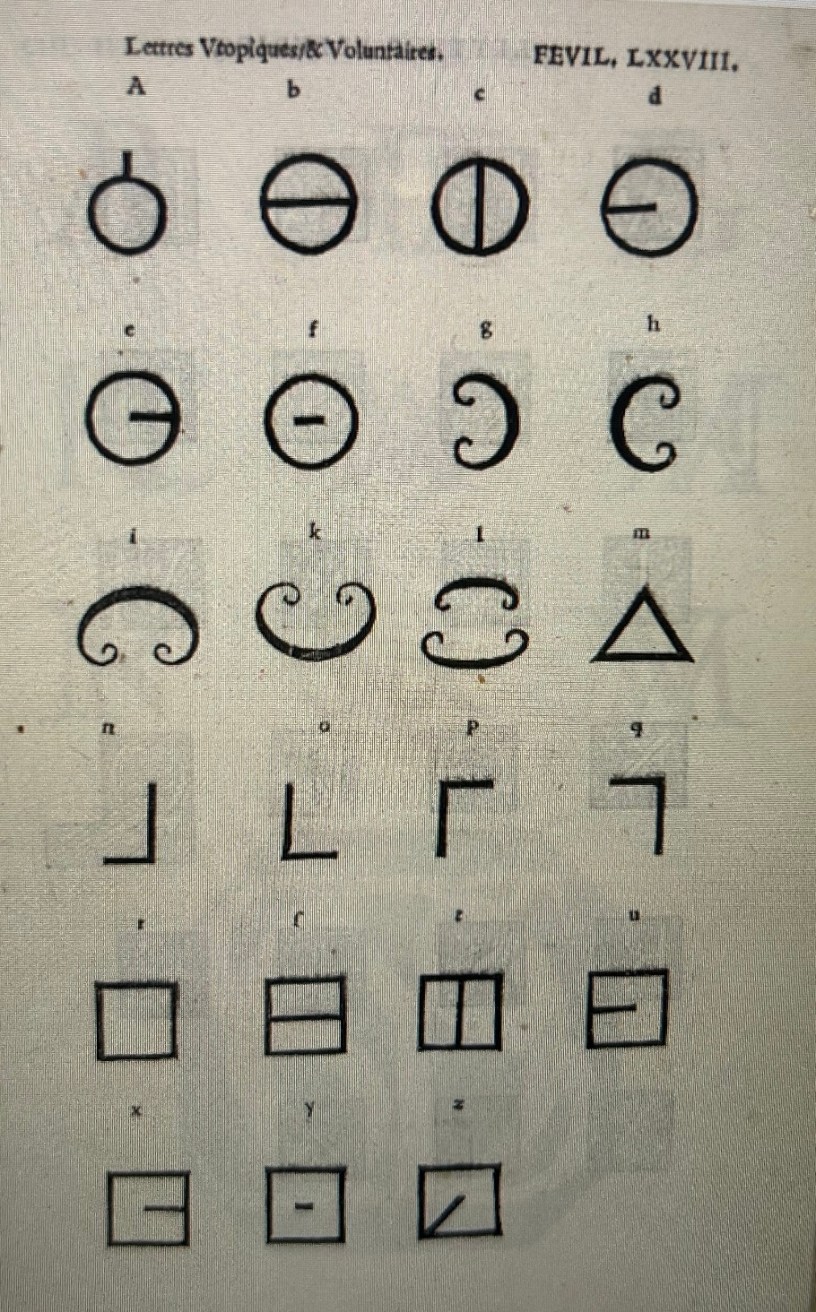
As a Linguist, I am always looking for new languages to study, even if they are fictitious! Imagine my delight when I reached the addendum following Thomas More’s Utopia Book II and found a brief sample of “The Utopian Tongue” written by More’s friend Peter Giles to Jerome Busleiden. How cool is this! A new language for me to study!
The Frontispiece of the original edition of ‘Utopia’, shows the fictional, Utopian alphabet which More invented.

[ Published in Louvain : Arte Theodorici Martini, 1516 (C.27.b.30.)]
Below is the sample of the “Utopian Tongue” as described by More. I have copied the translation by Robert Adams in bold:
A Meter of IIII Verses in the Utopian Tongue, briefly touching both the strange beginning and also the happy and wealthy continuance of the same commonwealth.
Utopos Utopia ha me Boccas commander peu from la not
chama island polta he has made chamaan Island
Bargol one,the only he I maglomi of the lands baccan of all
soma without gymnosophaon Philosophical
Agrama city,village gymnosophon philosophy labarem I have represented
bacha of all bodamilomin for the mortals.
Voluala freely, willingly barchin I impart heman those which are mine
la not lauoluala unwillingly dramme I receive
pagloni those which are better.
[Utopos ha Boccas peu la chama polta chamaan.
Bargol he maglomi baccan soma gymnosophaon.
Agrama gymnosophon labarem bacha bodamilomin.
Voluala barchin heman la lauoluala dramme pagloni.]
Which verses the translator according to his simple knowledge and poor understanding of the Utopian tongue has thus roughly Englished:
My king and conqueror, Utopus by name,
A prince of much renown and immortal fame,
Has made of me an isle that erst no island was,
Frought full of worldly wealth, pleasure and solace.
I, the one of all without philosophy,
Have shaped for man a philosophical city.
As I in me have nothing dangerous to impart,
So better to receive I am ready with all my heart.
There are only four verbs in the Utopian Tongue: Present 1st person—barchin, dramme, impartiō, accipiō; Perfect 1st person—labarembaucha, expressī
3rd person polta, and fēcit. Okay, four verbs, not too bad.
Utopian has 22 letters in its alphabet with letters based on the shapes of the circle, square, and triangle. These correspond almost exactly to the 23-letter Roman alphabet with the exception of the letters f, k, q, and x.
I did a deep dive into Academic Databases and Libraries to find more of More’s Utopian language—to no avail. Alas, I will keep searching!
Works Cited
Adams, Robert M., trans. and ed. Utopia: A New Translation, Backgrounds, Criticism. By Sir Thomas More. A Norton Critical Edition. New York: Norton, 1975. Pp. xii + 239.
 My French Quest
OMG, I totally forgot about this!
Have fun! For now, I think I’ll stick to Japanese, which has the advantage of having 3 different alphabets, with very often the 3 of them used in the same sentence. What else could I dream of, lol!
Wow, you know Japanese! I have not attempted the Asian languages. I did recently discover the incredible Japanese art from the Edo period. Thanks for stopping by! Robyn
Alas, I cannot say that I KNOW Japanese. I can read 2 alphabets, and have been working on knowing more kanji and grammar everyday. At this point, I can only read super simple picture books! But it’s a lot of fun
My Granddaughter Emily is working in linguistics and Bible Translation with Wycliff. She loves this kind of thing, so I am forwarding this one on to her. :>)
Dwight, What a great opportunity for your granddaughter to work with Wycliff. I am so excited for her! Thank you for sharing this post with her. I hope she finds enjoyment in translating the Utopian language! Robyn
I will try to remember to check with her! Thank you.
👍👍