
I recently found a treasure at the Walker Memorial Library at Howard Payne University: Professor Longfellow of Harvard: Studies in Literature and Philology (No. 5 Apr 1944) published by University of Oregon. This document contains copies of Longfellow’s personal letters and official documents from his tenure as the Smith Professor at Harvard, spanning over two decades. According to the author, Carl L. Johnson, Longfellow, “ came to Harvard esteemed as a scholar. He left his post famous as a poet” (v). My interest for the purpose of this blog is Longfellow, the esteemed scholar and linguist!
My Connection to Longfellow
From the moment I read “The Belfry in Bruges” by Henry Wadsworth Longfellow, I felt an immediate infinity to this prolific and resourceful translator. Like Longfellow, I have dedicated my professional life to linguistics, translation, and teaching modern languages in higher education.
According to Johnson, Longfellow was a pioneer in making advances to include Modern Languages at Harvard, which had previously been absent from its curriculum. In the early 19th century, the United States lacked the extensive literary resources and educational traditions found in Europe. For American scholars seeking literature in modern languages, travel to Europe was essential.
Longfellow did just that—he spent three years of study, travel, and observation abroad establishing new standards of academic achievement for himself and for the institutions where he would later teach. This immersion experience would fuse the native and the foreign!
Longfellow stated of this experience abroad,
“I have traversed France from Normandy to Navarre; smoked my pipe in a Flemish Inn; floated through Holland in a Trekschuit; and trimmed my midnight lamp in a German university… There is one kind of wisdom which we learn from the world, and another kind which can be acquired in solitude only (5, Outre-Mer: A Pilgrimage Beyond the Sea).”
[This is where my connection to Longfellow came in. Like him, I pursued cultural immersion to enhance my understanding of the French language and culture during a semester-long graduate internship at the Sorbonne in Paris. My thesis involved comparing the acquisition of French in an American classroom setting with learning through immersion in a French-speaking country.
During this internship, I was immersed in the traditional French language classroom for seven hours a day and would then practice my French skills in my Latin Quarter neighborhood of boulangeries and cafes with encouraging results. On weekends, I traveled across the various regions of France to experience the culture and different dialects of French in les Flamands in the northeast, les Alsaciens in the east where there is still a heavy influence of the Alemannic German dialect of Alsace; les Normands in the north, and la Provencaux in the south.]
Longfellow Abroad
As Johnson details in Professor Longfellow of Harvard, many American literary scholars attribute Longfellow with “interpreting the spirit of European culture to America.” He maximized the benefits of his initial stay in Europe, a period that deeply influenced the ideals of his generation. Through his teaching and translations, he introduced the richness of European literature to English-speaking audiences (Johnson, 14).
Longfellow’s linguistic ambitions were ambitious: he sought to master three or four languages, engaging in conversation, listening, reading, and writing as much as possible. He quickly became fluent in several languages, and from Venice, he wrote to his father:
“With the French and Spanish languages, I am conversant with as much ease and fluency as I do the English.” Eventually, he produced works such as the Italian sonnet “Il Ponte Vecchio di Firenze,” the French Christmas poem “Quand les astres de Noël,” and the German verse “Verlangst du, Erdgeboren!” (26).
Despite studying at prestigious American institutions like William and Mary, Harvard, and the University of Virginia, Longfellow received no formal language instruction, as satisfactory textbooks and qualified language teachers were not available at that time. For Longfellow, language instruction was far more than linguistic training—it represented intellectual progress and becoming a “citizen of the world” (27). While teaching at Bowdoin, he wrote and published textbooks in French, Spanish, and Italian to facilitate language learning for his students [see my post, “Longfellow and Goethe: Two Kindred Spirits from Different Worlds”].
Building the Harvard College Library

So this is cool! An intriguing part of Longfellow’s role during his travels was to acquire books for the Harvard College Library. With a budget of $2,000, he was responsible for curating a collection that would enrich the university’s resources in modern languages and literature. In a letter dated April 10, 1835, he requested funds specifically for purchasing texts related to modern languages, including Histoire Littéraire de la France. He emphasized the importance of acquiring Swedish, Danish, Icelandic, and German philological works and replications of the country (16). I want that job! He signed this letter of request “With much respect, Yr. Obt Sert. Henry W. Longfellow!
In a subsequent letter, dated October 17, 1835, he informed the faculty of his successful acquisition of Italian plays, Swedish modern literature, and rare German texts, noting that these resources were “not to be found under the Western Star” (19). How I would love, love, love to visit the Harvard College Library today and see if Longfellow’s collection of books is still part of the library.
Pedagogy in Europe
Longfellow made an important discovery while visiting Germany in his time abroad: “As to studying at a German university, there is absolutely more learning in Germany than in all the rest of the world…Such men as Raumer at Berlin, Heeren & Müeller at Gotingen exert a great influence wherever they may be—to say nothing of the mode of teaching, by extemporaneous lectures given from notes which I think the most effectual of the modes of teaching. Our mode of lecturing in the U. States by eloquent written lectures, which the hearers come to admire & go away to forget, is all naught”(20).
Longfellow as Professor
In 1836, Longfellow joined Harvard as the Smith Professor. His lectures covered the history of the French language, Anglo-Saxon literature, Swedish literature, the life and works of Goethe, and Jean Paul Richter. He was the first American professor to teach German literature, introducing courses on Faust, and Italian literature through Dante.
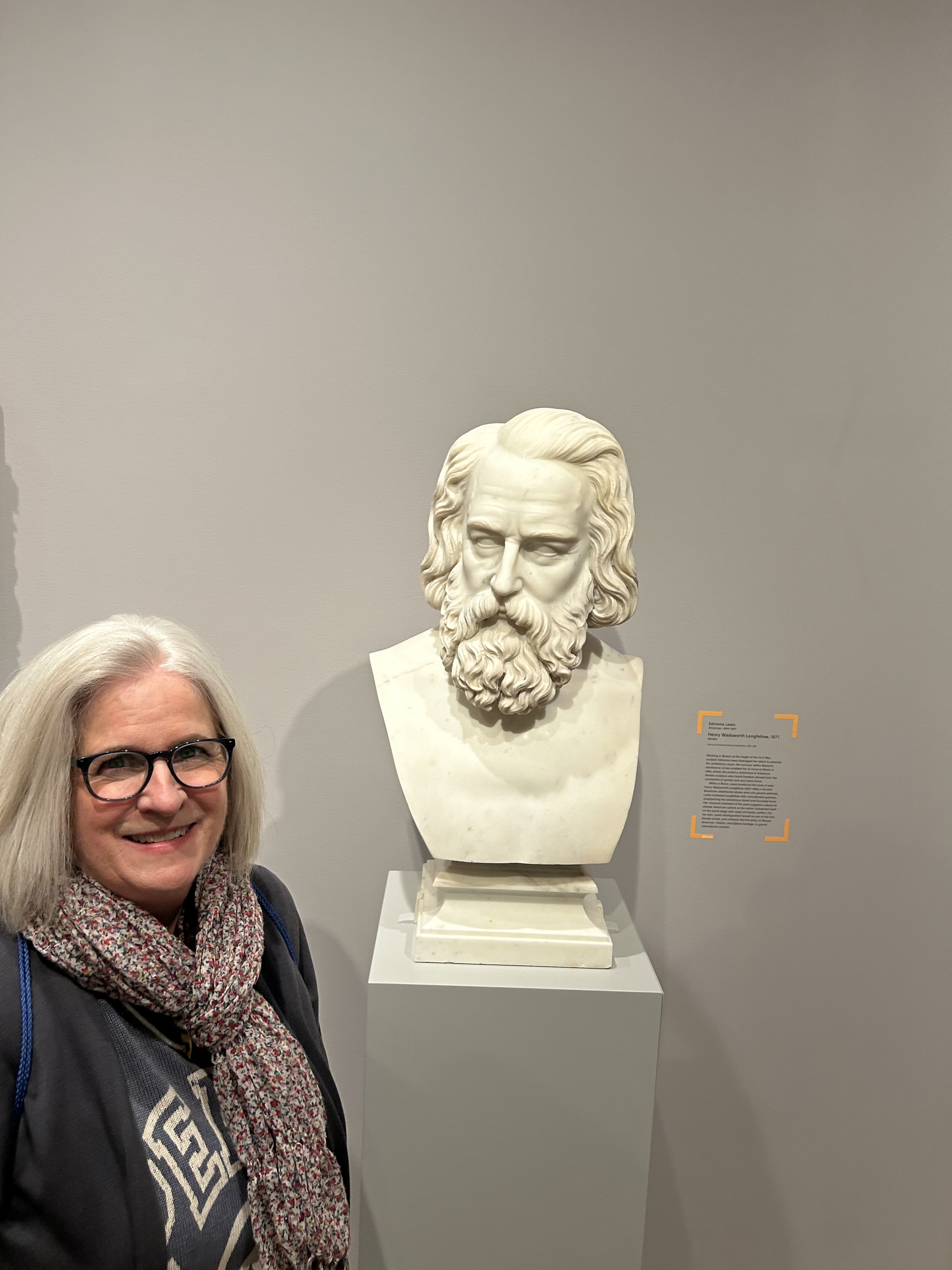
Longfellow revolutionized the idea of public lecture. Previously, these lectures were attended by members of the senior class, the more mature minds, and attendance was voluntary. By opening his lectures to the general public, he made scholarly discourse accessible to all (28). Despite his extensive teaching duties, Longfellow continued his research and translation work, his true passion, mastering languages including Icelandic, Anglo-Saxon (Beowulf), Danish, Swedish, German, Dutch, French (Victor Hugo!), Italian (Dante), Spanish, and Portuguese. His anthology, The Poets and Poetry of Europe, presents a rich selection of European poetry, with introductory essays on each region’s cultural and linguistic history.
I love that Longfellow became immersed in these cultures to better understand the origin of languages. He also studied these languages to better understand the challenges his students faced in second language acquisition [see my post: “Longfellow: Translation of 8th century Runic Literature from Iceland”].
Each chronological section of Europe is introduced by Longfellow in The Poets with cultural and linguistic history that, in most cases, he observed personally.
Teaching languages so fully committed as this must have given not only pleasure to the taught but joy to Longfellow, the teacher. Noting in his journal in 1847 that in that term he had two classes in Molière and Dante, he remarked: “No college work could be possibly pleasanter” (47).
Even though writing was his primary interest and he excelled as an Author and Poet, there are many reasons to also admire Longfellow the Linguist, the Professor, and the Etymologist. A good role model for this Professor!
Work Cited
Carl L. Johnson. Professor Longfellow of Harvard. University of Oregon Press, 1944.
 My French Quest
“Longfellow was a pioneer in making advances to include Modern Languages at Harvard”. I had no idea! Fascinating and informative post, thanks