
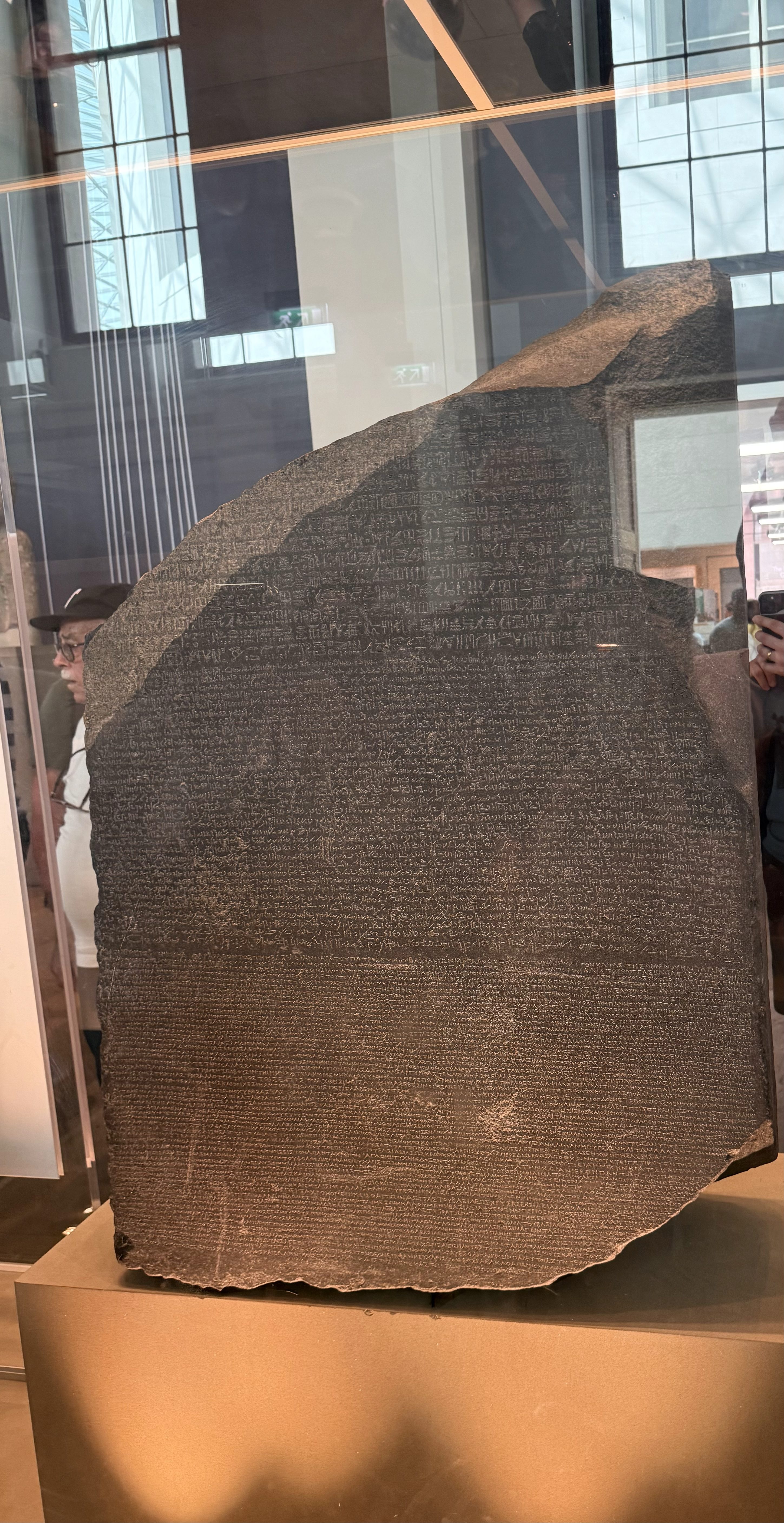
This week, I checked another item off my bucket list! I finally got to see the Rosetta Stone at the British Museum in London. This has been a quest of mine since I was first introduced to this incredible story by Nina Burleigh in her book, Mirage, Napoleon’s Scientists and the Unveiling of Egypt, concerning the unlocking of the secrets of Egypt’s ancient civilization.
Two hundred years ago, Egypt was an unknown country in the Middle East: unmapped, its history and people obscure.
The first recorded proposal of exploring this Islamic culture of Central Europe was made at the Battle of Vienna in the late 17th century, mostly by writers and merchants. This thirty-day voyage by sea from Europe to the Orient only increased the fascination of discovering “The Orient” and all the magical secrets that it held. The hieroglyphic script and language of this civilization had not been translated in over 1500 years. Within these borders lay relics of the oldest human civilization in the world.
Why did Napoleon want to conquer Egypt?
According to Nina Burleigh’s investigation in Mirage, her investigation of Napoleon’s Scientist and the Unveiling of Egypt, “The French did not invade Egypt in 1798 to solve historical mysteries.” On the contrary, Napoleon led 50,000 soldiers across the Mediterranean as European countries competed to claim territory.
As his hero, Alexander the Great, had done 2,000 years before, Napoleon wanted to conquer the world. According to Paul Strathern in Napoleon in Egypt, Napoleon read about Alexander’s conquest at the age of 20 in Volney’s Voyage en Egypte. Napoleon was 19. He was a romantic, inspired by the conquests of Alexander and Caesar. He spoke daily with his Generals about a voyage to Egypt and became obsessed with mounting this campaign (27).
Egypt was a gateway to Africa and Asia. Nile provided sugarcane, flax, indigo, wheat, rice, gold, and timber. Main Reason: to beat the British there. It would dampen British expansion, “a conquest taken from the English (36).”
In addition, as with Alexander, Napoleon would take with him on this journey scientists, artists, philosophers, and botanists, or Savants as he would refer to them. Consequently, after three years of hunger, hardship, uncertainty and disease, these French scholars would return to France with a powerful respect for the land in which they had dedicated their lives and research.
THE SAVANTS
Who were these 151 Savants and why would Napoleon choose to take them on this expedition? They were Parisian artist and scientists, astronomers, engineers, naturalists, physicists, doctors, chemists, botanists, poets, and musicologists. Napoleon’s goal was to have the Savants classify everything, map the land, find water, and befriend leaders. Some of the more notable savants were:
–Chemist: Claude-Louis Berthollet, Geometer
–French Artist André Dutertre: who sketched the scholars.
–Mathematician Gaspard Monge (rue Monge, Arenes des Lutece !!!); best friend of Napoleon: invented descriptive geometry= representing figures in three dimensions on one plane.
–Egypt scholar: Joseph Fourier; Diplomat and explorer and Dominique-Vivant Denon (who would later become the director of the Louvre Museum). Upon their return, these Savants would produce a twenty-three volume, exhaustive encyclopedia of their findings in Egypt, La Description de l’Égypte. These findings include engravings, rocks, peoples, plants, beasts, birds and fish.
–Chemist Nicolas-Jacques Conté: worked with Greuze. Painter. Invented pencils of clay and graphite. Invented barometer for atmospheric pressure in which he measured the Giza pyramids! **428 feet. After the British invasion, the French lost everything on their ships. Conté found a way to manufacture gunpowder, printing press, steel for sabers, baked bread, windmills to grind wheat, and a factory to make woolen cloth for uniforms.!! Watercolors of Egypt expedition.
One of the engineers’ greatest contributions, however, would be finding the Rosetta Stone.
In July 1799, the engineers found an oddly inscribed pinkish rock in Rosetta. The Stone was a decree written in 196 B.C. by Ptolemy V. It detailed taxes and instructed that statues be erected in various temples and that the decree be published in the writing of the speech of the gods, the writing of the people (demotic), and the writing of the books, in Greek.
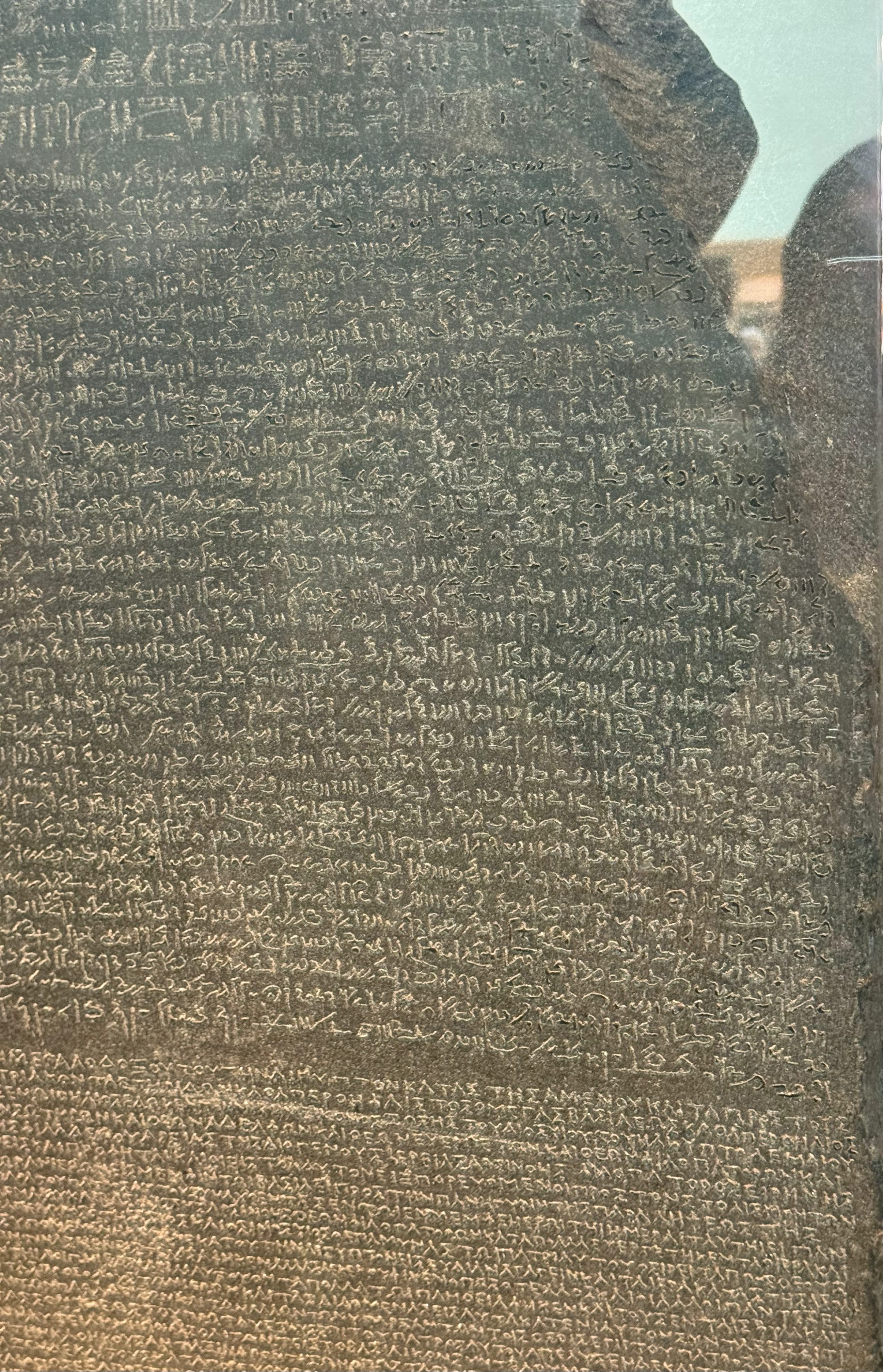
The Rosetta Stone had 3 scripts: Greek, hieroglyphics, and demotic. Translators could use the Greek and demotic to translate the Hieroglyphics!! When they found the stone, 1500 years had passed since any human could read Egyptian hieroglyphic script because the Christians who conquered Egypt in the 3rd century ordered Egyptians to stop using their ancient religious writing. So, they switched to the Greek alphabet (114).

Translating the Rosetta Stone
A second book that I highly recommend on the subject of translating the Rosetta Stone is The Linguist and the Emperor: Napoleon and Champollion’s Quest to Decipher the Rosetta Stone by Daniel Meyerson.
As a linguist, I found this story very compelling. In all of my arduous pursuits to acquire knowledge about the French language, my quest has been pretty easy compared to those linguists of Napoleon’s expedition. As a linguist, I must acquire knowledge about the language of a particular culture and how it varies across speakers and geographic regions. It is also important to study how to represent the structure of various aspects of language, such as sounds and meaning, and how these components of language interact with each other. When I was learning French, for example, I moved to Paris for 6 months in order to immerse myself in this culture and gain insight into the phonology and semantics of this region [ and to BE in Paris, bien sûr]. Of course, I could have studied French in other Francophone countries such as Belgium, Benin, Canada, Guinea, etc. , where the dialectology is completely different.
In his book, Meyerson relates the story of Jean-Francois Champollion (1790-1832), a linguist who would be instrumental in deciphering the hieroglyphs of the Rosetta Stone. Meyerson studied the Egyptian language and writing system which had not been translated or used for 1500 years. In the third century, Egyptians were ordered to stop using the ancient religious writing of hieroglyphics and switch to the Greek alphabet. The ancient history and culture of Egypt was therefore a mystery. According to Meyerson, Champollion would have to rely on his studies of Egyptian history under the Pharaohs, Persian Egypt, the Greeks, the Romans, and consequently, the Christian and Arab domination.
For centuries, scholars had debated the age of Egyptian civilization and the purpose and function of hieroglyphic script. They believed these scripts were used for sacred purposes and not for historical information. Champollion, however, was able to prove these assumptions to be wrong. He made it possible to retrieve information about the ancient Egyptians by combing phonetic and ideographic signs.
The Rosetta Stone had three scripts: Greek, hieroglyphics and demotic. The Egyptian section used both hieroglyphs and demotic script, the simplest form of cursive Egyptian; hieratic, or priestly script, and linear hieroglyphs were also used.
Translators could use the Greek and demotic to translate the 14 lines of hieroglyphics. However, a major piece of the puzzle was still missing. No one was able to decipher the symbol’s meanings. Meyerson asserts that Champollion was the one who determined that Greek and Egyptian inscriptions on the Rosetta Stone are paraphrases of each other and could not be transliterated. They give a general meaning of the decree and are not word-for-word translations as many translators have tried to use in the past.
For example, the hieroglyphs painted on countless papyri, engraved on statues, chiseled on the walls of tombs, and the sides of obelisks all have an oval ring that winds around a cluster of hieroglyphs. These rings enclose the names of the foreign as well as the native pharaohs, [215].
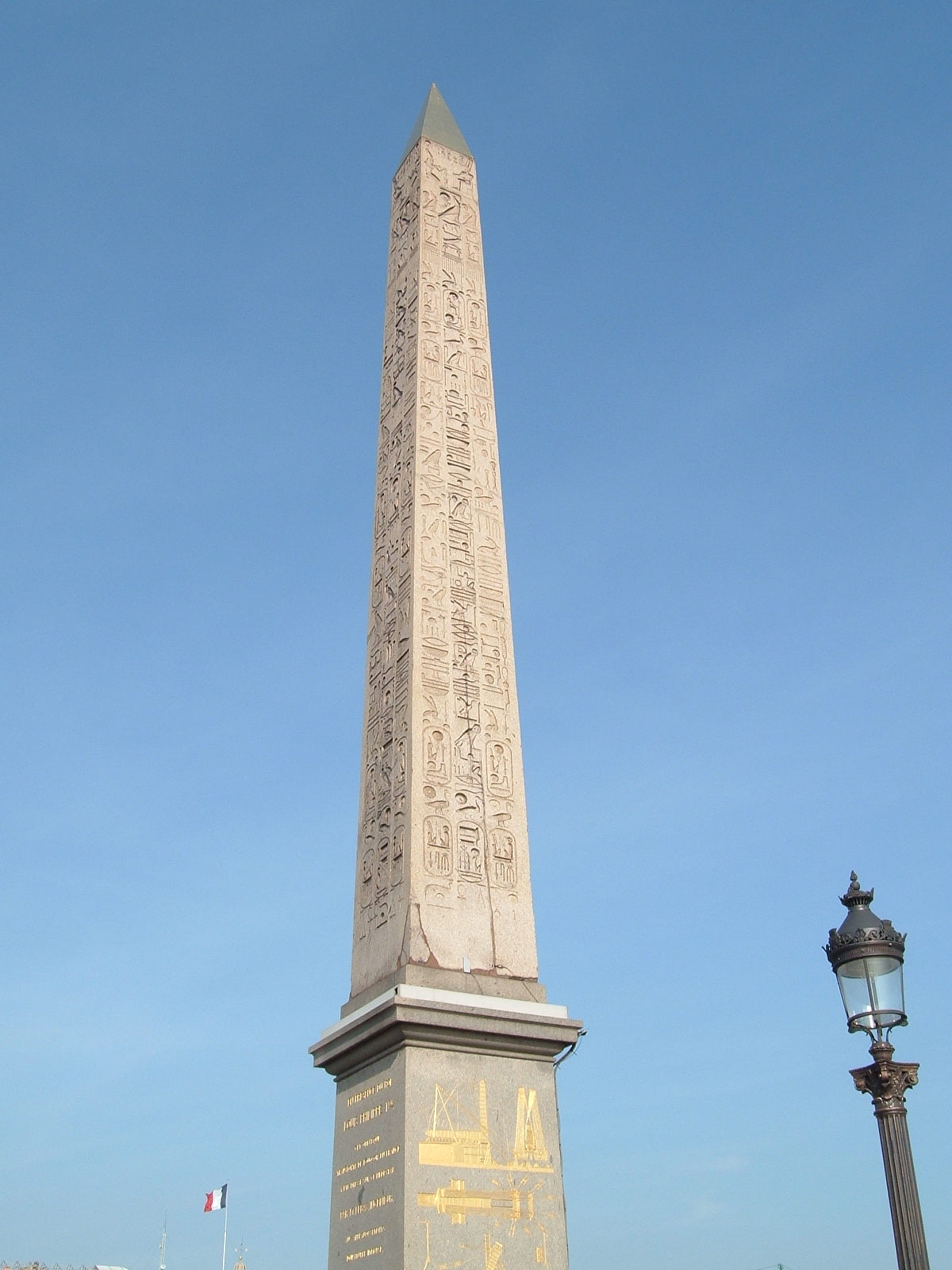
Champollion also used Ptolemaios, a Greek form of Ptolemy, to decipher the eight hieroglyphs encircled in the cartouche on the Rosetta stone. Then he used a “rebus” to indicate sounds, the “acrophonic” principle.
In addition, the name KLEOPATRA is found inscribed in Greek on the broken-off pedestal of Bankes’ obelisk. For “Ptolemy”, The “T” is represented by a hand, “T” in Cleopatra; “Alksentros”= Alexander the Great; ALKSNDRS, no vowels. The “S’s” are both given by a double bolt sign. Champollion allows for homophones[262].
K, in Kleopatra, is a semicircle or loaf of bread. “K” of Alexander, a basket with a handle. The bread-loaf sign always seen in feminine names would= TE in Coptic, “the” .
Champollion goes on to decipher a long list of Greek and Roman cartouches, increasing the numbers of letters in his Egyptian alphabet to over 40, and hieroglyphs are used only for writing foreign names. There are 500 words in the Greek section of the Rosetta Stone corresponding to the 1,419 hieroglyphic signs in the Egyptian section. [265] “F”= horned viper. It is the 3rd person pronoun in both Coptic and ancient texts.
There is much more on the translation codes and methods in Meyerson’s The Linguist. It was worth the read for me!
What a cool, cool job. Imagine the person who has reached the acme of your profession; a person with similar skill sets and passions who has surpassed all others in your field. Champollion is that person for me in linguistics and translation.
Unfortunately, Champollion would become very ill and die at the age of 42 before all of his research and translations could be published. His brother would do this posthumously. Before his death, he traveled to Egypt, where he was able to read many hieroglyphic texts that had never before been studied, and brought home a large body of new drawings of hieroglyphic.
As a linguist and translator, I aspire to unlock French texts for myself and my readers of English as a first language to experience the beauty and joy of literature and prose as it was originally intended.
Translation is a great passion of mine and has touched a little corner of the world. I am in awe of Champollion’s work as a translator and linguist of a miraculous rebirth of a civilization that was hidden for centuries. Wow. There are no words!
Work Cited
Meyerson, Daniel. The Linguist and the Emperor; Napoleon and Champollion’s Quest to Decipher the Rosetta Stone. New York: Random House, 2005.


It is magical to stand before the Rosetta Stone and marvel at it. Here in Melbourne we have a tiny little stone tablet with cuneiform that’s about 4000 years old. It’s a tax receipt – rather banal really — but I always go to see it whenever I’m at the State Library where it’s on permanent display.
How wonderful to have great history in your country. Americans must travel abroad to see these important artifacts of history!
Surely not? You have so many wealthy philanthropists who have built up the most marvellous collections in all kinds of artistic and historical fields.
Melbourne owes its great art collection to a man called Felton and his bequest meant that they we were able to buy many great pieces just before the art market really boomed and things became prohibitively expensive. But he wasn’t the only one, many who had made a fortune in the Gold Rush thought it was their civic duty to contribute to civic institutions like the library, the museum, the art gallery etc.
Yes Lisa, this is so true. We do have a unique collection of the arts and history acquired by wealthy philanthropists such as Carnegie, Astor, Hearst, etc.
I was too hasty in my last response.
I was referring to my personal penchant to having access to ancient civilizations and artifacts, such as the Rosetta Stone, relics of the Roman era, medieval cathedrals , Renaissance architecture, etc. I appreciate your comments and point of clarification! Robyn